


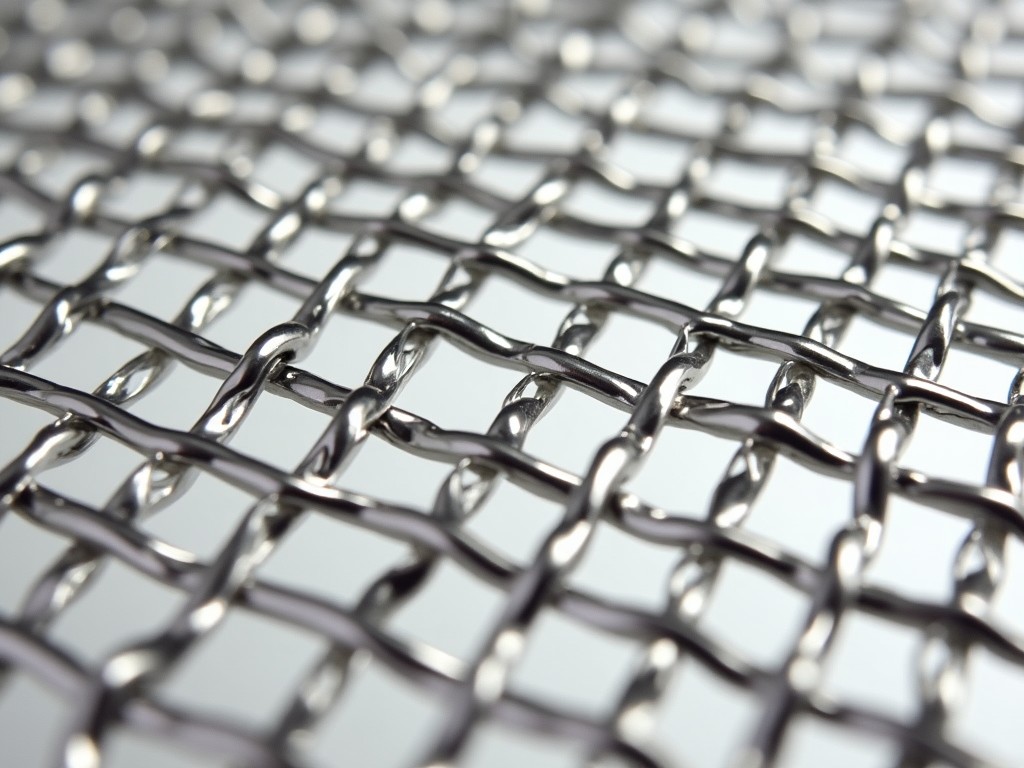
304 Stainless Steel Plain Weave Wire Mesh Cloth
304 Stainless Steel Plain Weave Wire Mesh Cloth
304 stainless steel plain weave wire mesh cloth is a foundational industrial material formed by interlacing warp and weft wires in a simple over-one-under-one pattern. This construction creates a balanced, symmetrical grid with uniform opening sizes and consistent tensile strength in both directions. The plain weave structure offers predictable flow characteristics, making it suitable for applications requiring precise particle retention, filtration efficiency, or mechanical support. Unlike twill or Dutch weaves, plain weave maintains equal wire diameter in both axes, simplifying design calculations for pressure drop, open area, and mechanical loading.
The base material, AISI 304 stainless steel, contains approximately 18% chromium and 8% nickel, providing a passive chromium oxide layer that resists oxidation and corrosion in mildly aggressive environments. This alloy maintains mechanical integrity up to 870°C intermittently and 925°C continuously in air, making it suitable for thermal processing applications. Its non-magnetic annealed condition and ease of fabrication further support widespread use across food, chemical, and pharmaceutical industries where cleanliness and durability are critical.
Key Technical Characteristics
The performance of 304 stainless steel plain weave mesh is governed by three interrelated parameters: wire diameter, opening size, and mesh count. These dimensions are not independent—changing one directly affects the others and the resulting open area percentage. For example, a 20 mesh specification with 0.30mm wire yields approximately 51.8% open area, while the same mesh count with 0.45mm wire reduces open area to 36.0%. Engineers must evaluate these trade-offs based on required flow rates, particle retention thresholds, and mechanical load conditions.
Tensile strength of annealed 304 wire typically ranges from 500 to 750 MPa, depending on cold work during drawing. When woven into mesh, the joint strength at crossover points becomes critical—plain weave relies on friction and mechanical interlock rather than welding, so tensile load is distributed across multiple wire intersections. This design enhances fatigue resistance in vibratory applications but limits point-load capacity compared to welded or bonded alternatives. The modulus of elasticity remains ~193 GPa, ensuring predictable deflection under uniform pressure.
Chemical resistance is a defining advantage of 304 SS in plain weave form. It withstands exposure to organic chemicals, dilute acids, and alkaline solutions commonly encountered in washing, rinsing, and filtration processes. However, it is susceptible to pitting and crevice corrosion in chloride-rich environments above 50 ppm, particularly at elevated temperatures. For such conditions, 316L stainless steel may be preferred due to its molybdenum content, though 304 remains the economical choice for general industrial use where chloride exposure is intermittent or controlled.
Typical Specifications and Dimensions
| Mesh Count (per inch) | Typical Wire Diameter (mm) | Opening Size (mm) | Open Area (%) | Common Applications |
|---|---|---|---|---|
| 4 | 1.00 | 5.34 | 63.0 | Coarse filtration, insect screens, architectural panels |
| 10 | 0.50 | 2.04 | 51.8 | General straining, debris barriers, vibratory screens |
| 20 | 0.30 | 0.97 | 51.8 | Fine particle filtration, catalyst supports, laboratory sieves |
| 40 | 0.20 | 0.44 | 40.0 | Precision screening, powder sieving, medical device pre-filters |
| 60 | 0.15 | 0.27 | 30.3 | Air filtration, hydraulic fluid straining, semiconductor wet bench |
| 100 | 0.10 | 0.15 | 25.0 | Ultra-fine filtration, inkjet printer guards, optical component shielding |
Note: Values shown are typical for annealed 304 stainless steel wire. Actual dimensions may vary based on wire tolerance, weaving tension, and post-processing. Custom mesh counts, wire diameters, and widths are available upon request. Non-standard constructions—such as dual-diameter plain weave or flattened profiles—can be engineered to meet specific hydraulic or mechanical requirements.
Industrial Applications and Functional Rationale
In food processing, 304 SS plain weave mesh is used for belt conveyors, drying trays, and washing systems where direct product contact requires FDA-compliant materials. The smooth, non-porous surface minimizes bacterial harborage, and the alloy resists corrosion from organic acids, salts, and cleaning agents like sodium hydroxide or citric acid solutions. Open area and wire diameter are selected based on product size, drainage needs, and belt tension—finer meshes for small particulates like herbs or powders, coarser for fruits or vegetables requiring airflow and drainage.
Chemical and pharmaceutical manufacturers specify this mesh for intermediate filtration stages in liquid processing, where it removes catalyst fines, resin beads, or agglomerated solids without degrading under solvent exposure. Its compatibility with common process chemicals—including alcohols, ketones, and dilute mineral acids—allows repeated use in batch and continuous systems. The plain weave’s symmetric structure ensures consistent pressure drop across the filter media, simplifying system design and reducing the risk of channeling or uneven loading.
Environmental and water treatment applications leverage the mesh’s durability in submerged or flowing conditions. It serves as pre-filtration for membrane systems, protecting ultrafiltration or reverse osmosis elements from large debris. In aeration tanks, it supports biofilm carriers or acts as a barrier in moving bed bioreactors. The material’s resistance to biological fouling and ease of cleaning via backwashing or chemical-in-place (CIP) procedures support long-term operational stability in municipal and industrial wastewater systems.
Customization and Manufacturing Considerations
Width availability ranges from 50 mm to 3000 mm, constrained primarily by loom capabilities and handling logistics. Standard roll lengths vary with mesh fineness—coarser meshes (e.g., 4–20 mesh) are commonly supplied in 30–50 m rolls, while finer meshes (60–100 mesh) may be limited to 10–20 m to prevent handling damage and maintain dimensional accuracy. Edge treatments include selvaged (looped) edges for fray resistance or cut edges for direct integration into frames or housings, depending on installation method.
Post-weaving processes such as annealing, passivation, or electropolishing can be applied to modify surface properties. Annealing relieves internal stresses introduced during weaving, improving ductility and reducing the risk of stress corrosion cracking. Passivation enhances the chromium oxide layer using nitric or citric acid baths, particularly beneficial after welding or mechanical deformation. Electropolishing achieves a microscopically smooth finish, minimizing particle adhesion in sanitary applications—though it slightly reduces wire diameter and must be accounted for in final opening size calculations.
Tolerances are typically held to ±0.02 mm on wire diameter and ±2% on mesh count for standard products. Tighter tolerances are achievable through precision drawing and inline inspection but may increase cost and lead time. For applications requiring certified performance—such as aerospace fluidics or semiconductor wafer processing—custom lots can be produced with full traceability, including mill certifications for wire raw material and lot-specific tensile testing.
Quality Assurance and Inspection Protocols
Quality control begins with raw material verification—each wire spool is accompanied by a mill test report confirming chemical composition per ASTM A240/A240M and mechanical properties. Incoming wire undergoes diameter sampling using laser micrometers or optical comparators to ensure conformity to specifications before weaving. During production, tension monitoring systems maintain consistent warp and weft tightness to prevent distortion or irregular opening sizes.
Finished mesh is inspected visually and dimensionally under standardized lighting. Open area verification is conducted using calibrated test sieves or image analysis software to confirm average opening size and distribution. For critical applications, bubble point testing or airflow resistance measurements may be performed to validate filtration performance characteristics. Surface cleanliness is assessed via wipe tests or water break analysis to detect oils, particulates, or residues that could contaminate sensitive processes.
Documentation includes a certificate of conformance (CoC) detailing mesh count, wire diameter, width, length, material grade, and any post-processing applied. Traceability is maintained via lot numbers linking back to raw material spools and production batches. While third-party certifications (e.g., ISO 9001, AS9100) depend on the manufacturer’s quality system, the underlying inspection logic follows industry-standard practices for industrial filtration media. Customers requiring specific test protocols—such as ASTM F316 for pore size or E11 for sieve compliance—should specify requirements during quotation.
Packaging, Handling, and Storage
Mesh rolls are typically wound on rigid cores (plastic or metal) with inner diameters ranging from 50 mm to 150 mm, selected based on roll weight and handling equipment. The outer surface is protected with polyethylene film or kraft paper to prevent scratching, dirt accumulation, or moisture exposure during transit. Ends are secured with tape or plastic straps to prevent unwinding. For widths exceeding 1500 mm, intermediate supports or split winding may be used to manage weight and prevent sagging.
Storage should occur in a clean, dry environment with stable temperature and humidity to prevent oxidation or staining. Although 304 stainless steel resists atmospheric corrosion, prolonged exposure to chlorides, acids, or alkaline condensates can initiate surface degradation. Rolls should be stored horizontally when possible; vertical storage is acceptable for shorter lengths (<15 m) but risks telescoping or edge damage if not properly restrained. Avoid direct contact with concrete or dissimilar metals that may cause galvanic staining.
Handling recommendations include using roll lifts, fork truck cradles, or motorized unwinders to avoid bending or kinking the mesh. Sharp edges or protrusions in handling equipment can damage wires or alter opening geometry. When cutting to length, use shears or rotary cutters designed for stainless steel to minimize burrs and work hardening. For installation into frames or housings, allow for thermal expansion—approximately 9.6 µm/m·°C for 304 SS—and avoid over-tensioning, which can induce fatigue over time.
Comparison with Alternative Materials and Weaves
Compared to 316L stainless steel, 304 offers approximately 20% lower material cost while maintaining adequate corrosion resistance for most indoor and temperate outdoor environments. The absence of molybdenum in 304 limits its resistance to pitting in chloride-containing solutions above 50–100 ppm, particularly at temperatures exceeding 60°C. In such cases, 316L’s superior localized corrosion resistance justifies the higher cost. However, for applications with intermittent exposure, frequent cleaning, or controlled water chemistry, 304 provides a cost-effective balance of performance and longevity.
When evaluated against plain weave, twill weave provides greater tensile strength and finer mesh capabilities due to its staggered wire path, allowing higher wire density for the same opening size. However, twill creates asymmetric flow paths and is more prone to trapping particles in the wire valleys, complicating cleaning. Dutch weave (especially reverse Dutch) achieves even finer filtration at lower pressure drops by using coarse warp and fine weft wires, but it is directional—performance varies significantly depending on flow orientation. Plain weave remains preferred when bidirectional symmetry, predictable pressure drop, and ease of cleaning are priorities.
Alternative materials such as brass, bronze, or carbon steel mesh are rarely selected for 304 SS applications due to inferior corrosion resistance or mechanical properties. Brass and zinc-containing alloys risk dezincification in acidic or alkaline conditions, while carbon steel requires coatings or linings that add complexity and failure points. Monel or Hastelloy meshes are reserved for highly aggressive environments (e.g., hydrochloric acid, sulfuric acid, or high-temperature oxidizing conditions) where 304 SS would rapidly degrade—these are niche solutions justified only by extreme process demands.
For technical consultation, custom specifications, or sample requests, please contact our engineering team to discuss your application requirements.