


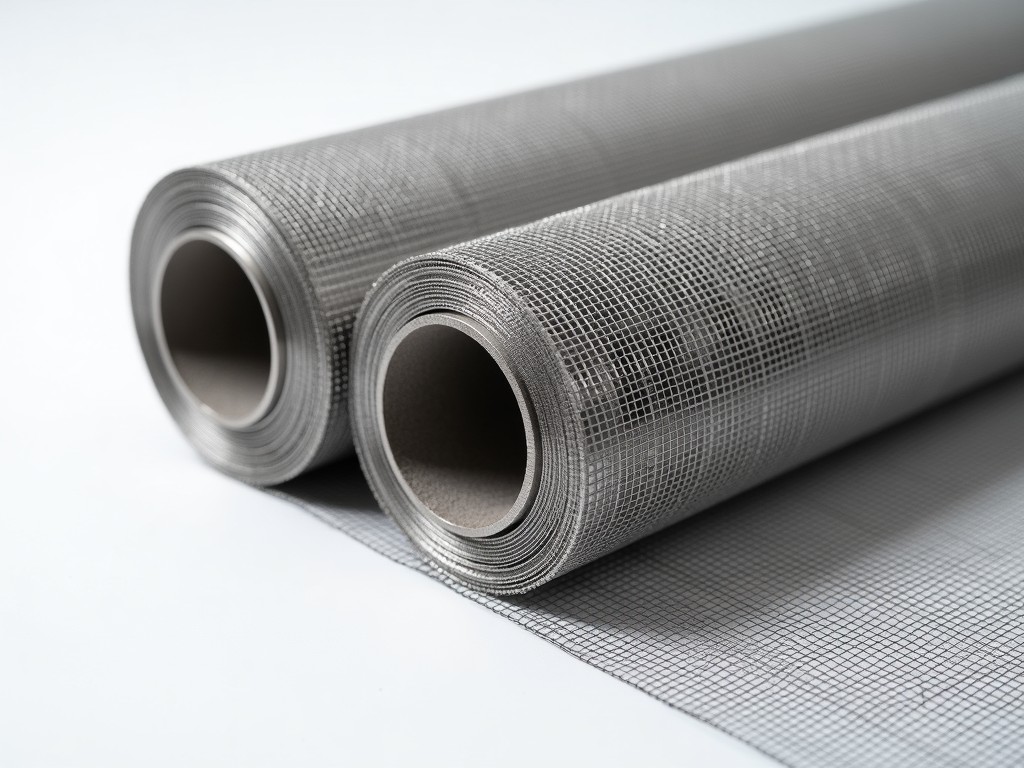
304 Stainless Steel Wire Mesh Roll For Filtration
304 Stainless Steel Wire Mesh Roll for Filtration
304 stainless steel wire mesh rolls are manufactured from austenitic stainless steel wire with a typical composition of 18% chromium and 8% nickel, providing inherent corrosion resistance in neutral and mildly acidic environments. The material is non-magnetic in the annealed condition and maintains structural integrity at temperatures up to 870°C intermittently and 925°C continuously. Wire diameters range from 0.05 mm to 2.0 mm, enabling precise control over open area and mechanical strength. The mesh is woven in plain, twill, or Dutch patterns, each affecting flow dynamics and particle retention characteristics. Rolls are supplied with consistent width and length tolerances to facilitate seamless integration into automated filtration systems.
Material Properties and Performance Characteristics
The corrosion resistance of 304 stainless steel stems from a passive chromium oxide layer that self-repairs in oxidizing conditions, making it suitable for water treatment, food processing, and chemical filtration where exposure to chlorides is limited. Mechanical properties include a tensile strength of 500–700 MPa and elongation of 40–60%, allowing the mesh to withstand differential pressure without permanent deformation. The material exhibits good formability, enabling it to be pleated, sintered, or framed without cracking. Thermal expansion coefficient is approximately 17.2 µm/m·°C, which must be accounted for in high-temperature applications to avoid stress buildup in constrained assemblies.
Mesh Specifications and Filtration Efficiency
Filtration performance is determined by mesh count (wires per inch), wire diameter, and weave type, which collectively define the nominal pore size and open area percentage. For example, a 100 mesh plain weave with 0.12 mm wire diameter yields approximately 140 µm nominal pore size and 36% open area, while a Dutch weave of the same mesh count can achieve sub-50 µm retention due to asymmetric wire spacing. Open area directly impacts pressure drop; higher open area reduces energy consumption in liquid or gas filtration systems. The mesh is available in roll widths from 500 mm to 2000 mm and lengths up to 50 m, with edge options including selvaged, hemmed, or raw cut to match downstream processing requirements.
Comparison of Weave Types for Filtration Applications
| Weave Type | Wire Diameter Relationship | Typical Use Case | Flow vs. Retention Trade-off |
|---|---|---|---|
| Plain Weave | Warp and weft wires of equal diameter | Pre-filtration, particle sizing, general filtration | Balanced flow and retention; predictable pressure drop |
| Twill Weave | Warp and weft wires of equal diameter | Higher strength requirements, viscous fluids | Greater load-bearing capacity; slightly higher pressure drop than plain weave |
| Dutch Weave | Warp wires thicker than weft; weft wires driven close together | Fine filtration, gel removal, catalyst recovery | High retention efficiency at lower pressure drop compared to fine plain weaves |
Industrial Applications and Process Integration
In liquid filtration, 304 stainless steel wire mesh is used in strainers, filter housings, and centrifugal separators to remove particulates from water, oils, and solvents, where its smooth surface minimizes product adhesion and facilitates cleaning. In gas filtration, it serves as a medium for coalescing filters, flame arrestors, and dust collection systems, benefiting from its thermal stability and non-combustibility. The material is also employed in food and beverage processing for sieving liquids and solids, meeting FDA 21 CFR §177.1520 requirements for indirect food contact when properly passivated. In pharmaceutical manufacturing, it supports downstream purification steps where cleanability and resistance to cleaning-in-place (CIP) agents are critical.
Customization and Manufacturing Considerations
Mesh specifications are tailored to process conditions: finer weaves and lower open area are selected for high-retention applications, while coarser meshes with higher open area are used where pressure drop must be minimized. Edge treatments such as welding, folding, or framing are applied based on installation method—whether the mesh is clamped, welded into a cartridge, or inserted into a slotted housing. Post-weaving processes like passivation (using nitric or citric acid) enhance corrosion resistance by removing free iron from the surface, while stress relieving at 350–400°C reduces residual stress from weaving, improving dimensional stability during thermal cycling. Width and length tolerances are typically held to ±2 mm and ±0.5% respectively to ensure consistent roll-to-roll performance.
Quality Assurance and Inspection Protocols
Quality control begins with wire certification, verifying chemical composition and mechanical properties against ASTM A580/A580M. During weaving, real-time monitoring ensures consistent wire tension and pick count to maintain uniform aperture dimensions. Finished rolls undergo visual inspection for defects such as broken wires, skips, or double picks, followed by dimensional verification using optical comparators or laser scanning systems to measure wire diameter, mesh count, and roll width. Open area is calculated from measured parameters, and bubble point testing may be performed for critical filtration ratings to verify largest pore size. All inspection data is traceable to the production batch, supporting compliance with ISO 9001 and industry-specific standards.
Packaging, Handling, and Storage
Rolls are wound onto rigid cores with inner diameters of 50 mm or 100 mm, depending on weight and handling requirements, and wrapped in polyethylene film to protect against moisture and surface contamination. Outer packaging consists of corrugated cardboard boxes or wooden crates for shipments exceeding 20 kg, with corner guards and strapping to prevent deformation during transit. Storage should occur in a dry, covered environment with temperatures between 5°C and 35°C to avoid condensation-induced staining; direct contact with concrete or dissimilar metals should be avoided to prevent galvanic corrosion or staining. Each roll is labeled with material grade, mesh specification, dimensions, batch number, and passivation status for easy identification in inventory systems.
For technical consultation, custom specifications, or sample requests, contact our engineering team to discuss your filtration requirements.
Request Technical Specification