


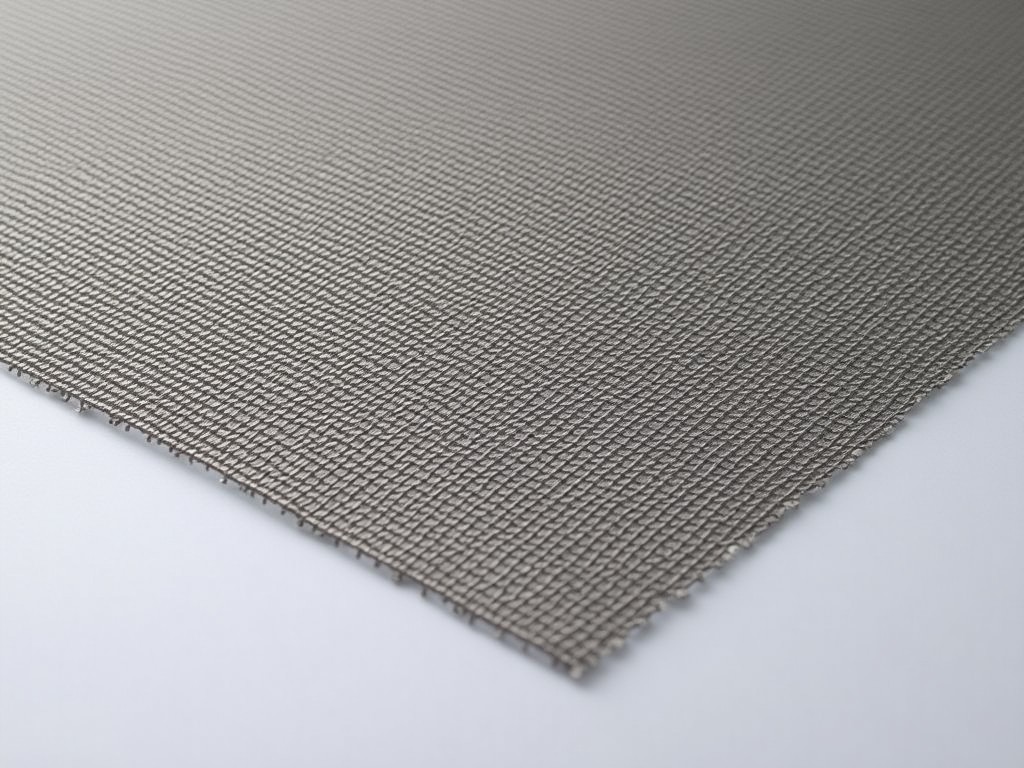
316 Stainless Steel Dutch Weave Filter Mesh Screen
316 Stainless Steel Dutch Weave Filter Mesh Screen
Dutch weave filter mesh is a precision-engineered filtration medium where warp wires are significantly thicker than shute wires, and the shute wires are woven tightly together to form a dense, smooth surface. This construction creates a tortuous path for particle capture, enabling filtration at micron levels far below the nominal wire diameter. Unlike plain or twill weaves, Dutch weave relies on the compacted shute layer to achieve its retention rating, making it ideal for applications requiring absolute barrier performance rather than nominal pore size rating.
When manufactured from 316 stainless steel, Dutch weave mesh gains enhanced resistance to pitting and crevice corrosion in chloride-containing environments, such as marine settings, chemical processing, and pharmaceutical washdown systems. The alloy’s molybdenum content (typically 2-3%) provides superior durability compared to 304 stainless steel, particularly under elevated temperatures or exposure to oxidizing acids. This material choice ensures long-term structural integrity in continuous operation where mechanical strength and chemical stability are both critical.
Technical Characteristics
The performance of 316 stainless steel Dutch weave mesh is defined by several interdependent parameters: warp wire diameter, shute wire diameter, pick count (shute wires per inch), and resulting mesh count and micron rating. Because the shute wires are densely packed, the effective filtration rating is determined by the smallest opening formed between adjacent shute wires, not by the mesh count alone. For example, a mesh described as 800x1200 Dutch weave may retain particles as small as 5-10 microns despite having a nominal opening larger than 20 microns due to the shute layer’s compaction.
Wire diameters are selected based on the required burst strength, flow rate, and thermal stability. Thicker warp wires provide structural support and resistance to deformation under differential pressure, while finer shute wires enable fine particle retention. The aspect ratio between warp and shute diameters typically ranges from 3:1 to 5:1 in standard Dutch weaves, with reverse Dutch weave inverting this ratio for applications where surface loading is a concern. All dimensions are held to tight tolerances during weaving to ensure repeatable performance across batches.
| Parameter | Typical Range | Influence on Performance |
|---|---|---|
| Warp Wire Diameter | 0.10 – 0.50 mm | Determines burst strength and structural rigidity |
| Shute Wire Diameter | 0.05 – 0.20 mm | Controls micron retention and surface smoothness |
| Shute Count (Pick Count) | 800 – 2000 wires/inch | Directly affects filtration rating and pressure drop |
| Micron Rating | 1 – 25 μm (absolute) | Particle size retained with >99% efficiency |
| Air Permeability | 10 – 200 L/min/dm² @ 0.1 bar | Indicates flow resistance under low differential pressure |
Material Properties of 316 Stainless Steel
316 stainless steel (UNS S31600) is an austenitic chromium-nickel-molybdenum alloy with a typical composition of 16-18% chromium, 10-14% nickel, and 2-3% molybdenum. The molybdenum addition significantly improves resistance to pitting corrosion in environments containing chlorides, bromides, or iodides—common in marine atmospheres, bleach-based cleaning systems, and offshore oil and gas processing. Compared to 304 stainless steel, 316 maintains its passive layer more effectively under warm, saline conditions, reducing the risk of localized attack that could compromise mesh integrity over time.
Mechanical properties are stabilized through cold working during the wire drawing and weaving processes. Typical tensile strength ranges from 520 to 750 MPa, with yield strength between 210 and 550 MPa depending on the degree of work hardening. Elongation at break remains above 40% in annealed condition, allowing the mesh to conform to housing contours without cracking. The alloy retains its austenitic structure down to cryogenic temperatures, making it suitable for low-temperature filtration applications such as liquefied gas processing.
Oxidation resistance is effective up to approximately 870°C (1600°F) in continuous service and up to 925°C (1700°F) in intermittent exposure. Beyond these temperatures, scaling may occur, though the underlying alloy retains its corrosion-resistant properties. For applications involving sustained high temperatures, such as hot gas filtration in chemical reactors, 316L (low-carbon variant) is often preferred to minimize sensitization and intergranular corrosion risk after welding or prolonged heating.
Filtration Mechanisms and Retention Behavior
Dutch weave mesh operates primarily through surface filtration, where particles larger than the effective pore size are captured on the upstream face, forming a filter cake that can enhance efficiency over time. Unlike depth filters, the retention mechanism is not reliant on tortuous paths within a thick medium but rather on the precise geometry of the shute wire layer. This results in a sharp cutoff characteristic—particles just below the rated size pass through, while those above are retained with high repeatability, making it suitable for applications requiring precise particle classification.
Hydrophobicity or hydrophilicity can be influenced by surface finish and contaminants, but the inherent chemistry of 316 stainless steel is hydrophilic due to its passive oxide layer. This property aids in wetting during liquid filtration, reducing the risk of air entrapment and ensuring full utilization of the effective filtration area. For applications requiring hydrophobic behavior, such as venting or gas-liquid separation, surface treatments like fluoropolymer coating may be applied post-weaving without altering the base mesh structure.
Industrial Applications
In pharmaceutical manufacturing, 316 stainless steel Dutch weave mesh is used for sterile filtration of buffers, solvents, and final product solutions where bacterial retention and non-fiber-releasing properties are critical. The smooth surface allows for complete sanitization via CIP (clean-in-place) and SIP (sterilize-in-place) procedures, and the mesh retains integrity under repeated steam exposure. It is commonly installed in cartridge housings, disc filters, or as a support layer for 0.2 μm membrane filters in large-scale purification systems.
Chemical processing plants deploy this mesh for catalyst recovery in fine chemical synthesis, where recovering sub-micron particles from reaction mixtures is essential for yield optimization and environmental compliance. The mesh withstands exposure to aggressive solvents, acids, and bases while maintaining dimensional stability. In polymerization processes, it filters monomers and polymer solutions to prevent catalyst fouling and ensure product purity, with mesh ratings selected based on the molecular weight cutoff of the target polymer.
In food and beverage processing, 316 stainless steel Dutch weave is used for filtering edible oils, syrups, and brewing liquids where metal contamination and microbial control are regulated. Its resistance to corrosion from organic acids, salts, and cleaning agents (e.g., caustic soda, phosphoric acid) ensures compliance with FDA and 3-A sanitary standards. The mesh is also employed in dairy processing for whey protein concentration and in beverage clarification to remove yeast, haze-forming proteins, and polyphenols without altering flavor profiles.
Aerospace and defense applications include filtering hydraulic fluids, lubricants, and fuel systems where particulate control prevents wear in precision valves and actuators. The mesh’s resistance to fatigue under cyclic pressure loads and its compatibility with synthetic esters, phosphate esters, and jet fuels make it suitable for high-reliability systems. In gas turbine engines, it protects fuel nozzles and oil scavenge systems from ingested contaminants that could lead to thermal distortion or blockage.
Customization and Manufacturing Considerations
Mesh dimensions are customizable to fit specific housing geometries, with standard roll widths ranging from 500 mm to 2000 mm and lengths cut to order. Edges can be finished with selvage, hemmed, or welded rings depending on installation requirements. For circular disc filters, the mesh is punched or laser-cut to precise diameters with burr-free edges to prevent media migration or housing damage. Tolerances on diameter and flatness are held to ±0.1 mm for precision applications.
Weaving parameters are adjusted based on the target micron rating and required flow rate. Engineers specify the warp/shute diameter ratio, pick count, and weave tightness to balance retention efficiency against pressure drop. Prototypes are often tested using bubble point or liquid-liquid displacement methods to validate performance before full-scale production. Custom weaves, such as twin Dutch or mesh-over-mesh configurations, are available for applications requiring graded filtration or enhanced dirt-holding capacity.
Post-weaving treatments include passivation (typically nitric or citric acid) to remove free iron and enhance the chromium-rich passive layer, stress relief annealing to reduce residual stresses from drawing and weaving, and ultrasonic cleaning to remove lubricants and particulates. Each step is documented and traceable to lot numbers. Packaging is designed to prevent deformation—mesh is rolled on rigid cores, interleaved with acid-free paper, and sealed in polyethylene bags within crush-resistant cartons for shipment.
Quality Assurance and Testing
Quality control begins with incoming wire inspection, where diameter, tensile strength, elongation, and surface finish are verified against mill certificates. Chemical composition is confirmed via optical emission spectroscopy (OES) to ensure compliance with ASTM A240/A240M for 316 stainless steel. During weaving, tension and pick count are monitored in real time to maintain uniformity. Finished mesh undergoes visual inspection under magnified lighting to detect broken wires, skips, or double picks that could compromise integrity.
Functional testing includes bubble point testing for gas-liquid systems to determine the largest pore size, and liquid permeability testing using water or solvent to measure flow characteristics. For absolute-rated filters, challenge testing with standardized particles (e.g., PSL spheres) validates retention efficiency. All test results are retained with the product lot and made available upon request. Traceability extends from raw material to final shipment, supporting audits in regulated industries such as medical devices and aerospace.
Comparison with Alternative Media
Compared to sintered stainless steel filters, Dutch weave offers lower pressure drop at equivalent retention ratings due to its thinner profile and smoother surface, reducing energy consumption in pumping systems. While sintered media provide greater dirt-holding capacity and thermal shock resistance, they are more difficult to clean and can trap contaminants internally. Dutch weave allows for visual inspection and effective backwashing, making it preferable in applications where cleanability and reuse are prioritized over lifetime loading capacity.
Against woven wire mesh with plain or twill weave, Dutch weave achieves significantly finer retention without requiring extremely fine warp wires, which would be prone to breakage and clogging. A 316 SS Dutch weave rated at 5 microns may use 0.15 mm warp wires, whereas a plain weave achieving similar retention would require warp wires under 0.05 mm—easily damaged during handling and cleaning. This structural advantage enhances durability in high-pressure differential applications.
When contrasted with polymeric membranes, 316 stainless steel Dutch weave withstands higher temperatures, broader chemical compatibility, and mechanical cleaning without degradation. While membranes offer absolute retention at lower nominal pressures, they are susceptible to tearing, fouling, and chemical attack. Dutch weave is often used as a pre-filter or support layer for membranes to extend their life, combining the robustness of metal with the precision of membrane filtration in hybrid systems.
Installation and Maintenance Guidelines
Proper installation requires ensuring the mesh is seated evenly in the housing without twisting or over-tensioning, which can induce localized stress and reduce burst strength. Gaskets or O-rings should be compatible with both the process fluid and cleaning agents, and compression should be uniform to prevent leakage or mesh creep. In high-vibration environments, additional support rings or perforated backing plates may be used to minimize fatigue cracking at stress points.
Cleaning methods depend on the contaminant type. For particulate fouling, backwashing with filtered fluid or compressed air (below 2 bar) is effective. For organic or biological deposits, alkaline or enzymatic cleaners followed by rinsing are recommended. Passivation may be restored after aggressive cleaning using dilute citric acid solutions. Ultrasonic cleaning in a neutral bath removes submicron particulates without damaging the weave. All cleaning procedures should be validated to avoid reducing mesh life or altering surface properties.
Regular inspection should include checking for discoloration (indicating overheating or chemical attack), wire elongation, or surface pitting. Pressure drop monitoring across the filter provides an indirect measure of fouling; a sudden increase may signal blockage or media deformation. Replacement intervals are determined by either time-based schedules (e.g., every 6 months in continuous service) or condition-based triggers, such as a 50% rise in differential pressure or visible damage during inspection.