


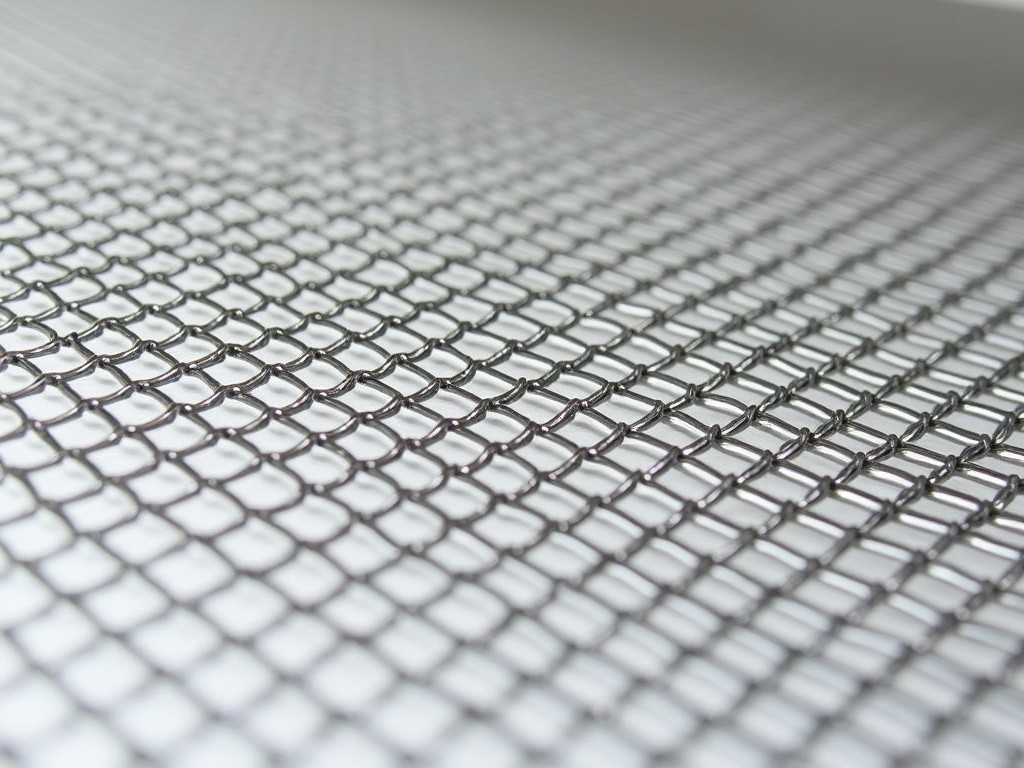
316 Stainless Steel Powder Coated Security Window Mesh Screen
316 Stainless Steel Powder Coated Security Window Mesh Screen
Security window mesh screens manufactured from 316 stainless steel wire with a powder-coated finish provide corrosion-resistant protection for exterior openings in demanding environments. The combination of marine-grade alloy substrate and polymer coating delivers dual-layer defense against environmental degradation while maintaining structural integrity for intrusion resistance.
Unlike standard carbon steel or 304 stainless alternatives, 316 grade contains molybdenum (typically 2-3%) which significantly enhances resistance to chlorides and acidic atmospheres common in coastal, industrial, and chemical processing facilities. The powder coating adds a UV-stable barrier that prevents direct exposure of the stainless steel to airborne contaminants while offering color customization for architectural integration.
This product addresses the limitations of uncoated stainless screens that may suffer from tea-staining or localized pitting in saline environments, and avoids the premature failure of painted carbon steel alternatives that lack inherent corrosion resistance. Engineers specify this configuration when service life exceeds 15 years with minimal maintenance is required.
Material and Construction Specifications
The base mesh is woven from 316 stainless steel wire with typical diameters ranging from 0.8mm to 2.0mm depending on aperture size and load requirements. Common weave patterns include plain weave for uniform strength distribution and twill weave for increased flexibility in curved installations. Wire tensile strength typically exceeds 800 MPa in the annealed condition, with work hardening during weaving further enhancing resistance to deformation.
Powder coating is applied via electrostatic spray followed by thermal curing at 180-200°C, resulting in a coating thickness of 60-100μm with adhesion strength exceeding 5 MPa. The coating formulation uses thermosetting polyester or epoxy-polyester hybrids selected for UV stability, chemical resistance, and flexibility to accommodate mesh deflection without cracking. Standard colors include RAL 7016 (anthracite grey), RAL 9005 (black), and RAL 9010 (pure white), with custom colors available upon request.
Edge finishing options encompass folded hems, welded frames, or integrated rubber splines for secure retention in window apertures. Frame materials match the mesh substrate (316 stainless) to prevent galvanic coupling, with frame thicknesses typically 1.5-3.0mm depending on span and wind load calculations. All welding uses TIG process with filler wire matching base metal composition to maintain corrosion resistance in heat-affected zones.
Performance Characteristics
Corrosion resistance is evaluated through salt spray testing (ASTM B117) where coated 316 stainless mesh typically shows no red rust after 1000+ hours exposure, with coating integrity maintained throughout test duration. The underlying stainless steel provides backup protection should the coating suffer localized damage, preventing rapid propagation of corrosion as seen with coated carbon steel alternatives.
Mechanical properties include tensile strength of the coated composite exceeding 1200 N/mm width for 1.5mm wire plain weave, with elongation at break typically 8-12%. Impact resistance meets EN 1627 WK2 standards when properly framed, resisting manual attack with basic tools. Open area ratios range from 60% for 4mm x 4mm apertures to 80% for 6mm x 6mm, balancing visibility, airflow, and security requirements.
Thermal stability allows continuous operation from -40°C to +80°C without coating embrittlement or loss of adhesion. The powder coating inhibits galvanic corrosion between the stainless steel and dissimilar metals in fastening systems, though direct contact with aluminum or galvanized steel should still be avoided through use of insulating washers or separators as per ISO 12944-6 guidelines.
Typical Applications
Marine installations specify this product for pier-side facilities, offshore platforms, and coastal housing where salt spray exposure exceeds 500mg/m²/day. The molybdenum content in 316 stainless resists pitting that would occur in 304 grade under similar conditions, while the powder coating prevents accumulation of salt crystals that could create crevice corrosion sites.
Industrial environments including chemical processing plants, wastewater treatment facilities, and food manufacturing plants benefit from resistance to both atmospheric corrosion and occasional chemical splash. Coating colors can be selected to match facility safety coding systems (e.g., yellow for caution zones) while maintaining cleanability for hygiene requirements.
Architectural applications in high-end residential and commercial buildings use the product for security screening that maintains sightlines without visual degradation over time. Unlike painted alternatives that chalk or fade, the UV-stable coating retains color consistency for extended periods, reducing lifecycle costs associated with repainting or replacement.
Customization Options
Aperture sizes are customizable from 2mm x 2mm for insect screening to 10mm x 10mm for maximum airflow and visibility, with wire diameter adjusted accordingly to maintain structural performance. Common combinations include 1.2mm wire with 4mm apertures (68% open area) for balanced security and ventilation, or 1.6mm wire with 6mm apertures (75% open area) for high-flow applications.
Panel dimensions are limited only by transportation and handling constraints, with typical maximum widths of 1200mm for single-panel units and unlimited height through horizontal mullion framing. Custom shapes including arched, circular, or trapezoidal panels are produced using CNC bending of 316 stainless frames followed by mesh attachment via spline or welding.
Coating specifications can be adjusted for specific environmental challenges: increased thickness (up to 150μm) for high-abrasion areas, antimicrobial additives for healthcare settings, or graffiti-resistant topcoats for public access locations. Frame integration options include pre-drilled mounting holes, integrated fastening channels, or adaptable clip systems for retrofitting into existing window apertures.
Quality Control and Testing
Incoming wire undergoes chemical verification via spark testing or OES to confirm 316 composition (typically 16-18% Cr, 10-14% Ni, 2-3% Mo) with carbon content controlled below 0.08% to prevent sensitization during welding. Wire diameter tolerance is maintained within ±0.03mm to ensure consistent weave density and open area calculation accuracy.
Post-weaving inspection includes aperture measurement using calibrated gauges and tensile testing of wire samples to confirm minimum strength requirements. Powder coating is assessed for thickness using magnetic or eddy current probes, adhesion via cross-hatch test (ASTM D3359), and flexibility using mandrel bend test (ASTM D522) to ensure coating integrity during handling and installation.
Finished panels undergo load testing simulating wind pressure (typically 1500 Pa) and impact resistance using weighted pendulum tests. Visual inspection checks for coating uniformity, edge damage, and frame alignment. Documentation includes material certificates, coating batch records, and test reports available upon request for project verification.
Comparison with Alternative Materials
| Property | 316 SS Powder Coated | 304 SS Powder Coated | Galvanized Steel Painted |
|---|---|---|---|
| Coastal Environment Life Expectancy | 15-25+ years | 5-10 years (pitting risk) | 2-5 years (coating failure common) |
| Chloride Resistance (ppm) | >1000 | <200 | N/A (dependent on coating) |
| UV Stability (coating) | Excellent (polyester) | Excellent (polyester) | Good to Fair |
| Impact Resistance (J) | >20 (1.6mm wire) | >20 (1.6mm wire) | >15 (thinner wire common) |
| Maintenance Requirement | Annual inspection | Semi-annual in chloride zones | Annual repainting often needed |
*Values represent typical performance; actual service life depends on specific environmental conditions, installation quality, and maintenance practices.
Installation and Maintenance
Installation requires compatible fastening materials to prevent galvanic corrosion; use 316 stainless screws or bolts with nylon washers when attaching to dissimilar metals. For masonry openings, employ plastic anchors or stainless steel inserts to avoid direct contact between mesh frame and concrete, which can create alkaline conditions detrimental to certain powder coatings over extended periods.
Cleaning recommendations include low-pressure water washing with neutral pH detergent (6-8) to remove accumulated salts, dirt, or pollutants. Avoid abrasive cleaners, wire brushes, or chloride-based solvents that could damage the coating or penetrate to the substrate. In high-deposition environments, quarterly rinsing may be advisable to prevent long-term contaminant buildup.
Repair of minor coating damage is possible using touch-up kits matched to the original RAL color, though large-scale damage may necessitate panel replacement to maintain corrosion barrier integrity. Frame-to-mesh connections should be inspected annually for signs of loosening or corrosion, particularly in vibration-prone installations.
Ordering Information
To request a quotation, provide the following specifications: exact panel dimensions (width × height), aperture size and wire diameter preference, required open area percentage, coating color (RAL number or sample), frame type (if needed), and installation environment details (coastal, industrial, architectural). For retrofit projects, include existing window frame measurements and mounting constraints.
Samples are available upon request for material and coating verification, typically supplied as 150mm × 150mm swatches showing weave pattern, color accuracy, and edge finish. Lead times vary from 2-4 weeks for standard configurations to 6-8 weeks for custom shapes or specialized coating requirements, excluding shipping time.
Packaging includes individual polyethylene wrapping for each panel, corner protectors for frame edges, and palletizing with stretch wrap for secure transit. Export shipments comply with ISPM 15 standards for wooden packaging, with moisture desiccants included for long-distance transport to prevent condensation-related issues during transit.
For technical consultation, custom specifications, or project-specific engineering support regarding 316 stainless steel powder coated security window mesh screens, please contact our technical team.
Request Technical Consultation