


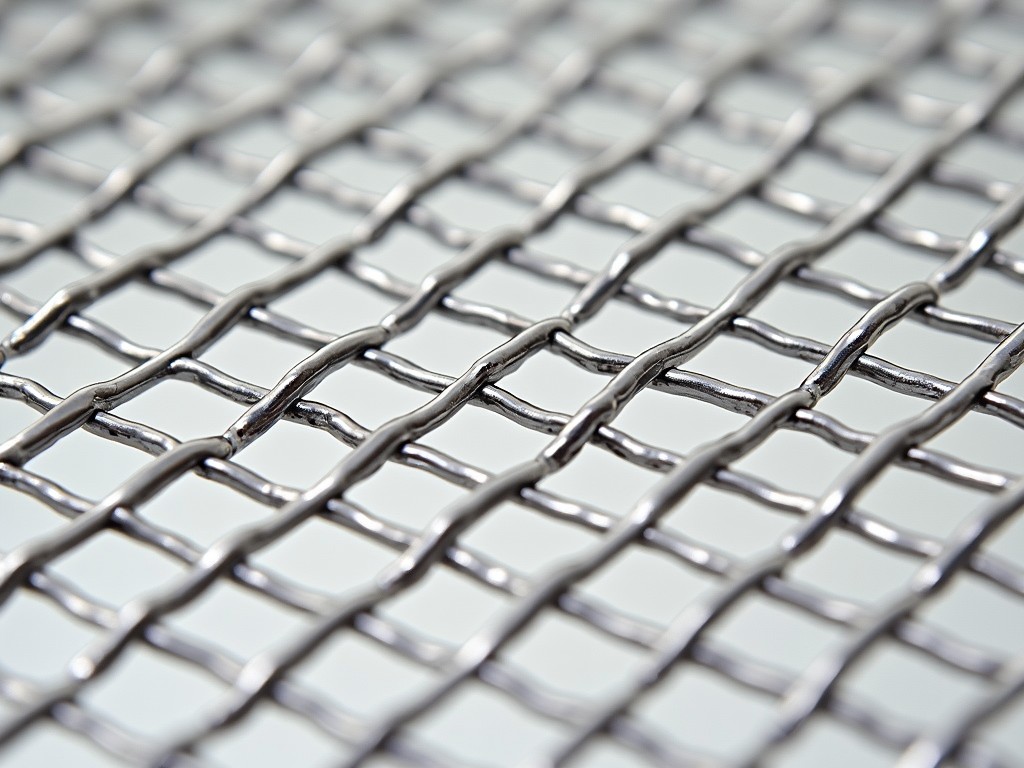
Acid Resistant 316L Stainless Steel Wire Mesh
Acid Resistant 316L Stainless Steel Wire Mesh
316L stainless steel wire mesh is specified when corrosion resistance to chlorides, acids, and harsh chemical environments is critical. The low-carbon variant of 316 stainless steel minimizes carbide precipitation during welding, preserving the passive chromium oxide layer that provides its protective barrier. This makes it suitable for prolonged exposure to sulfuric, phosphoric, and acetic acids at moderate concentrations and temperatures where standard 304 stainless steel would suffer pitting or crevice corrosion.
Material Composition and Corrosion Mechanism
316L contains approximately 16-18% chromium, 10-14% nickel, and 2-3% molybdenum, with carbon held below 0.03%. The molybdenum addition significantly enhances resistance to chloride-induced pitting and crevice corrosion compared to 304 or 316 grades. In acidic environments, the stable passive film reforms rapidly after minor disruption, provided oxidizing agents are present to maintain the Cr₂O₃ layer. This self-healing characteristic is essential in dynamic process conditions where mechanical cleaning or flow-induced wear may occur.
Typical Industrial Applications
Acid resistant 316L wire mesh is selected not merely for its material grade but for its ability to maintain structural integrity and filtration performance under specific process stresses. Its use is justified when failure due to corrosion would lead to contamination, downtime, or safety hazards. Engineers specify it where alternatives would require frequent replacement or where hygiene and product purity are non-negotiable.
- Filtration of acidic catalysts in petrochemical refining, where mesh retains solid particles while resisting degradation from sulfuric acid sludge.
- Support grids in chemical reactors handling phosphoric acid-based fertilizer production, maintaining open area for gas distribution despite prolonged acid vapor exposure.
- Washdown screens in food processing lines using peracetic acid sanitizers, preventing wire disintegration that could introduce metallic contaminants into product streams.
- Anode baskets in electrowinning cells for metal recovery from acidic leach solutions, where dimensional stability ensures consistent current distribution.
Mesh Specifications and Customization
Performance in acidic service depends on more than material alone—wire diameter, opening size, and weave pattern directly influence pressure drop, mechanical strength, and effective filtration area. These parameters are tailored to match process hydraulics, particle retention requirements, and cleaning methods. Customization ensures the mesh functions as an integrated component rather than a generic commodity.
| Parameter | Typical Range | Customization Notes |
|---|---|---|
| Wire Diameter | 0.20 mm – 2.00 mm | Selected based on tensile strength needs and clogging resistance; finer wires increase open area but reduce collapse pressure. |
| Opening Size (Mesh Count) | 2 mesh – 400 mesh | Coarser meshes for bulk filtration; finer meshes for catalyst recovery or particle classification; mesh count affects flow dynamics nonlinearly. |
| Weave Pattern | Plain weave, Twill weave, Dutch weave | Plain weave offers symmetry; twill improves drape and strength; Dutch weave provides high filtration efficiency with lower pressure drop for viscous fluids. |
| Width & Length | Up to 2000 mm width; coils or cut-to-length | Width limited by loom capacity; lengths customized to minimize waste in installation; edge treatments available for framing or welding. |
Manufacturing and Quality Considerations
Producing reliable 316L wire mesh requires attention to raw material traceability, annealing consistency, and surface finish. Variations in nickel or molybdenum content, even within specification limits, can affect long-term corrosion performance in borderline acidic conditions. Manufacturers mitigate this through certified mill test reports and batch-specific chemical analysis. Final inspection includes visual examination for defects, dimensional verification, and, when required, electrochemical passivation testing to confirm surface readiness.
Stress relief annealing is critical after weaving to reduce residual stresses that could accelerate stress corrosion cracking (SCC) in chloride-containing acids. The process is controlled to avoid sensitization—typically heating between 1050–1150°C followed by rapid cooling—to maintain the low-carbon advantage. Edge treatment (e.g., folding, welding, or framing) is performed using compatible 316L filler metal to prevent galvanic couples at boundaries.
Comparison with Alternatives
Selecting 316L over other materials involves evaluating total cost of ownership, not just initial price. While higher-grade alloys like 904L or duplex stainless steels offer superior resistance in extreme conditions, they come at significantly higher cost and may be unnecessary for many acid service applications. Conversely, opting for 304 or 316 (standard carbon) risks premature failure in environments where chloride or acid concentration fluctuates, leading to unplanned maintenance.
| Material | Pitting Resistance Equivalent Number (PREN) | Typical Use Limit in Acid Service |
|---|---|---|
| 304 Stainless Steel | 18–20 | Suitable only for mild organic acids or very low chloride exposure; prone to pitting in sulfuric acid >10% or with chlorides. |
| 316 Stainless Steel | 23–25 | Acceptable for many inorganic acids if carbon content is controlled; risk of sensitization during welding reduces corrosion resistance in HAZ. |
| 316L Stainless Steel | 23–25 | Preferred for welded assemblies; low carbon prevents sensitization; effective in sulfuric, phosphoric, and organic acids up to moderate concentrations and temperatures. |
| 904L Stainless Steel | 36–38 | Reserved for severe reducing acids like acetic acid or formic acid at high concentrations; over-engineered for most mesh applications unless chloride levels exceed 10,000 ppm. |