


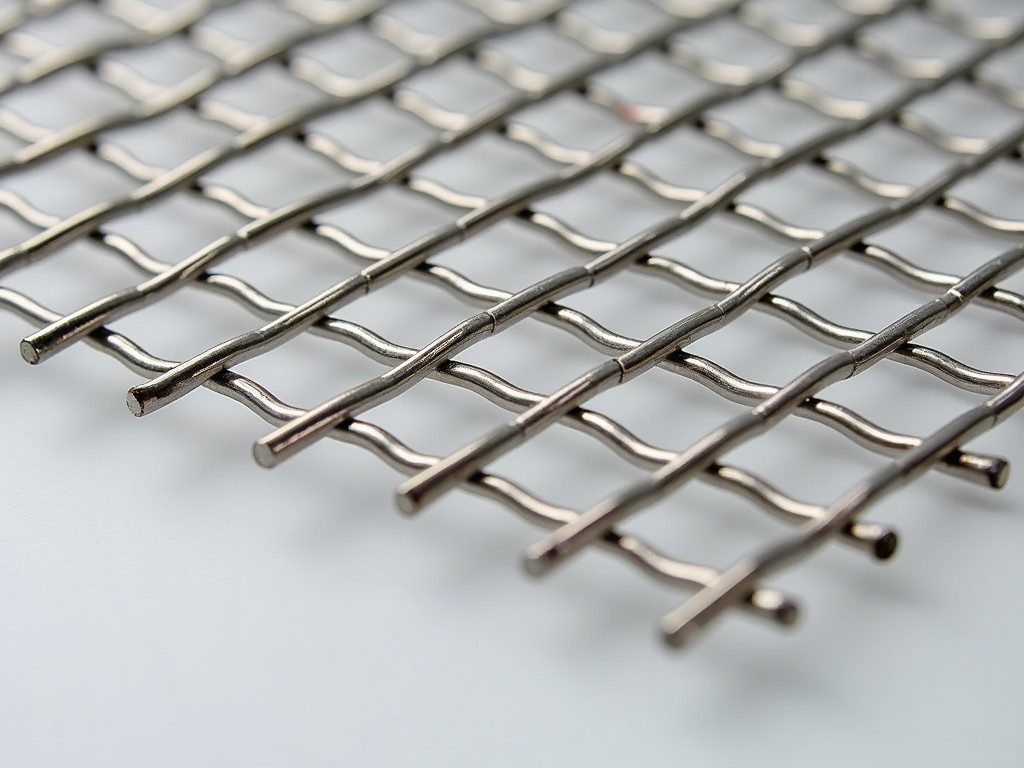
Anti Rust Epoxy Coated Stainless Steel Wire Mesh
Anti-Rust Epoxy Coated Stainless Steel Wire Mesh
Material Composition and Corrosion Resistance Mechanism
The base material is austenitic stainless steel wire, typically grade 304 or 316, selected for its inherent chromium oxide passive layer that resists oxidation in ambient conditions. However, in environments with chloride exposure, acidic vapors, or prolonged moisture, localized pitting or crevice corrosion can initiate at surface defects or weld points. To mitigate this, a thermosetting epoxy coating is applied via electrostatic spray or dip coating, forming a continuous barrier that isolates the metal substrate from electrolytes and oxygen.
The epoxy formulation used is a bisphenol-A diglycidyl ether (DGEBA) resin cured with aliphatic amines, providing excellent adhesion to stainless steel and resistance to UV degradation, salt spray, and chemical splashes. Coating thickness is controlled between 80–120 microns, measured via magnetic induction gauges, ensuring full coverage without bridging mesh openings. This dual-layer protection—passive metal oxide plus inert polymer barrier—significantly extends service life compared to uncoated stainless steel in harsh industrial atmospheres.
Mesh Construction and Geometric Specifications
The wire mesh is fabricated using plain weave or twill weave patterns, where wires are interlaced at 90-degree angles to form uniform square or rectangular apertures. Wire diameter ranges from 0.2 mm to 2.0 mm, directly influencing tensile strength and open area percentage. Aperture sizes are available from 0.5 mm to 50 mm, enabling precise filtration, sieving, or barrier functions based on particle size retention requirements.
Open area percentage, calculated as the ratio of void space to total area, typically falls between 30% and 70% depending on wire diameter and aperture size. This parameter is critical for applications involving fluid flow, airflow, or light transmission, where pressure drop or visibility must be minimized. Mesh count (wires per linear inch) is inversely related to wire diameter and aperture size; for example, a 10 mesh count corresponds to approximately 2.54 mm aperture with 0.5 mm wire.
All dimensions are maintained within ISO 9044 tolerances: aperture size ±5%, wire diameter ±0.02 mm, and squareness deviation <1°. These tight tolerances ensure consistent performance in automated sorting, screening, or precision filtration systems where dimensional drift could cause blockages or false rejections.
Performance Characteristics Under Environmental Stress
Salt spray resistance is validated per ASTM B117, with coated samples showing no red rust formation after 1,000 hours of exposure to 5% NaCl fog at 35°C. In contrast, uncoated 304 stainless steel typically exhibits initial rust spots within 200–400 hours under identical conditions. The epoxy coating prevents underfilm corrosion by inhibiting electrolyte penetration to the metal interface, a failure mode common in poorly adhered or porous coatings.
Chemical resistance testing reveals stability against dilute acids (5% sulfuric acid, 10% acetic acid), alkalis (5% sodium hydroxide), and common industrial solvents (isopropyl alcohol, mineral spirits) at 23°C for 24 hours. Prolonged exposure to strong oxidizing agents (e.g., concentrated nitric acid) or aromatic hydrocarbons may cause coating swelling or microcracking, necessitating material-specific validation for such environments.
Thermal endurance is limited to continuous operation below 120°C; above this threshold, the epoxy begins to soften, reducing adhesion and barrier integrity. For high-temperature applications exceeding 150°C, alternative coatings such as PTFE or ceramic-based systems are recommended, though they sacrifice some mechanical flexibility and impact resistance compared to epoxy.
Typical Industrial Applications and Functional Rationale
In food processing plants, this mesh is used in drying tunnels and conveyor belts where washdown cycles with chlorinated sanitizers and high humidity would degrade uncoated stainless steel over time. The epoxy coating prevents corrosion-induced product contamination and maintains hygienic surface integrity without requiring frequent replacement.
Chemical plants employ it as a separator in slurry filtration units handling acidic or brine-based solutions. The coating resists permeation by chloride ions that would otherwise initiate pitting at weld joints or wire crossings, preserving structural integrity and reducing unplanned downtime for mesh replacement.
Marine and coastal infrastructure utilizes the mesh in ventilation grates and debris screens exposed to salt-laden air and intermittent splashing. Unlike galvanized or painted steel alternatives, the epoxy-coated stainless steel maintains appearance and function without chalking, flaking, or staining, reducing maintenance cycles in hard-to-access locations.
Pharmaceutical manufacturing uses it in aseptic processing equipment where particle shedding must be minimized. The smooth, non-porous epoxy surface resists microbial adhesion and facilitates cleaning-in-place (CIP) procedures, supporting compliance with FDA 21 CFR Part 11 and EU GMP Annex 1 requirements for cleanable surfaces.
Customization Options and Manufacturing Considerations
Wire diameter, aperture size, and weave pattern can be adjusted to meet specific filtration efficiency, tensile load, or flow rate requirements. Custom dimensions are achievable through precision weaving on shuttle or rapier looms, with minimum order quantities typically starting at 10 square meters for non-standard specifications.
Coating color is available in standard RAL shades (e.g., RAL 9005 black, RAL 7035 light gray) or custom-matched upon request, using pigments dispersed in the epoxy resin prior to curing. Color stability is verified per ASTM D2244 for delta-E <5 after 500 hours UV exposure (QUV-A, 0.89 W/m² at 340 nm).
Edge treatments include folded, welded, or overlocked finishes to prevent fraying and facilitate integration into frames or mounting systems. For applications requiring electrical grounding, uncoated wire tabs can be left at designated points, or conductive epoxy variants can be specified (available upon engineering review).
Roll widths are standardly available up to 2.0 meters; wider formats require custom loom setup and may involve seam welding with overlap joints tested for coating continuity. All customizations are subject to feasibility review based on material availability, tooling constraints, and coating process limitations.
Quality Assurance and Inspection Protocol
Incoming stainless steel wire is certified to ASTM A240/A240M with mill test reports verifying chromium (16–18%) and nickel (8–10.5%) content for 304 grade, or molybdenum (2–3%) for 316. Diameter and tensile strength are verified via statistical sampling per ISO 9001-inspired procedures before weaving.
Post-weaving, mesh undergoes visual inspection under 10x magnification for wire breaks, skipped picks, or uneven tension. Aperture uniformity is checked using calibrated gauges or optical comparators against master templates. Coating adhesion is assessed via cross-hatch test (ASTM D3359) requiring minimum 4B rating, indicating <5% coating removal.
Holiday detection (pinhole testing) is performed using a DC holiday detector at 67.5 volts per micron of coating thickness, ensuring no defects exceed 0.5 mm in diameter. Salt spray and chemical resistance tests are conducted on lot samples per customer request, with results documented in batch-specific quality reports.
Final packaging includes interleaving with polyethylene film to prevent abrasion during transit, rolled on cardboard cores with inner diameter 76 mm, and secured with plastic strapping. Each roll is labeled with product code, dimensions, batch number, and QR code linking to digital test certificates.
Comparison with Alternative Protective Coatings
| Property | Epoxy Coated | PTFE Coated | Uncoated 304 SS |
|---|---|---|---|
| Salt Spray Resistance (ASTM B117) | >1000 hours (no red rust) | >1500 hours | 200–400 hours (initial rust) |
| Max Continuous Use Temp | 120°C | 260°C | 870°C (oxidation limit) |
| Coating Adhesion (ASTM D3359) | 4B–5B | 5B (non-stick surface) | N/A |
| Flexibility / Impact Resistance | Good | Fair (prone to cracking) | Excellent |
| Typical Cost Factor | 1.0x (baseline) | 1.8–2.2x | 0.7x |
The epoxy coating offers a balanced solution for applications requiring moderate temperature resistance, good mechanical durability, and cost-effective corrosion protection. PTFE provides superior thermal and chemical resistance but at higher cost and reduced toughness, making it suitable for specialized high-heat or non-stick processes. Uncoated stainless steel remains viable only in dry, low-chloride environments where corrosion risk is negligible.
Ordering Information and Technical Support
To request a quotation, provide the following: required width and length (in meters or feet), wire diameter, aperture size or mesh count, weave pattern (plain/twill), preferred stainless steel grade (304/316), coating color (RAL or custom), and any edge treatment or special tolerances. Environmental exposure details (e.g., temperature range, chemical contact, humidity) are recommended to validate coating suitability.
Samples of standard configurations (e.g., 1 mm wire, 5 mm aperture, 304 SS, gray epoxy) are available upon request for evaluation, typically shipped within 3–5 business days. Custom samples require 10–15 days for production and coating lead time.
Standard production lead time is 15–20 working days after approval of drawings and material confirmation. Expedited options are available for critical projects, subject to production schedule and material availability. All shipments are exported in compliance with ISPM 15 wood packaging regulations and include moisture barrier protection.
Technical support includes material selection guidance, coating compatibility review, and installation best practices. For inquiries, contact our engineering team via the provided channels. We do not offer installation services but can recommend certified integrators familiar with mesh handling and tensioning systems.
For detailed specifications, customization requests, or to discuss your application requirements, please reach out to our technical sales team.
Request Quotation or Technical Consultation