


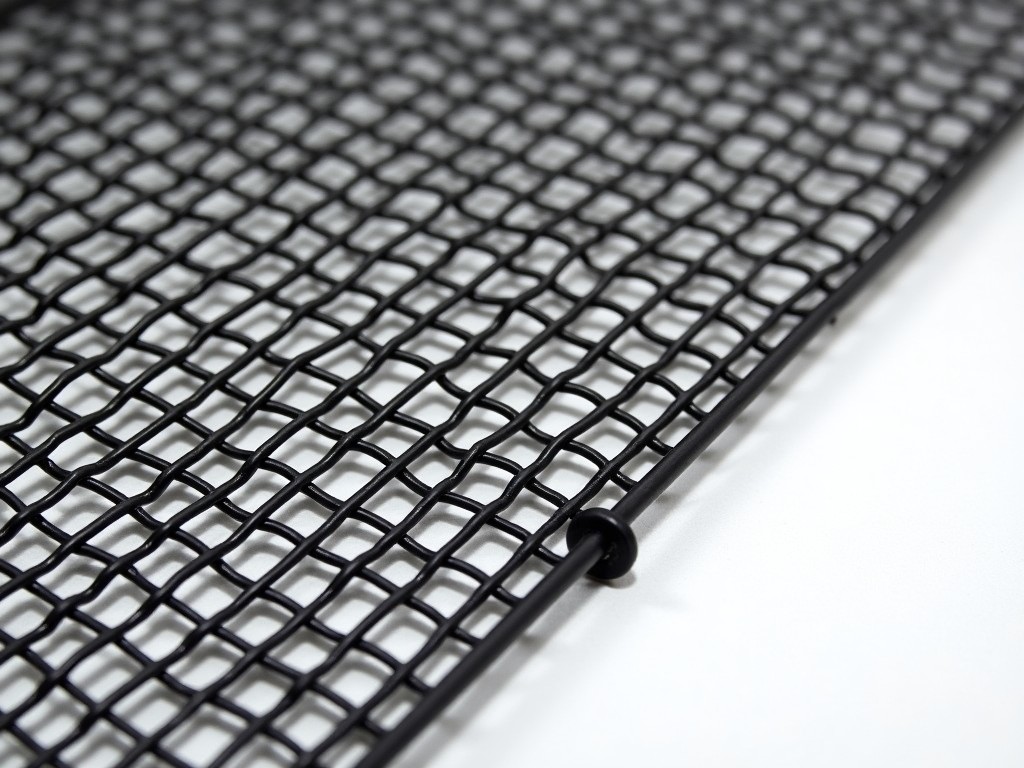
Black Powder Coated 304 Stainless Steel Screen Mesh
Black Powder Coated 304 Stainless Steel Screen Mesh
This product combines the corrosion resistance of 304 stainless steel with a durable black powder coating to meet demanding industrial filtration and separation requirements. The coating adds surface protection while maintaining the mechanical integrity of the base mesh. It is engineered for environments where both chemical resistance and visual discretion are important.
Material and Construction Details
The base material is ASTM A240 Type 304 stainless steel wire, containing approximately 18% chromium and 8% nickel for balanced oxidation and corrosion resistance. Wires are precision-drawn to consistent diameters, typically ranging from 0.2 mm to 2.0 mm depending on mesh specification. The weaving process follows standard plain Dutch or twill patterns to ensure uniform opening sizes and structural stability.
After weaving, the mesh undergoes a thermoset powder coating process using epoxy-polyester hybrid powder formulated for UV stability and chemical resistance. The coating is applied via electrostatic spray and cured at 180–200°C to achieve a minimum thickness of 60–80 microns. This creates a non-porous, adherent layer that resists chipping, fading, and mild chemical exposure without delaminating from the stainless steel substrate.
Performance Characteristics
The powder coating does not significantly alter the open area percentage of the mesh; typical reduction is less than 2% due to coating buildup on wire surfaces. Flow dynamics remain largely unchanged, making it suitable for liquid filtration, air separation, and particulate screening where consistent flow rates are critical. The coating adds negligible weight—approximately 15–25 g/m² depending on wire diameter and mesh count.
Adhesion strength exceeds 3.5 MPa per ASTM D3359 standards, ensuring the coating remains intact during handling, installation, and operational vibration. Hardness measures 2H–3H on the pencil scale, resisting surface abrasion from light contact. The coating maintains integrity from -20°C to 80°C continuous exposure; intermittent exposure up to 120°C is possible with reduced lifespan.
Underlying 304 stainless steel retains its corrosion resistance in environments with pH 4–10, resisting atmospheric oxidation, freshwater, and mild alkaline solutions. The coating acts as a barrier against direct chemical contact but is not intended for prolonged immersion in solvents, acids, or chlorides beyond mild exposure limits. For harsher chemical environments, alternative coatings or uncoated 316L stainless steel may be more appropriate.
Typical Industrial Applications
In food processing equipment, the black finish reduces visual glare under bright inspection lighting and helps conceal minor product residue between cleaning cycles, supporting hygiene standards without compromising cleanability. The coating is non-toxic and complies with FDA 21 CFR §175.300 for indirect food contact when cured properly.
Architectural and decorative installations use this mesh for railing infills, façade screens, and interior partitions where a uniform matte black appearance is desired. The corrosion resistance ensures longevity in exterior installations exposed to urban pollution and occasional moisture, while the coating minimizes visible weld marks or wire discoloration over time.
Industrial sorting and recycling lines benefit from the reduced light reflection, which improves sensor accuracy in optical sorting systems by minimizing false triggers from reflected beams. The coating also helps prevent metal-to-metal galling in high-vibration screening applications where mesh contacts support frames.
Comparison: Coated vs. Uncoated 304 Stainless Steel Mesh
| Property | Uncoated 304 SS Mesh | Black Powder Coated 304 SS Mesh |
|---|---|---|
| Surface Appearance | Metallic gray, reflective | Uniform matte black, low glare |
| Coating Thickness | None | 60–80 microns |
| Open Area Reduction | 0% | <2% |
| Abrasion Resistance | Dependent on wire hardness | Enhanced surface hardness (2H–3H) |
| Chemical Barrier | Direct exposure to environment | Mild barrier; not for prolonged solvent/acid exposure |
| Temperature Limit (Continuous) | Up to 425°C (oxidation limit) | Up to 80°C (coating integrity) |
| Visual Discretion | High visibility | Low visibility; blends with dark backgrounds |
Note: Values represent typical ranges. Actual performance depends on specific wire diameter, mesh count, coating formulation, and curing conditions. Custom tolerances and documentation are available upon request.
Customization Options
- Wire diameter: 0.2 mm – 2.0 mm (custom diameters available)
- Mesh count: 2 – 500 openings per inch (linear or rectangular)
- Weave pattern: Plain Dutch, twill Dutch, plain square, reverse Dutch
- Coating color: Black (standard), custom RAL colors available
- Width: Up to 2000 mm (standard rolls), slit to width available
- Length: Continuous rolls or cut-to-length panels
- Edge treatment: Hemmed, welded, fringed, or framed edges
Custom specifications require detailed technical drawings or application parameters including operating temperature, chemical exposure, mechanical load, and required open area. Tolerances for opening size and wire diameter can be held to ±0.02 mm for precision filtration applications.
Quality Control and Testing
Incoming 304 stainless steel wire is certified with mill test reports verifying chemical composition and mechanical properties. Wire diameter is sampled per batch using laser micrometry with traceability to national standards. Mesh width and length are inspected via calibrated laser gauges before coating.
Post-coating, adhesion is verified via cross-hatch tape test (ASTM D3359) on every production run. Coating thickness is measured using magnetic induction gauges at multiple points per square meter. Visual inspection under 500 lux lighting checks for pinholes, uneven coverage, or contamination. Open area verification is conducted using optical comparators or image analysis software for critical filtration grades.
Rolls are wound with interleaving protective film to prevent coating abrasion during transit. Ends are sealed and labeled with batch number, dimensions, material grade, and coating specification. Each shipment includes a certificate of conformance referencing the applied standards.