


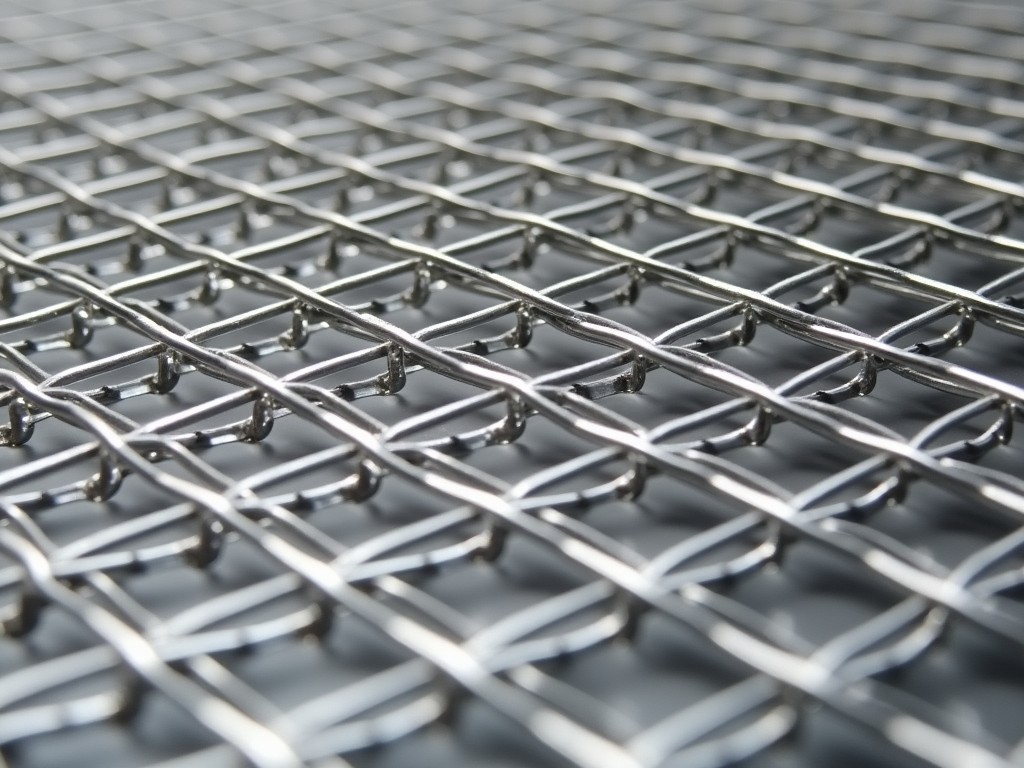
Chemical Industry 316 Stainless Steel Mesh
Chemical Industry 316 Stainless Steel Mesh
In chemical processing environments, filtration and separation components must withstand prolonged exposure to corrosive media, elevated temperatures, and mechanical stress. 316 stainless steel mesh is selected for these applications due to its specific alloy composition, which provides enhanced resistance to chlorides and reducing acids compared to standard austenitic grades. This material choice directly impacts equipment longevity, maintenance frequency, and process safety in plants handling aggressive substances.
Material Composition and Corrosion Resistance
The 316 grade contains approximately 16-18% chromium, 10-14% nickel, and 2-3% molybdenum. The molybdenum addition is critical for resisting pitting and crevice corrosion in chloride-containing environments, such as those found in pickling lines, seawater cooling systems, and halogenated solvent recovery. Unlike 304 stainless steel, 316 maintains passive film stability at temperatures up to 870°C in intermittent service and 925°C in continuous service, making it suitable for both ambient and elevated temperature chemical processes.
Corrosion performance is further influenced by surface finish and post-weld treatment. Pickling and passivation after fabrication remove embedded iron and restore the chromium-rich oxide layer. In reducing acids like sulfuric or hydrochloric acid, corrosion rates depend on concentration and temperature; 316 shows acceptable performance in dilute solutions below 40°C but requires higher alloy alternatives (e.g., 904L or Hastelloy) for concentrated or boiling conditions. Users should consult isocorrosion diagrams for specific process conditions.
Mesh Specifications and Tolerances
316 stainless steel mesh is manufactured by weaving precision-drawn wire in either plain weave or twill weave configurations. Plain weave offers symmetrical flow characteristics and equal tensile strength in warp and weft directions, while twill weave provides finer filtration with increased wire diameter capacity for the same opening size. Wire diameter, opening size, and mesh count are interrelated parameters defined by industry standards such as ASTM E11 and ISO 9044.
Typical specifications include mesh counts from 2 to 635 openings per linear inch, with corresponding opening sizes ranging from 25.4 mm down to 20 microns. Wire diameters vary from 0.025 mm for ultrafine filtration to 3.0 mm for heavy-duty screening. Tolerances on opening size are typically ±10% for woven mesh, though tighter control (±5%) is achievable through precision drawing and inspection. Custom specifications require explicit definition of mesh count, wire diameter, weave type, and edge treatment.
Applications in Chemical Processing
In chemical plants, 316 stainless steel mesh serves as a reliable barrier in liquid-solid separation, catalyst retention, and flame arrestment. For example, in polymer production, it prevents catalyst fines from migrating into downstream reactors while allowing monomer flow. In acid recovery systems, it filters particulates from spent acid streams without degrading under exposure to ferric chloride or copper sulfate. Its non-reactive nature ensures no contamination of sensitive intermediates in pharmaceutical or fine chemical synthesis.
Beyond filtration, the mesh functions as a support medium for packed beds in distillation columns and as a current distributor in electrochemical cells. Its open area percentage—calculated as the ratio of opening area to total surface area—directly affects pressure drop and flow efficiency. A 100 mesh count with 0.1 mm wire typically delivers 36% open area, balancing filtration efficacy with hydraulic resistance. Engineers select mesh geometry based on Reynolds number, particle size distribution, and allowable pressure loss in the system.
Manufacturing and Quality Control
Production begins with cold-drawn 316 stainless steel wire, annealed to achieve uniform tensile properties (typically 500-750 MPa UTS). Woven on precision looms, the mesh undergoes dimensional verification using optical comparators or laser gauges to confirm opening size and wire diameter. Edge treatments—such as hemming, framing, or welding to perforated plates—are applied per customer specifications to prevent fraying and facilitate installation.
Quality assurance includes visual inspection for defects (broken wires, skips, double picks), dimensional audits, and material verification via positive material identification (PMI) using XRF. For critical applications, hydraulic burst testing or air permeability testing may be conducted to validate integrity and flow characteristics. All test methods follow recognized standards, with results traceable to raw material batches.
Comparison with Alternatives
When evaluating mesh materials for chemical service, engineers compare 316 stainless steel against alternatives based on corrosion resistance, cost, and mechanical properties. The following table summarizes typical performance characteristics under ambient conditions in chloride-containing environments.
| Material | Pitting Resistance Equivalent Number (PREN) | Typical Use Limit in NaCl | Relative Cost Factor |
|---|---|---|---|
| 304 Stainless Steel | 18 | < 100 ppm Cl⁻ | 1.0 |
| 316 Stainless Steel | 24 | 100-1000 ppm Cl⁻ | 1.2 |
| 316L Stainless Steel | 24 | 100-1000 ppm Cl⁻ | 1.25 |
| 904L Stainless Steel | 36 | > 1000 ppm Cl⁻ | 2.5 |
Note: PREN = %Cr + 3.3×%Mo + 16×%Ni. Higher values indicate greater pitting resistance. Cost factors are relative to 304 and vary with form, quantity, and market conditions. Actual performance depends on temperature, pH, and aeration.
Customization and Ordering Information
Industrial buyers specify 316 stainless steel mesh by defining mesh count or opening size, wire diameter, weave type, width, length, and edge finish. Common widths range from 100 mm to 2000 mm, with lengths tailored to roll size or cut-to-length panels. Edges may be left raw, hemmed with overlapping wire, or fitted with stainless steel frames for direct mounting. For applications requiring frequent removal, grommets or clamping strips can be integrated.
To receive an accurate quotation, provide the following: exact mesh specification (e.g., 100 x 100 mesh, 0.12mm wire), material grade (316 or 316L), dimensions, quantity, and any required certifications (e.g., EN 10204 3.1). Lead times typically range from 2 to 4 weeks for standard specifications, depending on raw material availability and production load. Samples are available upon request for validation in simulated process conditions.
For technical consultation on mesh selection for your specific chemical process—including compatibility assessment, pressure drop estimation, or installation guidance—contact our engineering team. We provide detailed recommendations based on your operating parameters to ensure optimal performance and service life.