


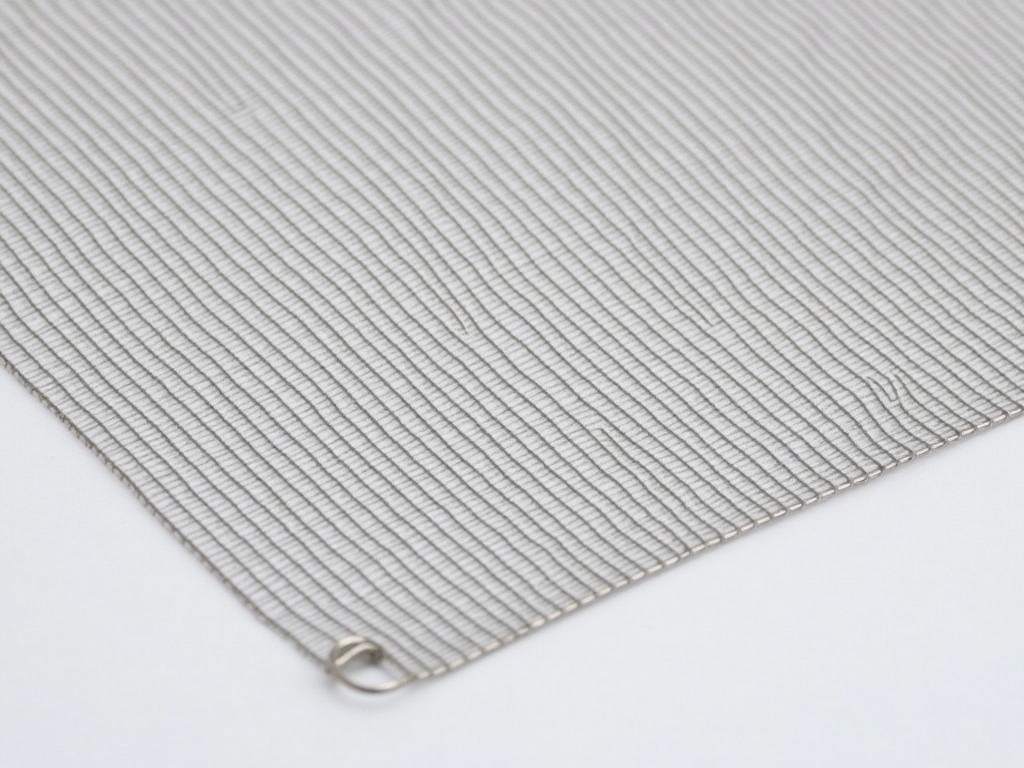
China 304L Stainless Steel Woven Wire Mesh
China 304L Stainless Steel Woven Wire Mesh
Material Composition and Corrosion Resistance
304L stainless steel is a low-carbon variant of austenitic 304, containing approximately 18% chromium and 8% nickel, with carbon content limited to 0.03% maximum. This reduced carbon level minimizes carbide precipitation during welding, enhancing resistance to intergranular corrosion in as-welded conditions. The alloy maintains excellent general corrosion resistance in atmospheric, freshwater, and mildly acidic environments, making it suitable for applications where welding is required and post-weld annealing is impractical.
Compared to standard 304, 304L offers superior weldability without sacrificing mechanical properties. Tensile strength typically ranges from 515 to 750 MPa, with yield strength between 205 and 515 MPa, depending on cold work. Elongation at break exceeds 40%, indicating good ductility for forming and weaving processes. These properties ensure the mesh retains structural integrity under mechanical stress while resisting localized corrosion in chloride-containing environments up to moderate concentrations.
Weave Patterns and Opening Characteristics
The woven wire mesh is produced using plain dutch, twill dutch, or plain square weaves, each selected based on filtration precision and flow dynamics. Plain square weave provides symmetrical openings with equal warp and weft wire diameters, ideal for uniform particle retention. Twill dutch weave features a finer weft and coarser warp, creating a tight surface layer with tapered pores that enhance dirt-holding capacity without excessive pressure drop. Plain dutch weave uses a similar principle but with even finer weft wires, achieving sub-micron filtration ratings.
Mesh specifications are defined by micron rating, open area percentage, and wire diameter. For example, a 100 mesh plain square weave with 0.12mm wire yields approximately 149 micron openings and 36% open area. A twill dutch weave of equivalent nominal rating may achieve 70 micron filtration with 25% open area due to asymmetric flow paths. These parameters directly influence flow rate, pressure drop, and particle retention efficiency in liquid and gas filtration systems.
Typical Industrial Applications
In chemical processing, 304L woven wire mesh serves as a support medium for catalyst beds in fixed-bed reactors, where its corrosion resistance and open structure prevent channeling while withstanding periodic thermal cycling. The low-carbon variant is preferred over 304 when welding is required to attach the mesh to perforated plates or frames, avoiding sensitization that could lead to stress corrosion cracking in oxidizing environments.
Food and beverage industries utilize this mesh for inline strainers and sanitary filters due to its non-toxic surface, ease of cleaning (CIP/SIP compatible), and resistance to food acids and cleaning agents. The smooth, crevice-free weave minimizes bacterial harborage points, meeting 3-A Sanitary Standards for dairy and beverage equipment when properly finished. In pharmaceutical manufacturing, it functions as a pre-filter in purified water systems, protecting downstream reverse osmosis membranes from particulate fouling without introducing metallic contaminants.
Environmental applications include aeration tank diffusers in wastewater treatment, where the mesh supports fine-bubble diffusion membranes. Its resistance to biofouling and ability to withstand intermittent chlorine shocks ensure long-term performance. In oil and gas, it acts as a sand control screen in water inflow control devices, balancing gravel retention with hydraulic conductivity in low-pressure reservoirs.
Customization Parameters
Wire diameter ranges from 0.05mm to 2.0mm, allowing precise control over filtration rating and mechanical strength. Thinner wires enable finer micron ratings but reduce burst pressure tolerance; thicker wires increase durability at the cost of open area and flow rate. Standard roll widths extend to 2000mm, with custom slitting available to meet specific conveyor or housing dimensions. Lengths are typically supplied in 30m or 50m rolls, though cut-to-length panels can be fabricated with edge treatments such as hemming, framing, or adhesive backing.
Surface finishes include annealed (soft), spring temper (half-hard), and full hard, selected based on required flexibility and abrasion resistance. Annealed mesh conforms easily to irregular surfaces, while tempered grades maintain planar stability under differential pressure. Edge options encompass raw cut, welded hem, PVC-coated edge, or stainless steel framing strips, chosen to prevent fraying and facilitate installation in housing systems.
Quality Assurance and Testing
Each batch undergoes chemical composition verification via optical emission spectrometry to confirm chromium, nickel, and carbon levels align with ASTM A240 Type 304L specifications. Mechanical properties are validated through tensile testing on wire samples drawn from the same heat, ensuring yield and elongation values meet minimum requirements. Mesh integrity is assessed via bubble point testing for filtration-grade products, where the pressure required to initiate air flow through wetted mesh correlates to the largest pore size.
Dimensional accuracy is checked using optical comparators or laser scanning to verify wire diameter, pitch, and open area against design tolerances (±5% for micron rating, ±0.01mm for wire width). Visual inspection under 10x magnification identifies weaving defects such as double picks, missing wires, or thick spots. For sanitary applications, surface roughness is measured to ensure Ra ≤ 0.8μm, minimizing adsorption and facilitating cleanability. All test reports are traceable to the raw material lot and production shift.
Comparison with Alternative Materials
| Property | 304L Woven Mesh | 316L Woven Mesh | Polypropylene Mesh |
|---|---|---|---|
| Max Operating Temp (°C) | 870 | 925 | 100 |
| Chloride Resistance | Moderate (up to 200 ppm) | High (up to 1000 ppm) | Excellent |
| Tensile Strength (MPa) | 515–750 | 515–750 | 20–40 |
| Typical Use Case | General chemical, food, wastewater | Marine, chemical, high-chloride | Low-temp, disposable filters |
While 316L offers superior resistance to chlorides and reducing acids due to molybdenum addition, 304L provides adequate performance in most industrial environments at a lower material cost. The choice between grades depends on exposure to chlorides, temperature, and required service life. Polypropylene mesh lacks the thermal and mechanical strength for high-pressure or high-temperature processes but serves as a cost-effective option for ambient-temperature, low-pressure filtration where chemical compatibility is sufficient.
Ordering and Technical Support
To receive an accurate quotation, provide the required mesh specification: weave pattern, micron rating or mesh count, wire diameter, width, length, and any edge treatment. Indicate the operating environment (temperature, pressure, fluid composition, pH) to confirm material suitability. For replacement parts, supplying a sample or detailed drawing ensures dimensional and functional compatibility.
Technical assistance is available for material selection, weave optimization, and installation guidance. Samples can be dispatched for evaluation under actual process conditions, typically within 5–7 business days for standard configurations. Production lead time for custom orders ranges from 10 to 20 days, depending on complexity and volume. All products are packaged in moisture-resistant cartons with interleaving paper to prevent surface abrasion during transit, with export packaging compliant with ISPM 15 standards for wooden pallets when required.