


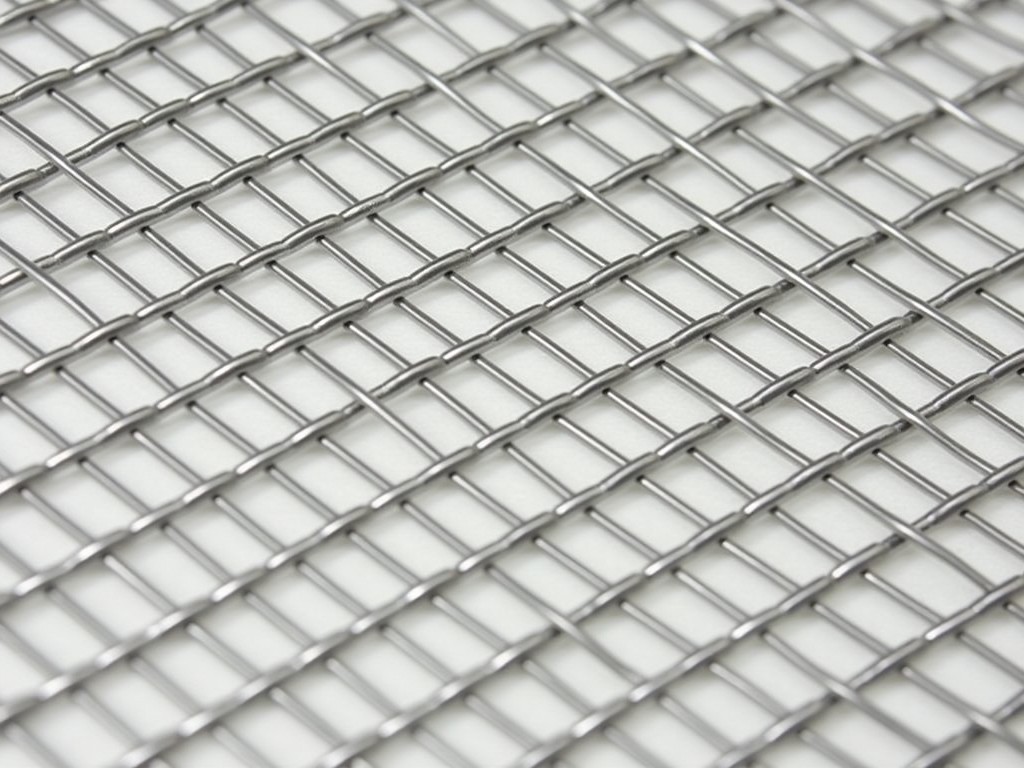
China 316 Stainless Steel Welded Wire Mesh
China 316 Stainless Steel Welded Wire Mesh
China 316 stainless steel welded wire mesh is a corrosion-resistant filtration and screening material manufactured by resistance welding perpendicular strands of austenitic stainless steel wire into a uniform grid pattern. The 316 alloy composition—typically containing 16-18% chromium, 10-14% nickel, and 2-3% molybdenum—provides enhanced resistance to chlorides and acidic environments compared to 304 grade, making it suitable for marine, chemical processing, and wastewater applications where pitting and crevice corrosion are concerns. The welding process creates joints with tensile strength matching or exceeding the parent wire, eliminating weak points common in woven or knotted meshes. Standard mesh openings range from 1 mm to 100 mm, with wire diameters from 0.5 mm to 8.0 mm, allowing customization for specific filtration, containment, or reinforcement requirements. Manufacturing adheres to ASTM A180 and ISO 9044 standards for welded steel wire mesh, ensuring dimensional consistency and mechanical reliability.
Material Composition and Corrosion Resistance
The 316 stainless steel grade used in this welded wire mesh contains molybdenum as a key alloying element, which significantly improves resistance to pitting corrosion in chloride-containing environments such as seawater, brine solutions, and deicing salts. Unlike 304 stainless steel, which may suffer localized attack under similar conditions, 316 maintains a stable passive chromium oxide layer even when exposed to sulfides and acids commonly found in industrial wastewater and chemical processing streams. The alloy’s low carbon content (typically ≤0.08%) minimizes carbide precipitation during welding, reducing susceptibility to intergranular corrosion in the heat-affected zone. For applications involving prolonged exposure to temperatures above 425°C, low-carbon 316L variants are available to further enhance weld joint stability. These material properties translate to longer service life in aggressive environments compared to carbon steel or lower-grade stainless alternatives.
Manufacturing Process and Structural Integrity
Production begins with straightening and cutting 316 stainless steel wire to precise lengths, followed by automated resistance welding where intersecting wires are fused under controlled pressure and electrical current. The welding parameters—typically 100-300 amps and 0.1-0.5 seconds per weld—are optimized to achieve full penetration without excessive spatter or wire distortion, ensuring joint strength meets or exceeds 95% of the base wire’s tensile capacity. Post-welding, the mesh undergoes optional stress-relief annealing at 400-450°C to reduce residual stresses that could affect dimensional stability during fabrication or installation. Surface passivation using nitric or citric acid baths removes free iron and enhances the chromium-rich passive layer, critical for maintaining corrosion resistance after welding. Each roll or panel is inspected for weld consistency, opening accuracy, and edge straightness before packaging.
Standard Specifications and Customization Options
| Parameter | Standard Range | Customizable Options |
|---|---|---|
| Mesh Opening | 1 mm – 100 mm | Custom apertures from 0.8 mm to 150 mm |
| Wire Diameter | 0.5 mm – 8.0 mm | 0.3 mm – 10.0 mm (subject to weldability) |
| Roll Width | 0.5 m – 2.5 m | Up to 3.5 mm with seamless splicing |
| Roll Length | 10 m – 50 m | Custom lengths up to 100 m |
| Edge Finish | Raw cut or folded selvage | Welded edge, framed border, or PVC coating |
| Surface Treatment | Passivated (standard) | Electropolished, PTFE coating, or pickled |
Customization extends beyond dimensional parameters to include functional modifications for specific industrial needs. For filtration applications requiring precise particle retention, mesh openings can be held to tolerances of ±0.1 mm using precision straightening and welding fixtures. In architectural or safety barriers, edges are often folded or welded into frames to eliminate sharp protrusions and simplify mounting. For food processing or pharmaceutical environments, electropolishing reduces surface roughness to Ra <0.4 μm, minimizing bacterial adhesion and facilitating cleaning-in-place (CIP) procedures. Clients requiring non-standard configurations—such as tapered meshes for hoppers or radial patterns for centrifuge baskets—can provide technical drawings for engineering review and tooling setup. All custom specifications are validated through first-article inspection before full production release.
Industrial Applications and Functional Advantages
In chemical processing plants, 316 stainless steel welded wire mesh serves as catalyst support grids, where its open structure allows uniform gas or liquid flow while maintaining structural integrity under thermal cycling and exposure to corrosive reagents. The non-weaving construction prevents unraveling if a single wire is damaged, a critical safety feature in continuous operation environments. Wastewater treatment facilities use this mesh in screenings and grit chambers to capture solids larger than the aperture size; the smooth weld joints reduce rag accumulation compared to knotted meshes, lowering maintenance frequency. Marine applications include aquaculture pens and seawater intake screens, where molybdenum content resists chloride-induced pitting that would degrade 304-grade alternatives within months. For structural reinforcement in precast concrete, the mesh provides crack control in thin slabs and walls, with weld strength ensuring load distribution matches design specifications.
Architectural applications leverage the material’s aesthetic durability—exterior façades and sunshades made from this mesh resist staining and require minimal cleaning over decades of UV and moisture exposure. In food processing, the smooth, crevice-free surface complies with FDA and 3-A Sanitary Standards for equipment in contact with consumables, particularly when electropolished finish is specified. The mesh also functions as a flame arrestor in industrial dryers and vents, where the wire diameter and opening size are calculated to quench flame propagation based on NFPA 69 guidelines. Unlike perforated sheet, welded wire mesh offers higher open area percentages (typically 40-80%) for equivalent strength, improving efficiency in ventilation, drainage, and filtration systems without compromising mechanical performance.
Quality Control and Testing Protocols
Dimensional verification occurs at multiple stages: wire diameter is checked with micrometers (±0.005 mm accuracy), opening size is measured using calibrated gauges or vision systems, and roll width is monitored via laser sensors to ensure consistency within ±0.5 mm. Weld integrity is assessed through tensile testing of sampled joints per ASTM A370, with acceptance criteria requiring weld strength to exceed 90% of the parent wire’s ultimate tensile strength. Visual inspection under 10x magnification identifies incomplete welds, spatter, or wire misalignment that could compromise corrosion resistance or structural performance. For critical applications, non-destructive options such as dye penetrant testing are available upon request to detect surface-breaking flaws in welds. Chemical composition validation via portable XRF or lab-based OES confirms 316 grade conformity, particularly chromium, nickel, and molybdenum content, before material release.
Passivation effectiveness is verified using copper sulfate swab tests or ferroxyl solution to detect free iron on the surface, ensuring the passive layer is intact after welding and handling. Batch traceability is maintained through heat numbers and production logs, linking raw material certificates to finished goods for audit purposes. Customers receive mill test reports (MTRs) detailing chemical composition, mechanical properties, and inspection results upon request. For orders requiring certification to specific standards—such as EN 10219 for structural applications or ASTM A240 for plate equivalence—additional testing and documentation can be arranged. All quality control procedures follow ISO 9001:2015 guidelines, with calibration records traceable to national standards.
Packaging, Handling, and Logistics
Finished mesh is typically rolled onto cardboard or plastic cores with inner diameter of 50 mm or 75 mm, protected by polyethylene sleeves to prevent moisture ingress and surface abrasion during transit. Rolls are secured with biodegradable strapping and placed on wooden pallets or stacked in crates depending on dimensions and weight—standard rolls under 25 kg are packed 20-30 per pallet, while heavier rolls exceeding 50 kg are limited to 10-15 per pallet to maintain stack stability. Corner protectors and edge boards prevent deformation of the roll shape, particularly for wider meshes prone to telescoping. For overseas shipments, desiccant packs and vapor corrosion inhibitors (VCI) are included in the packaging to mitigate humidity-related risks during sea freight. Each package is labeled with product code, dimensions, weight, heat number, and QR code linking to digital MTRs and installation guidelines.
Handling recommendations include using roll lifts or forklifts with soft jaws to avoid denting the mesh edges; dragging rolls across rough surfaces should be avoided to prevent wire scoring or coating damage. Storage should occur in dry, covered areas with temperature stability to prevent condensation-induced staining, though the 316 grade’s corrosion resistance minimizes risk compared to carbon steel alternatives. For cut-to-length panels, flat stacking with interleaving paper or plastic sheets prevents surface abrasion between pieces. Clients requiring just-in-time delivery can discuss consignment stock arrangements or segmented release schedules based on project milestones. All packaging materials are recyclable or reusable where facilities exist, supporting sustainability objectives in supply chain management.
Ordering Information and Technical Support
To initiate a quotation, provide the following technical details: required mesh opening size, wire diameter, roll width and length, edge finish preference, and any surface treatment or certification needs. If the application involves specific environmental conditions—such as exposure to certain chemicals, temperature ranges, or mechanical loads—include those specifics to enable material and design validation. For replacement parts or exact-match requests, supplying a sample or detailed sketch with dimensions ensures accurate replication. Our technical team reviews submissions for manufacturability, confirms tolerances, and suggests alternatives if constraints arise—for example, recommending a slightly larger opening to accommodate welding tolerances without compromising function. Quotations include itemized pricing, tooling notes (if applicable), lead time estimates, and packaging specifications.
Standard lead times for stock specifications range from 2-4 weeks, while custom orders involving new tooling or special materials typically require 4-6 weeks, depending on complexity and current production capacity. Samples are available upon request—small swatches (100mm x 100mm) for evaluation are provided free of charge, with freight collected or prepaid based on arrangement. For large-diameter wire or non-standard alloys, sample production may involve setup fees, which are credited toward subsequent orders. Upon order confirmation, clients receive production schedules, inspection hold points, and shipping notifications. All technical inquiries are responded to within one business day by engineers familiar with material behavior, welding processes, and industrial application requirements. Contact us to discuss your project specifications and receive a detailed, no-obligation proposal.
For technical consultation, custom specifications, or to request a quotation, please contact our engineering team.
Request Technical Quotation