


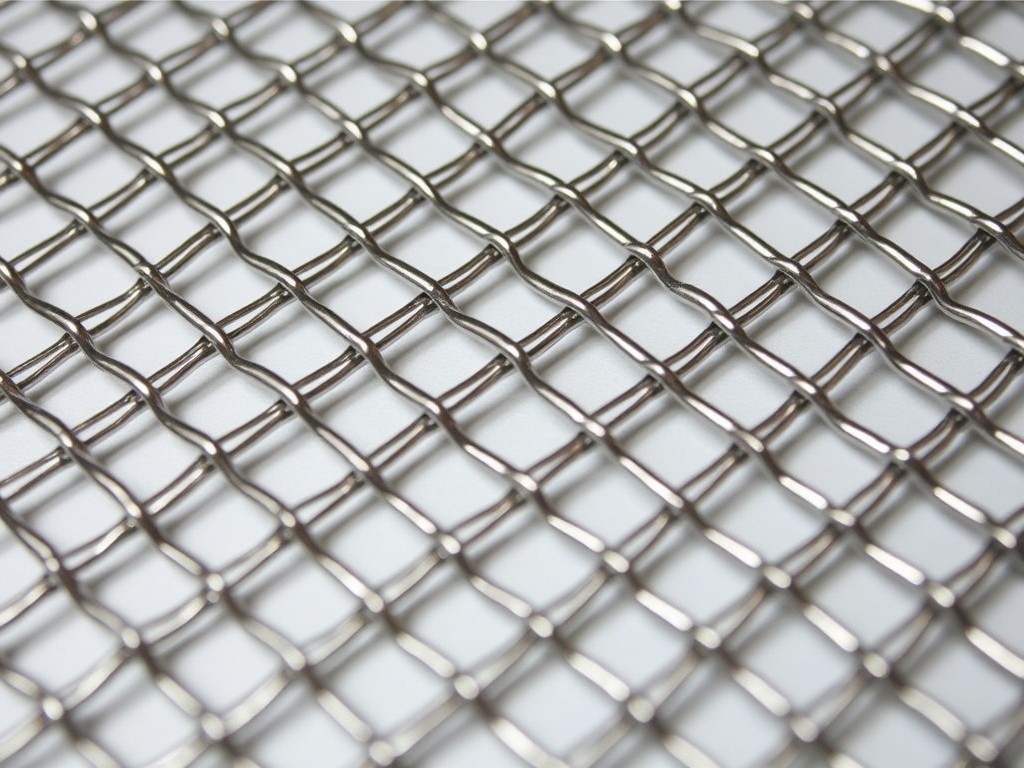
China Soft Stainless Steel Mesh
China Soft Stainless Steel Mesh: Engineering Specifications & Application Guide
Soft stainless steel mesh refers to woven wire cloth manufactured from austenitic grades — typically 304, 304L, 316, or 316L — that has undergone full annealing after weaving. This heat treatment removes work-hardening introduced during the weaving process, restoring ductility and allowing the mesh to be formed, folded, or draped without cracking or spring-back.
Chinese manufacturers supply this material in roll form (standard widths 1 m, 1.2 m, 1.5 m) or as cut-to-size panels, with mesh counts ranging from 2×2 to 635×635 and wire diameters from 0.025 mm to 1.6 mm. The combination of corrosion resistance and mechanical pliability makes it suitable for filtration, EMI shielding, architectural infill, and flexible conveyor belting.
Material Grades & Metallurgical Condition
Grade selection determines corrosion performance, temperature limits, and formability. All grades listed below are supplied in the fully annealed condition (solution annealed at 1050–1100 °C followed by rapid cooling) unless otherwise specified.
| Grade (ASTM/EN) | UNS No. | Typical PREN | Max Continuous Service Temp. | Key Characteristic |
|---|---|---|---|---|
| 304 / 1.4301 | S30400 | 18–20 | 870 °C | General-purpose; cost-effective |
| 304L / 1.4307 | S30403 | 18–20 | 870 °C | Lower carbon (≤0.03 %) for welding without sensitization |
| 316 / 1.4401 | S31600 | 24–26 | 925 °C | Molybdenum (2–3 %) improves pitting resistance |
| 316L / 1.4404 | S31603 | 24–26 | 925 °C | Preferred for welded assemblies in chloride environments |
| 904L / 1.4539 | N08904 | 35–37 | 400 °C (stress corrosion limit) | High nickel/molybdenum; severe chemical service |
Annealing also reduces magnetic permeability. As-woven 304 mesh typically shows relative permeability of 1.5–3.0 due to cold work; full annealing restores it to <1.02, critical for non-magnetic shielding applications.
Weave Patterns & Geometric Parameters
The weave pattern governs open area, flow characteristics, and mechanical behavior. Chinese mills typically stock the following patterns in soft annealed condition:
- Plain Weave — Each warp wire passes alternately over and under each weft wire. Symmetrical structure, highest stability, lowest open area for a given wire diameter. Standard for filtration below 150 mesh.
- Twill Weave — Each wire passes over two, under two, creating a diagonal pattern. Allows heavier wire diameters at the same mesh count, increasing strength and open area. Common for 150–400 mesh filtration and flexible conveyor belts.
- Dutch Weave (Plain Dutch / Twill Dutch) — Warp wires are larger diameter than weft wires; weft wires are driven tightly together. Zero clear openings; retention rated by absolute pore size (e.g., 10 µm, 25 µm). Used for high-pressure liquid/gas filtration.
- Five-Heddle / Reverse Dutch — Heavy weft wires, fine warp wires. High mechanical strength with fine filtration capability. Typical for polymer melt filtration.
Mesh count (wires per inch) and wire diameter jointly define aperture size and open area. For example, 200×200 mesh with 0.05 mm wire yields ~76 µm aperture and 36 % open area; the same mesh count with 0.04 mm wire yields ~91 µm aperture and 47 % open area. Always confirm aperture tolerance (±10 % is typical for fine meshes) when specifying for critical filtration.
Mechanical Behavior of Annealed Mesh
Full annealing transforms the mechanical response. The table below summarizes typical room-temperature properties for 304L plain-weave mesh after annealing at 1080 °C:
| Property | Typical Range | Test Basis |
|---|---|---|
| Tensile Strength (warp) | 350–550 MPa | ASTM E8 on flattened strip |
| Yield Strength (0.2 % offset) | 180–280 MPa | ASTM E8 |
| Elongation at Break | 40–55 % | ASTM E8 |
| Bend Radius (min, 180°) | 1.5 × wire diameter | Internal forming test |
| Spring-back Angle (90° bend) | <5° | V-bend test |
These values are significantly lower than as-woven mesh (which can exceed 1200 MPa tensile), but the trade-off is essential formability. The mesh can be deep-drawn into filter elements, pleated into cartridges, or wrapped around mandrels without edge cracking.
Surface finish after annealing is typically 2B (mill finish) or bright annealed (BA) if processed in protective atmosphere. Electropolishing is available as a post-treatment to reduce surface roughness (Ra <0.4 µm) and improve cleanability for pharmaceutical or food-contact applications.
Filtration Performance & Sizing Methodology
Soft stainless mesh serves two distinct filtration regimes: surface filtration (particles captured on the mesh face) and depth filtration (particles trapped within the wire matrix). For surface filtration, the nominal rating is derived from the aperture size; for Dutch weaves, the absolute rating is determined by bubble-point testing per ASTM F316 or ISO 4003.
When specifying mesh for a new filtration duty, provide the following parameters to the mill for accurate sizing:
- Target particle size (µm) and required removal efficiency (e.g., 99.9 % at 25 µm)
- Fluid type, viscosity, and operating temperature
- Differential pressure limit (typical clean ΔP: 0.05–0.15 bar for gas; 0.2–0.5 bar for liquid)
- Flow rate per unit area (m³/h·m² or GPM/ft²)
- Cleaning method (back-flush, ultrasonic, chemical) — dictates wire diameter and weave robustness
Chinese suppliers can perform bubble-point and flow-permeability testing on witness samples before full production. Request test certificates referencing ISO 9001 or IATF 16949 quality systems if your project requires traceability.
EMI/RFI Shielding Applications
Annealed stainless mesh is widely used for electromagnetic interference gaskets, cable braid, and enclosure ventilation panels. Shielding effectiveness (SE) depends on wire diameter, aperture size, and electrical continuity across the weave. For a given mesh geometry, SE can be approximated by:
SE (dB) ≈ 20 log₁₀(λ / 2a) + 20 log₁₀(σ / σ₀) + K
Where λ = wavelength, a = aperture dimension, σ = conductivity of stainless (~1.4 % IACS for 304), σ₀ = conductivity of copper, and K accounts for multiple reflections. In practice, 80–100 mesh 304L with 0.07 mm wire provides 40–60 dB attenuation from 30 MHz to 1 GHz when electrically bonded to a conductive frame.
Key design rules: maintain continuous electrical contact at seams (conductive adhesive, welding, or mechanical compression); avoid stretching the mesh beyond 3 % strain, which opens apertures and reduces SE; specify tin-plated or nickel-plated wire if galvanic corrosion with aluminum enclosures is a concern.
Architectural & Flexible Conveyor Uses
In architectural applications, soft mesh functions as light-diffusing facades, balustrade infill, or ceiling panels. The annealed condition allows on-site cutting and framing without specialized tooling. Typical specifications: 316L for coastal environments, 2–4 mm wire diameter, 20–50 mm aperture, supplied in 3 m × 10 m panels with border ropes or welded edge frames.
For flexible conveyor belting (e.g., food freezing, heat treatment, electronics), twill-weave 304L mesh with 0.9–1.2 mm wire diameter balances open area (45–55 %) for airflow and lateral stability. Belt edges are typically reinforced with stainless clincher loops or welded stainless rods to prevent fraying. Operating temperatures up to 600 °C are feasible with 316L; above that, consider nickel-alloy 600 or 601 mesh.
Quality Inspection & Acceptance Criteria
Reputable Chinese mills follow ISO 9044 (wire cloth — technical delivery conditions) and ASTM E2016 (standard specification for woven wire cloth). Standard inspection lot includes:
- Mesh count verification — optical comparator, 5 measurements per roll
- Wire diameter — micrometer at 10 random locations per roll
- Aperture size — image analysis for meshes finer than 100 mesh
- Weave pattern confirmation — visual and dimensional
- Surface condition — absence of broken wires, oil residue, annealing discoloration (straw color acceptable; blue/black indicates overheating)
- Mechanical test — tensile and bend test on witness sample per heat lot
- Chemical analysis — PMI (positive material identification) per heat number
For critical filtration or aerospace orders, request a Certificate of Conformance (CoC) with heat-lot traceability, raw-material mill certificates (EN 10204 3.1), and third-party witness testing (SGS, BV, TÜV) if contractually required.
Packaging, Shipping & Export Compliance
Standard export packaging for rolls: waterproof inner polyethylene sleeve, outer woven PP bag or wooden case with fumigation-free plywood. Rolls are secured on wooden pallets (max 1000 kg per pallet) with PET strapping. Panels are stacked flat with cardboard interleaves, edge-protected, and crated.
HS Code 7314.14.00 (woven cloth of stainless steel) applies for most countries. China export requires commercial invoice, packing list, certificate of origin (Form E for ASEAN, Form A for GSP), and fumigation certificate for wood packaging. REACH/RoHS declarations are available upon request for EU/US shipments.
Lead times: stock items (common mesh counts in 304/316L) — 5–7 days; custom weaves or non-stock grades — 3–4 weeks production + 2–4 weeks ocean transit depending on destination port.
Customization & Value-Added Services
Beyond standard roll supply, Chinese manufacturers offer the following value-added services. Confirm availability and minimum order quantities (MOQ) during quotation:
- Slitting to custom widths (min. 50 mm) with trimmed edges
- Cut-to-length panels with laser or waterjet cutting (±0.1 mm tolerance)
- Calendering (rolling) to reduce thickness and increase surface smoothness — typical thickness reduction 20–30 %
- Edge finishing: welded border frames, clincher loops, overlocked stitching, or PVC edge sealing
- Spot welding or resistance welding into formed shapes (filter discs, cones, cylinders)
- Electropolishing, passivation (ASTM A967), or PVD coating (TiN, DLC) for wear reduction
- Lamination with perforated plate or synthetic non-woven for composite filter media
Provide 2D/3D drawings (DXF, STEP) for formed parts. For filtration elements, share the housing drawing to ensure sealing geometry compatibility.
Frequently Asked Procurement Questions
Can I order a small trial quantity before committing to a full container?
Yes. Most mills accept trial orders of 1–2 rolls (approx. 30–60 m²) for stock specifications. Custom weaves typically require a minimum of 500 m² or one production run. Sample swatches (A4 size) are often provided free of charge; freight collect.
What information do you need for an accurate quotation?
Provide: grade (304/304L/316/316L/other), weave type, mesh count, wire diameter, roll width/length or panel dimensions, quantity, surface finish (2B/BA/electropolished), edge treatment, packaging preference, destination port, and any certification requirements (3.1, PMI, bubble-point test).
How do you verify the mesh is truly fully annealed?
Request a hardness test report (HV ≤180 for 304L) or a bend test photo showing 180° bend over 1.5× wire diameter without cracks. Magnetic permeability measurement (<1.02) is another reliable indicator. Reputable mills include these in the CoC.
What is the typical tolerance on aperture size for fine meshes (>200 mesh)?
ISO 9044 permits ±10 % on nominal aperture for meshes finer than 200 mesh. For critical filtration, specify a tighter tolerance (e.g., ±5 %) and request 100 % aperture inspection on witness samples — this adds cost and lead time.
Can you supply mesh with pre-applied adhesive backing for EMI gaskets?
Yes. Conductive acrylic or silicone PSA tapes (e.g., 3M 9703, Chomerics CHO-SEAL) can be laminated in-line. Specify adhesive type, liner, and shelf-life requirements. Minimum width typically 10 mm; MOQ 500 m.
How do you handle claims if mesh arrives with broken wires or weaving defects?
Document with photos (overall roll, close-up of defect, packing condition) within 7 days of receipt. Provide heat number from the label. Mills typically replace defective length or issue credit after root-cause analysis. Contractual terms should define AQL (e.g., 1.0 % for major defects) and dispute resolution.
Request a technical quotation for your soft stainless steel mesh requirement.
Share your specification sheet or describe the application — we will return grade recommendations, mesh geometry options, and lead-time estimates within one business day.
Submit Inquiry →