


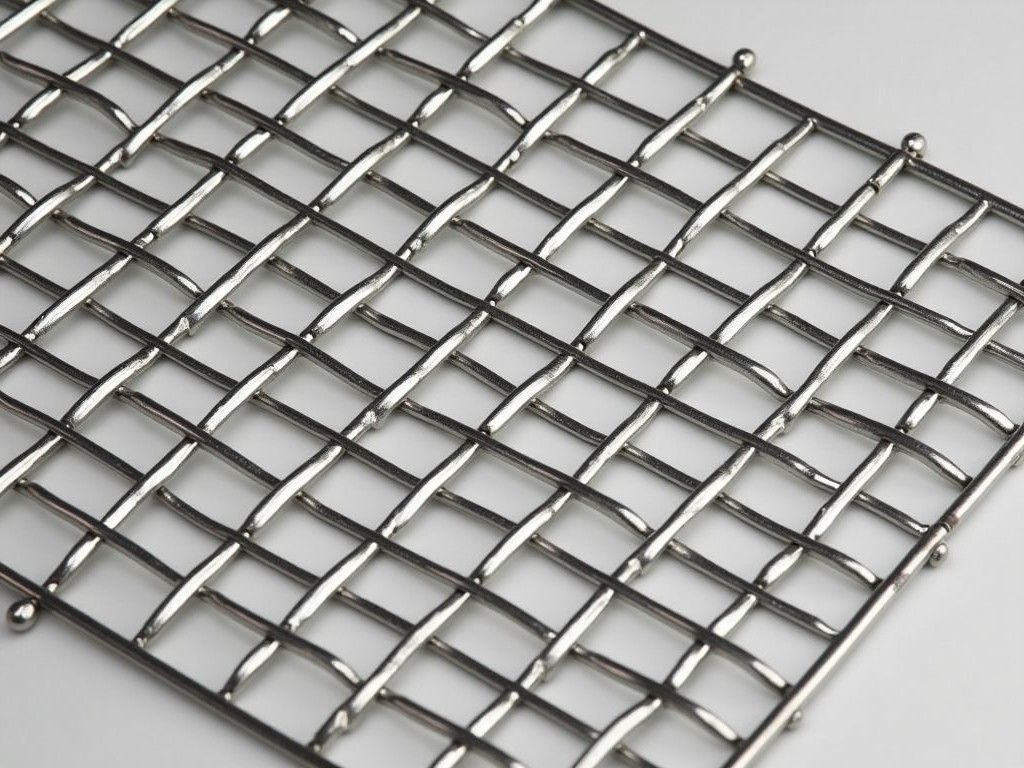
China Stainless Welded Wire Mesh
China Stainless Welded Wire Mesh
Stainless welded wire mesh produced in China combines corrosion-resistant alloy properties with precision resistance welding to create a durable, dimensionally stable grid used across filtration, shielding, and structural applications. Manufacturing follows ASTM E2016 and ISO 9044 standards for wire diameter tolerance, aperture uniformity, and weld strength, ensuring consistency for industrial procurement. The base material typically consists of austenitic grades like 304 or 316L, selected based on environmental exposure to chlorides, acids, or elevated temperatures. Welding is performed using automated CNC resistance welders that apply controlled heat and pressure at each intersection, minimizing thermal distortion while achieving tensile weld strength exceeding 90% of the parent wire. This process eliminates the need for weaving or knitting, resulting in a flat, rigid panel with predictable load-bearing behavior.
Unlike woven or extruded meshes, welded construction provides superior dimensional stability under tension, making it suitable for applications where aperture integrity must be maintained under cyclic loading or pressure differentials. The absence of interlacing wires eliminates stress concentrations at crossover points, reducing the likelihood of fatigue-induced failure compared to woven alternatives. Surface finish is typically passivated to enhance the chromium oxide layer, improving resistance to staining and pitting in humid or mildly corrosive environments. For harsh chemical exposure, electropolishing may be applied post-weld to remove embedded contaminants and further improve corrosion resistance. These treatments are verified via salt spray testing (ASTM B117) and ferroxyl testing for free iron detection.
Procurement specifications commonly reference wire diameter (ranging from 0.5mm to 6.0mm), aperture size (from 2mm x 2mm to 100mm x 100mm), and panel dimensions (standard widths up to 2m, lengths customizable to 6m or more). Tolerance on aperture size is typically ±5% for standard grades, achievable through precise wire feeding and weld pitch control. Panel flatness is maintained within 3mm deviation over a 1m length, critical for sealing in gasket applications or alignment in conveyor systems. Edge finishing options include trimmed, hemmed, or framed borders to prevent fraying and facilitate mounting. All dimensional and mechanical properties are documented in material test reports (MTRs) provided upon request.
Material Selection and Corrosion Resistance
Grade 304 stainless steel contains 18% chromium and 8% nickel, offering general-purpose resistance to atmospheric oxidation, freshwater, and mild alkalis. It is commonly selected for indoor architectural screens, food processing guards, and HVAC filters where chloride exposure is limited. Pitting resistance equivalent number (PREN) for 304 is approximately 18, making it unsuitable for prolonged exposure to seawater or de-icing salts. Grade 316L adds 2-3% molybdenum, increasing PREN to around 24 and significantly improving resistance to chlorides and acidic environments, such as in chemical processing or marine splash zones.
Low-carbon variants (304L, 316L) are preferred for welded assemblies to minimize sensitization during the welding process, which can lead to intergranular corrosion in the heat-affected zone. The 'L' designation indicates carbon content below 0.03%, reducing carbide precipitation at grain boundaries. For high-temperature applications exceeding 400°C, grade 310 or 321 may be considered due to superior creep resistance and oxidation stability, though welding requires specialized filler materials and post-weld heat treatment. Material test reports confirm composition via optical emission spectroscopy (OES) and include ferrite content measurements when required for weldability assessment.
Surface treatments are applied based on end-use requirements. Passivation in nitric or citric acid baths removes free iron and enriches the surface chromium ratio, enhancing spontaneous oxide layer formation. Electropolishing combines electrochemical smoothing with passivation, reducing surface roughness to Ra < 0.4µm, which minimizes particle adhesion in pharmaceutical or semiconductor environments. For decorative applications, a brushed or mirror finish may be specified, achieved through progressive abrasion or polishing prior to welding. All treatments are documented in batch-specific certification packs.
Manufacturing Process and Quality Control
Production begins with straightening and cutting of stainless steel wire to precise lengths, followed by cleaning to remove drawing lubricants and oxides. Wires are fed into parallel arrays via servo-driven rollers, ensuring consistent spacing and alignment before entering the weld zone. Resistance welding electrodes apply pulsed current (typically 500–2000A) for 10–50ms per spot, generating localized heat that fuses the wires without melting the core. Pressure is maintained for 100–300ms post-current to allow forging and stress relief at each junction. Weld nugget diameter is monitored via inline imaging, targeting 1.5–2.5x the wire diameter for optimal strength-to-appearance ratio.
In-line quality checks include laser-based aperture measurement (±0.1mm resolution), weld tensile testing (sampled at 1 per 50m²), and visual inspection for under-weld, over-weld, or misalignment. Aperture uniformity is critical for filtration consistency; deviation beyond ±10% can cause uneven flow or particle bypass. Weld strength is validated using peel or shear tests per AWS D1.1/D1.2M, with minimum values specified in purchase orders (e.g., ≥15N for 1.0mm wire). Surface cleanliness is verified via water break test or white glove inspection, particularly for sanitary applications.
Final inspection includes dimensional verification of panel size, flatness, and edge condition. Packaging is designed to prevent deformation during transit: panels are stacked flat with interleaving polyethylene sheets, secured in wooden crates or steel frames with corner protection. For export, ISPM 15-compliant pallets are used, and moisture barriers are included for sea freight. Each shipment includes a packing list, commercial invoice, and material test report traceable to the melt lot. Custom test reports (e.g., bend test, hydrolysis resistance) are available upon request with appropriate lead time.
Applications Across Industries
In chemical and petrochemical plants, stainless welded wire mesh serves as a support medium for catalyst beds in fixed-bed reactors, where it must withstand high temperatures, periodic thermal cycling, and exposure to hydrocarbons and sulfur compounds. The open area (typically 40–70% depending on aperture) allows for even gas distribution while preventing catalyst migration. Mesh panels are often layered with varying aperture sizes to create graded support beds, optimizing pressure drop and flow dynamics. Weld integrity is essential here, as any failure could lead to catalyst leakage and downstream contamination.
Food and beverage processing uses the mesh for conveyor belts, drying trays, and sieve screens in environments requiring frequent cleaning with alkaline detergents and high-pressure steam. The smooth, non-porous surface resists bacterial harborage and withstands CIP (clean-in-place) cycles without degradation. Aperture sizes are selected based on product size: 1–5mm for granular solids like sugar or grains, 10–20mm for blanched vegetables, and larger openings for drainage in washing lines. Compliance with FDA 21 CFR §177.1520 and EU 10/2011 is verified through migration testing, which confirms no harmful substance transfer under simulated use conditions.
Architectural and infrastructure applications include fall protection barriers on bridges, infill panels for balustrades, and cladding substrates for ventilated facades. Here, the mesh provides both safety functionality and aesthetic texture, with visibility typically exceeding 60% depending on weave density. Wind load calculations account for the mesh’s drag coefficient (Cd ≈ 1.2–1.8 for square apertures), and panel anchoring systems are designed to resist uplift and vibration. Surface treatments are chosen to match surrounding materials—brushed 304 for urban settings, 316L for coastal installations—to minimize galvanic coupling and staining over decades of exposure.
Standard Specifications and Customization
| Parameter | Typical Range | Notes |
|---|---|---|
| Wire Diameter | 0.5 mm – 6.0 mm | Custom diameters available upon request |
| Aperture Size | 2mm x 2mm – 100mm x 100mm | Square or rectangular; tolerance ±5% |
| Panel Width | Up to 2000 mm | Wider panels via splicing with overlap straps |
| Panel Length | Customizable to 6000 mm+ | Limited by handling and transport constraints |
| Material Grade | 304, 304L, 316L, 310, 321 | Other grades (e.g., 904L) available for specific corrosive media |
| Surface Finish | Passivated, electropolished, brushed, mirror | Selected based on environmental and hygiene requirements |
Customization extends beyond standard dimensions to include edge treatments, secondary operations, and performance testing. Hemmed edges involve folding the wire over a return flange (typically 5–10mm high) and welding it in place, eliminating sharp protrusions for safer handling in manual assembly lines. Framed edges use stainless steel angles or channels welded to the perimeter, providing rigidity for large-span applications where self-supporting mesh would sag under its own weight. Perforation or stamping can be applied post-weld to create localized openings for sensor mounting, fluid nozzles, or mechanical fasteners without compromising overall panel integrity.
Value-added processes include cutting to shape (via laser, plasma, or shear), bending to form trays or enclosures, and welding of fixtures such as lifting lugs or mounting brackets. These operations are performed using TIG or laser welding to minimize heat-affected zone distortion and maintain corrosion resistance in the modified areas. Post-fabrication passivation is recommended after any welding or grinding to restore the protective oxide layer. Customers requiring specific performance validation can request burst pressure testing, fatigue cycling, or EMC shielding effectiveness measurements, with protocols defined per IEC 61000-4-3 or MIL-STD-285 as applicable.
Quality Assurance and Documentation
Quality control is integrated at every stage, from raw material verification to final packaging. Incoming wire is accompanied by mill test reports (MTRs) confirming chemical composition, mechanical properties, and grain size, which are cross-checked against purchase order specifications. Spectrometric analysis is performed on each batch to detect tramp elements that could affect weldability or corrosion resistance. Wire diameter is measured using laser micrometers at multiple points per coil, with tolerance typically held to ±0.02mm for precision applications.
During production, statistical process control (SPC) charts monitor key parameters: weld current, voltage, pressure, and dwell time. Deviations beyond 2σ trigger automatic alerts for operator review. First article inspection (FAI) is conducted on the first panel of each production run, verifying all critical dimensions, weld appearance, and flatness before full-scale manufacturing begins. For high-reliability sectors like aerospace or medical devices, additional inspections such as dye penetrant testing or radiographic weld examination may be specified, though these are not standard for general industrial mesh.
Final documentation includes a certificate of conformance (CoC) stating compliance with referenced standards (e.g., ASTM E2016, ISO 9044), a detailed inspection report listing measured values for aperture, wire diameter, and panel dimensions, and the material test report traceable to the specific heat lot. For regulated industries, documentation can be expanded to include material safety data sheets (MSDS), REACH compliance statements, or FDA migration test summaries. All records are retained for a minimum of 10 years and made available for audit upon request.
For technical inquiries, custom specifications, or sample requests, please contact our engineering team to discuss your application requirements.
Request Technical Consultation