


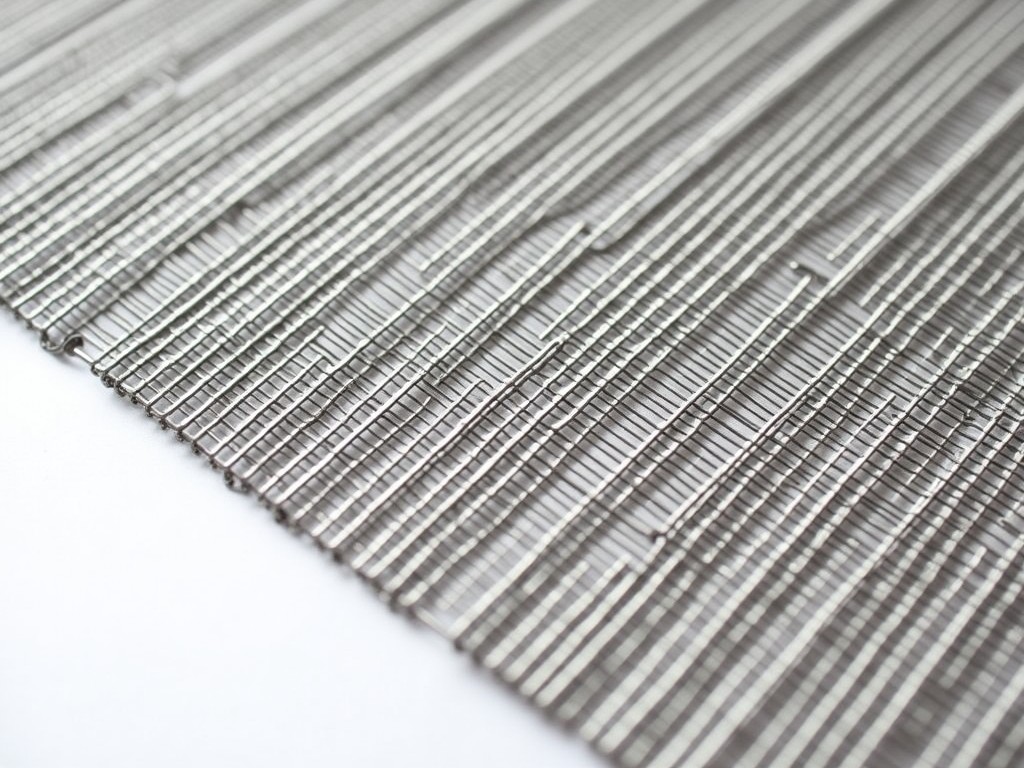
Custom 316 Stainless Steel Wire Mesh Supplier
Custom 316 Stainless Steel Wire Mesh Supplier
Selecting the right wire mesh for corrosive environments requires understanding material behavior, fabrication limits, and application-specific performance. This page explains the engineering characteristics of custom 316 stainless steel wire mesh, how it is manufactured to specification, and what technical factors influence suitability for industrial use.
Material Properties of 316 Stainless Steel Wire Mesh
316 stainless steel contains 16-18% chromium, 10-14% nickel, and 2-3% molybdenum, which significantly improves resistance to chlorides and acidic environments compared to 304 grade. The molybdenum addition enhances pitting and crevice corrosion resistance, making it suitable for marine, chemical processing, and wastewater applications where exposure to salts or acids is expected. Mechanical properties include a typical tensile strength of 515-690 MPa and yield strength of 205 MPa in the annealed condition, with elongation up to 40% depending on wire diameter and temper.
Wire mesh fabricated from 316 SS maintains these properties across a range of diameters, from fine filtration meshes (0.1mm wire) to heavy-duty screens (3mm+ wire). The alloy remains non-magnetic in the annealed state but may develop slight magnetism after cold working during weaving or welding. Oxidation resistance extends to approximately 870°C in continuous service and 925°C intermittently, though mechanical strength decreases above 425°C. These characteristics inform selection for high-temperature exhaust filters or chemical reactor components.
Customization Options for Industrial Applications
Custom 316 stainless steel wire mesh is defined by four primary parameters: wire diameter, opening size (or mesh count), weave pattern, and panel dimensions. Wire diameter is selected based on required strength, flow resistance, and filtration precision—common ranges span 0.08mm to 5mm. Opening size is specified as either clear opening (space between wires) or mesh count (openings per linear inch), with typical mesh counts from 2x2 to 400x400 for filtration and 1x1 to 4x4 for screening.
Weave patterns influence mechanical behavior and surface characteristics. Plain weave offers symmetric flow and equal warp/shaft strength, suitable for general filtration. Twill weave provides greater flexibility and finer mesh capabilities with higher wire diameters, often used in pressure filters. Dutch weave (plain or twill) creates a dense, tortuous path ideal for micron-rated filtration where flow rate must be balanced with particle retention. Welded mesh, where intersections are resistance-welded, provides rigidity for structural guards or security barriers where weaving alone lacks sufficient stiffness.
Panel dimensions are customized to fit equipment housings, conveyor systems, or architectural openings. Standard roll widths range from 0.5m to 3.0m, with lengths limited by handling—typically 10m to 50m per roll depending on weight. Custom cutting, edging (hemmed, fringed, or welded border), and framing (stainless steel angle or U-channel) are available to meet installation requirements. Tolerances on dimensions and opening uniformity are controlled per ASTM E11 or ISO 9044, with inspection available upon request.
Typical Industrial Applications and Performance Rationale
In chemical processing, 316 SS wire mesh serves as catalyst support grids, reactor internals, and filtration media where resistance to sulfuric acid, chlorides, and organic solvents is critical. The molybdenum content prevents localized attack that would compromise 304 SS in similar conditions, extending service life in continuous operation. Mesh counts from 20x20 to 100x100 are common for particle separation in liquid-liquid extraction or solid-liquid filtration.
Marine and offshore applications include seawater intake filters, aquaculture cages, and splash zone guards. Continuous immersion in saltwater demands resistance to pitting corrosion, which 316 SS provides due to its molybdenum content. Mesh is often specified with larger openings (e.g., 12.7mm square) to minimize biofouling while maintaining structural integrity under wave loading. Welded construction is preferred here for durability in dynamic environments.
Food and pharmaceutical processing uses 316 SS mesh for sanitary sieves, drying trays, and containment screens where cleanability and resistance to cleaning agents (including steam and alkaline CIP solutions) are required. The smooth, non-porous surface minimizes bacterial harborage, and electropolishing options further reduce surface roughness to Ra <0.4μm. Mesh counts are typically fine (100x100 to 300x300) for powder sizing or microbial retention.
Architectural and industrial safety applications involve machine guards, ventilation screens, and fall protection barriers. Here, mechanical strength and impact resistance are prioritized over filtration precision. Wire diameters of 2mm-4mm in plain or welded weave provide the necessary rigidity, while corrosion resistance ensures longevity in humid or chemically exposed factories. Panels are often framed and mounted with stainless steel hardware to prevent galvanic coupling.
Manufacturing Considerations and Quality Control
Weaving 316 SS wire requires precise tension control to maintain uniform opening dimensions, especially in fine meshes where wire diameters below 0.2mm are prone to breakage or deformation. Post-weaving processes such as annealing may be applied to relieve internal stresses from cold working, restoring ductility and corrosion resistance—critical for formed or bent panels. Surface passivation (citric or nitric acid treatment) is standard to enhance the passive oxide layer after fabrication.
Inspection includes visual examination for defects (broken wires, skips, double picks), dimensional verification of wire diameter and opening size using calibrated gauges or optical systems, and chemical spot testing to confirm molybdenum content and detect surface contamination. For critical applications, certification to EN 10204 3.1 or ASTM A240/A240M is available, documenting chemical composition and mechanical properties. Roll-to-roll consistency is monitored via statistical process control on wire feed and loom speed.
Packaging protects against mechanical damage and corrosion during transit. Rolls are wrapped in polyethylene film, placed on rigid cores, and secured in corrugated cardboard or wooden crates with desiccant packs for humid climates. Flat panels are interleaved with protective paper and stacked on pallets with edge guards. Export packaging includes ISPM 15-compliant timber and vapor barrier lining when required. Marking includes part number, material grade, dimensions, and heat traceability code.
Comparison Table: 316 SS vs. Alternative Materials for Wire Mesh
| Property | 316 Stainless Steel | 304 Stainless Steel | Epoxy-Coated Carbon Steel |
|---|---|---|---|
| Chloride Resistance | High (Mo-containing) | Moderate | Dependent on coating integrity |
| Max Continuous Use Temp | 870°C | 870°C | 150°C (coating limit) |
| Typical Tensile Strength | 515-690 MPa | 505-650 MPa | 400-550 MPa (base steel) |
| Corrosion in Wet Chloride | Low pitting risk | Susceptible to pitting | Coating degradation risk |
| Cost Relative to 304 SS | +15-25% | Baseline | -10-20% (initial) |
Note: Values are typical ranges. Actual performance depends on wire diameter, temper, surface finish, and environmental exposure. Epoxy-coated carbon steel costs exclude long-term maintenance and recoating.
Ordering Information and Technical Support
To receive a quotation for custom 316 stainless steel wire mesh, provide the following technical details: wire diameter (mm), opening size (mm or mesh count), weave pattern (plain, twill, Dutch, welded), panel dimensions (width × length or roll width × length), edge treatment, and required quantity. Specify if certification (e.g., EN 10204 3.1), passivation, or electropolishing is needed. For applications involving pressure, temperature, or chemical exposure, include operating conditions to assist in validating suitability.
Samples are available upon request for validation of filtration efficiency, flow pressure drop, or mechanical strength. Lead time varies from 2-4 weeks for standard specifications to 6-8 weeks for complex geometries or certified material. Export shipments are packaged to withstand moisture and handling, with full documentation provided for customs clearance.