


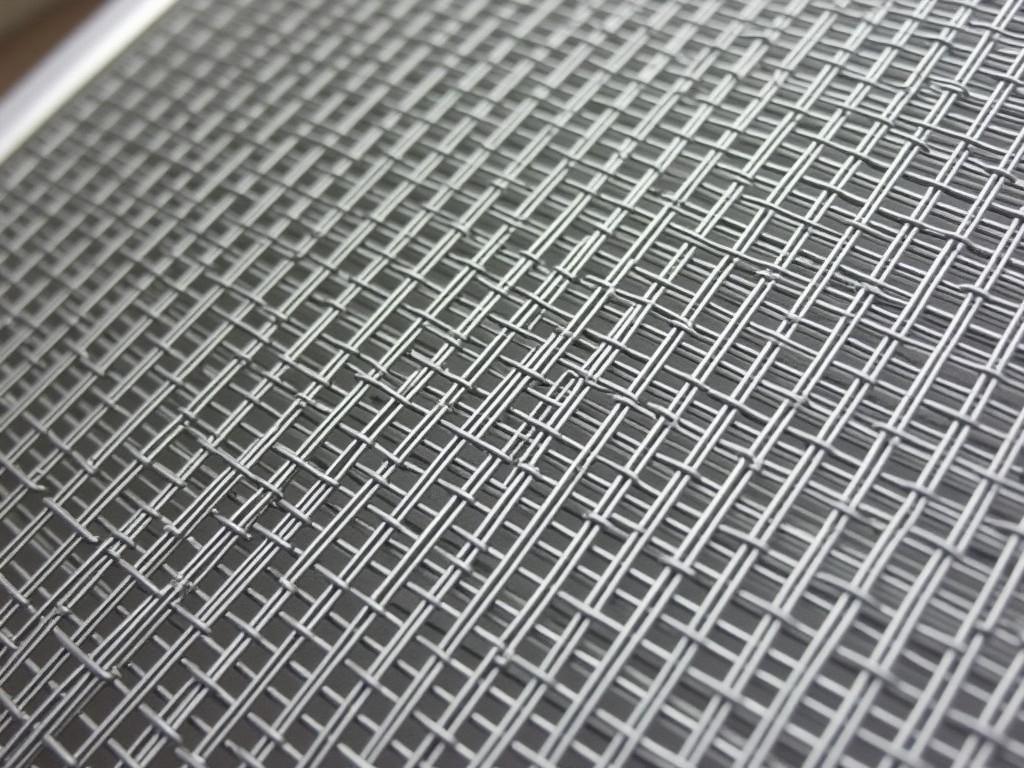
Custom Powder Coated Stainless Steel Screen Mesh
Custom Powder Coated Stainless Steel Screen Mesh
Powder coating stainless steel screen mesh combines corrosion resistance with surface protection tailored to demanding industrial environments. The process applies a thermosetting polymer layer over cleaned and pretreated stainless steel substrates, creating a barrier that resists chemical exposure, UV degradation, and mechanical wear while maintaining the mesh’s open area and structural integrity. This treatment is particularly valuable where standard stainless steel alone may suffer from staining, galling, or premature fouling due to particulate adhesion.
Material and Substrate Characteristics
The base mesh is fabricated from austenitic stainless steel grades, primarily 304 or 316L, selected for their chromium-nickel content that forms a passive oxide layer. Wire diameters typically range from 0.2 mm to 2.0 mm, with aperture sizes from 0.5 mm to 50 mm, depending on the weave pattern—plain Dutch, twill, or welded mesh. These parameters directly influence flow dynamics, filtration efficiency, and mechanical strength before coating application.
Surface preparation is critical to coating adhesion. The mesh undergoes alkaline cleaning, rinsing, and either phosphate conversion coating or abrasive blasting to achieve a profile of 1.5–3.0 µm Ra. This ensures mechanical interlocking between the substrate and the powder layer, reducing the risk of delamination under thermal cycling or impact loading. Without proper pretreatment, even high-performance powders may fail prematurely in humid or chemically active environments.
Powder Coating Process and Film Properties
Electrostatic spray application deposits thermoplastic or thermoset powders—commonly epoxy, polyester, or hybrid formulations—at thicknesses between 60 and 120 µm. The coated mesh then passes through a curing oven at 180–200°C for 10–15 minutes, triggering cross-linking that forms a continuous, non-porous film. Film thickness is measured via magnetic induction or ultrasonic methods, with uniformity maintained within ±10% across complex geometries.
The resulting coating provides a barrier against direct chemical contact with the stainless steel, extending service life in environments with chlorides, sulfides, or organic solvents. Hardness typically reaches 2H–4H on the pencil scale, offering resistance to abrasion from particulate impingement. Flexibility is retained due to the thin film and underlying ductile substrate, allowing the mesh to withstand bending during installation without cracking.
Performance Advantages in Industrial Use
Powder coating reduces surface energy, minimizing adhesion of sticky or fibrous materials such as polymers, food residues, or slurry fines. This self-cleaning effect decreases downtime for manual scraping or chemical cleaning in continuous operation systems. In contrast to uncoated mesh, where blinding can increase pressure drop by 40–60% over time, coated variants maintain more stable flow characteristics under similar loading.
The coating also mitigates galvanic corrosion when the mesh contacts dissimilar metals in assemblies, acting as an insulating layer. Thermal stability exceeds 150°C for standard epoxy powders, with specialized formulations available for sustained exposure up to 250°C. Color options—such as RAL 1018 (zinc yellow) for visibility or RAL 9005 (black) for light absorption—are selected based on operational needs rather than aesthetics alone.
Customization Parameters
Every dimension of the screen mesh is tailored to the application: wire diameter, aperture shape, weave pattern, panel size, and edge treatment (folded, fringed, or framed). Coating specifications include powder type, color, gloss level (matte to high-gloss), and thickness tolerance. For food-grade or pharmaceutical use, coatings compliant with FDA 21 CFR 175.300 or EU 10/2011 are specified, with migration testing available upon request.
Secondary operations such as laser cutting, forming, or integration into housings are performed post-coating to avoid damaging the film. Masking techniques protect threaded inserts, sealing surfaces, or contact zones where electrical conductivity or weldability is required. These considerations are defined during the design phase to prevent field modifications that could compromise coating integrity.
Quality Assurance and Testing
Adhesion is verified via cross-hatch testing (ASTM D3359) with tape removal, requiring a minimum rating of 4B for industrial applications. Holiday detection identifies pinholes in the coating using high-voltage spark testing, critical for immersion services. Salt spray resistance (ASTM B117) is evaluated, with coated 316L mesh typically exceeding 1,000 hours before red rust appearance, compared to under 200 hours for uncoated equivalents in the same condition.
Open area percentage is measured before and after coating to confirm minimal occlusion—typically less than 5% reduction due to film buildup on wire edges. Tensile strength of the wire is unaffected by the low-temperature curing process, preserving the mesh’s load-bearing capacity. All test reports are traceable to batch numbers and available for customer review prior to shipment.
Typical Applications
In chemical processing, coated mesh serves as catalyst supports or filter elements in reactors handling acidic or alkaline streams, where coating prevents pitting that could compromise structural integrity. In food production, it is used in dry sifting or wet sieving of powders and granules, reducing product buildup and simplifying sanitation between batches. The coating’s smooth finish minimizes crevices where microorganisms could harbor.
Environmental engineering applications include membrane pre-filtration in wastewater treatment, where the coating resists biofouling and extends cleaning intervals. In aggregate processing, it protects woven screens from abrasive wear caused by quartz or granite particles, increasing service life in vibratory separators. Each application leverages the combination of substrate strength and surface modification to address specific failure modes.
| Parameter | Typical Range | Notes |
|---|---|---|
| Stainless Steel Grade | 304, 316L | 316L preferred for chloride exposure |
| Wire Diameter | 0.2–2.0 mm | Aperture size inversely related |
| Coating Thickness | 60–120 µm | Measured mid-span, not on edges |
| Adhesion (Cross-Hatch) | 4B or better | ASTM D3359 Method B |
| Salt Spray Resistance | >1,000 hrs (316L) | Before red rust, ASTM B117 |
| Operating Temperature | -40°C to 150°C | Standard epoxy; higher with specialty powders |
Ordering and Technical Support
Quotations require detailed specifications: mesh dimensions, wire count, aperture size, weave type, stainless steel grade, coating color (RAL or Pantone), thickness tolerance, and any post-coating operations. Drawings or sketches are preferred to avoid misinterpretation, especially for non-rectangular panels or integrated features. Lead times typically range from 3–6 weeks after drawing approval, depending on complexity and coating cure scheduling.
Samples are available for validation, usually uncoated or with a representative coating patch to assess adhesion and appearance. Technical consultation includes mesh selection based on open area expectations, pressure drop calculations, and chemical compatibility screening. Engineers are encouraged to submit environmental data—temperature, pH, contaminant types—to optimize coating selection rather than relying on generic recommendations.