


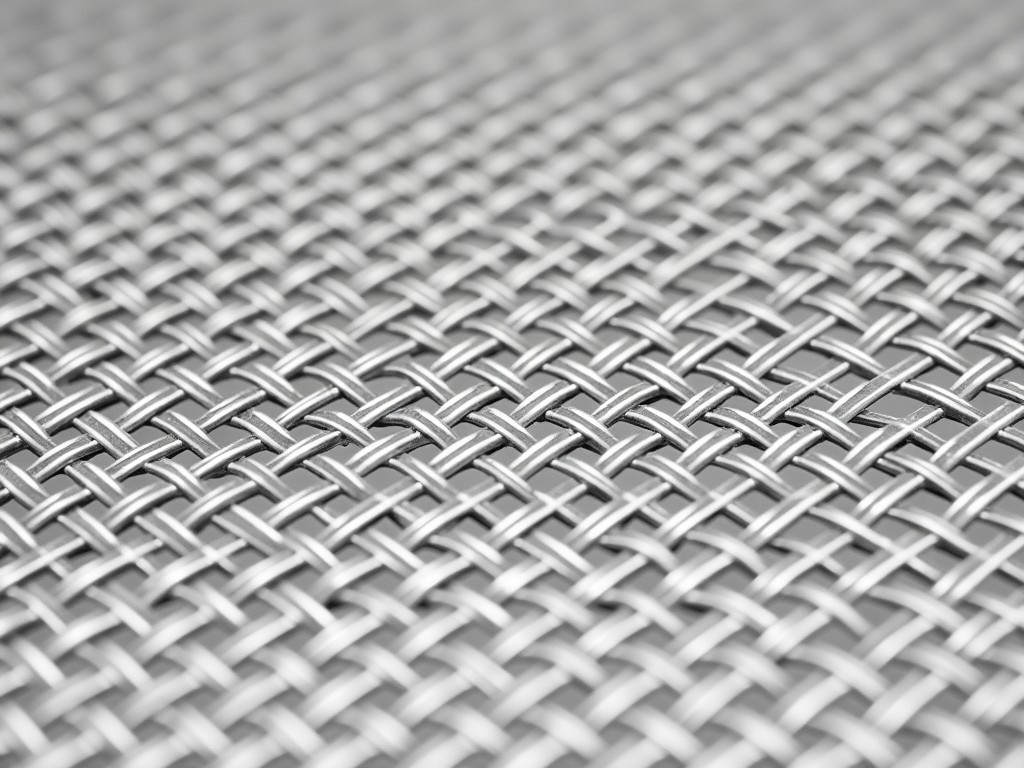
Fine 316 Stainless Steel Plain Woven Mesh
Fine 316 Stainless Steel Plain Woven Mesh
Fine 316 stainless steel plain woven mesh is a precision-engineered filtration and screening material constructed from corrosion-resistant austenitic stainless steel wire. The plain weave structure—where each warp wire passes alternately over and under each weft wire—creates a uniform, symmetrical opening pattern with consistent tensile strength in both directions. This configuration provides predictable flow characteristics and mechanical stability under cyclic loading, making it suitable for applications requiring dimensional accuracy and long-term integrity in aggressive environments.
The 316 grade contains 16-18% chromium, 10-14% nickel, and 2-3% molybdenum, which significantly enhances resistance to pitting and crevice corrosion in chloride-rich environments compared to 304 stainless steel. This composition allows the mesh to maintain structural integrity in marine atmospheres, chemical processing plants, and pharmaceutical manufacturing where exposure to salts, acids, or sanitizing agents is common. The molybdenum content is critical for preventing localized corrosion that could compromise filtration efficiency or lead to premature failure.
Wire diameter and opening size are tightly controlled during weaving to ensure repeatable performance across batches. Typical wire diameters range from 0.05 mm to 0.5 mm, with corresponding opening sizes from 0.1 mm to 2.0 mm, enabling precise particle retention for fine filtration, catalyst support, or electromagnetic shielding applications. Tolerances are maintained to ±0.01 mm on wire diameter and ±0.02 mm on opening size through precision drawing and tension-controlled weaving processes, ensuring consistency in high-volume production.
Technical Specifications
| Parameter | Typical Range | Notes |
|---|---|---|
| Wire Diameter | 0.05 mm – 0.5 mm | Customizable to ±0.01 mm tolerance |
| Opening Size | 0.1 mm – 2.0 mm | Defined as clear opening between wires |
| Mesh Count | 50 – 400 wires per inch | Warp and weft counts are equal in plain weave |
| Open Area Percentage | 30% – 70% | Dependent on wire diameter and mesh count |
| Tensile Strength (Wire) | 500 – 700 MPa | Annealed condition; cold-drawn available |
| Width | Up to 2000 mm | Seamless widths available; edge options: selvage, hemmed, or cut |
| Length | Up to 50 m per roll | Custom lengths available; splicing upon request |
Material Properties and Performance
The austenitic microstructure of 316 stainless steel provides non-magnetic properties in the annealed condition, which is essential for applications involving magnetic sensitivity, such as electronic component manufacturing or MRI-compatible equipment. Cold working during weaving can induce slight magnetism, but stress-relief annealing is available to restore non-magnetic characteristics if required. This property allows the mesh to be used in proximity to sensitive instrumentation without interference.
Thermal stability is a key advantage, with continuous service temperatures up to 870°C (1600°F) and intermittent exposure up to 925°C (1700°F). The mesh retains mechanical strength and oxidation resistance at elevated temperatures, making it suitable for furnace sight glasses, hot gas filtration, and thermal processing screens. Unlike polymeric alternatives, it does not deform, off-gas, or degrade under prolonged thermal cycling.
Chemical resistance extends to a wide range of organic solvents, alkaline solutions, and moderately acidic environments. The molybdenum content provides superior resistance to sulfides and phosphoric acid compared to standard 304 mesh, reducing the risk of stress corrosion cracking in industrial chemical streams. However, prolonged exposure to reducing acids like hydrochloric or sulfuric acid above 50°C may require material verification or alternative alloys such as 904L or Hastelloy for extreme conditions.
Applications
In pharmaceutical manufacturing, fine 316 mesh is used in fluid bed dryers and granulators to contain active pharmaceutical ingredients (APIs) while allowing efficient drying air flow. The smooth, crevice-free surface minimizes product adhesion and facilitates cleaning-in-place (CIP) procedures, reducing cross-contamination risks between batches. Its compliance with FDA 21 CFR Part 177 and USP Class VI requirements makes it suitable for direct contact with drug formulations.
Chemical processors employ this mesh as a support layer for catalysts in fixed-bed reactors, where it must withstand high temperatures, periodic thermal shocks, and exposure to reactive intermediates. The uniform opening size ensures even flow distribution across the catalyst bed, preventing channeling and hot spots that could reduce reaction efficiency or damage the reactor. Its mechanical durability allows for multiple regeneration cycles without deformation.
Food and beverage producers use fine 316 mesh in inline strainers for syrup clarification, pulp filtration, and yeast separation. The non-toxic, non-reactive surface meets 3-A Sanitary Standards and EHEDG guidelines, ensuring no leaching or microbial harborage. Easy disassembly and thorough cleaning support compliance with HACCP and FSMA regulations, particularly in dairy, brewing, and confectionery lines where product purity is critical.
Electronic manufacturers utilize the mesh as a shadow mask in vapor deposition processes or as an EMI/RFI shielding enclosure for sensitive circuits. The precise, repeatable opening geometry allows for consistent material thickness in thin-film coatings, while the conductive nature of stainless steel provides effective attenuation of electromagnetic interference across a broad frequency range. Its dimensional stability ensures registration accuracy over repeated production cycles.
Customization Options
Beyond standard specifications, the mesh can be tailored to specific process requirements through adjustments in wire diameter, opening size, and roll dimensions. Custom weaving allows for non-standard mesh counts or asymmetric configurations when directional flow characteristics are needed. Edge treatments include heat-sealed selvages to prevent fraying, ultrasonic welding for seamless joins, or polymer overcoating for additional chemical barrier properties in hybrid filtration systems.
Surface modifications such as electropolishing are available to reduce surface roughness and remove embedded contaminants, enhancing cleanability and corrosion resistance in ultra-pure applications. Passivation treatments can be applied post-weaving to restore the chromium oxide layer disrupted during manufacturing. For high-vacuum or outgassing-sensitive environments, vacuum annealing is offered to minimize volatile release from the metal matrix.
Width splicing techniques enable production of widths exceeding standard loom limitations while maintaining structural integrity at the joint. These splices are engineered to match the tensile strength and open area of the base mesh, ensuring seamless performance in large-format screens or conveyor belts. All customizations are supported by dimensional inspection and material traceability to ensure consistency with project specifications.
Quality Assurance and Testing
Quality control begins with raw material verification, where each coil of 316L stainless steel wire is accompanied by mill test reports confirming chemical composition, mechanical properties, and grain size. Incoming wire undergoes diameter measurement using laser micrometers and tensile testing to ensure conformance to ASTM A313 or EN 10270-3 standards before weaving. This prevents defects originating from substandard feedstock.
During weaving, real-time tension monitoring ensures uniform wire placement and prevents localized over-tightening or slack that could distort opening geometry. Post-weaving, every roll is subjected to optical inspection using automated vision systems to detect missing wires, double picks, or irregular openings. Mesh count and opening size are verified at multiple points across the width and length using calibrated microscopes and image analysis software.
Final inspection includes dimensional validation of roll width and length, surface cleanliness assessment, and, upon request, corrosion resistance testing via salt spray (ASTM B117) or potentiostatic polarization in simulated process environments. Test reports and certification documents are provided with each shipment, enabling full traceability from raw material to finished product. All inspections follow documented procedures aligned with ISO 9001:2015 requirements.
For technical consultation, custom specifications, or sample requests, contact our engineering team to discuss your application requirements.
Request Technical Specification Sheet