


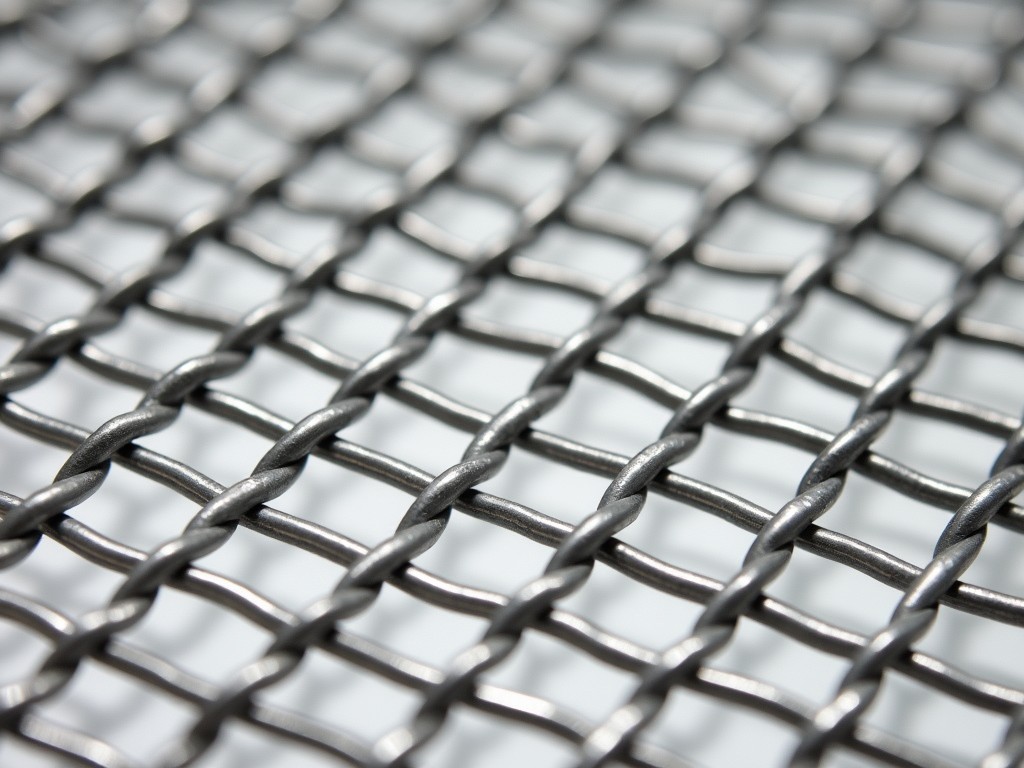
Heavy Gauge Stainless Steel Wire Mesh
Heavy Gauge Stainless Steel Wire Mesh
Heavy gauge stainless steel wire mesh is engineered for applications requiring exceptional mechanical strength, corrosion resistance, and dimensional stability under sustained loads. Unlike standard mesh products, heavy gauge variants utilize thicker wire diameters—typically ranging from 2.0 mm to 6.0 mm or more—combined with specific aperture sizes to achieve targeted performance characteristics. The manufacturing process involves precision drawing of stainless steel wire followed by weaving or welding techniques that maintain structural integrity at scale. Material selection prioritizes alloys such as 304, 316, and 316L stainless steel, each chosen based on environmental exposure factors including chloride concentration, temperature cycling, and pH levels. These meshes are not merely barriers; they function as load-bearing components in structural reinforcement, filtration systems, and protective enclosures where failure tolerance is minimal.
Material Composition and Corrosion Performance
The corrosion resistance of heavy gauge stainless steel wire mesh is fundamentally tied to its chromium and nickel content, which form a passive oxide layer on the surface. Grade 304 stainless steel, containing approximately 18% chromium and 8% nickel, provides adequate protection in mild atmospheric and freshwater environments. For marine, chemical processing, or high-chloride settings, grade 316—with added 2-3% molybdenum—offers significantly improved resistance to pitting and crevice corrosion. The low-carbon variant, 316L, minimizes carbide precipitation during welding, preserving corrosion resistance in heat-affected zones. Wire diameter directly influences the time-to-corrosion onset; thicker wires delay penetration but do not alter the inherent alloy-based resistance mechanism. Surface finish also matters: mill finish retains the natural passive layer, while electropolishing can enhance surface smoothness and contaminant shedding in hygienic applications.
Mechanical Properties and Load-Bearing Capacity
Heavy gauge mesh derives its structural capability from the tensile strength of the base wire and the efficiency of the interconnection method. Typical tensile strength for cold-drawn 304 stainless steel wire ranges from 800 to 1000 MPa, with 316 variants showing similar values. When woven, the mesh’s load distribution depends on crimp style—plain weave offers bidirectional strength, while twill weave provides enhanced flexibility and fatigue resistance. Welded mesh, meanwhile, achieves near-uniform load transfer at junctions, making it preferable for static structural roles. Aperture size inversely affects strength: smaller openings increase wire density per unit area, raising overall rigidity but reducing open area for flow. Engineers must balance these factors; for example, a 4 mm wire with 50 mm apertures in a welded configuration may support uniform loads exceeding 5 kN/m² in walkway applications, whereas the same wire in a 25 mm aperture weave could exceed 12 kN/m² due to higher material density.
Manufacturing Methods: Weaving vs. Welding
The choice between woven and welded construction significantly influences performance, cost, and suitability for specific applications. Woven mesh is produced on looms where warp and weft wires are interlaced, allowing for greater conformity to curved surfaces and better energy absorption under impact. This method preserves the full tensile strength of the wire since no localized heating occurs. However, wire-to-wire contact points may experience fretting wear over time in vibratory environments. Welded mesh, created by resistance welding at wire intersections, offers superior dimensional stability and resistance to panel distortion under load. The weld nugget typically achieves 60-80% of the parent wire’s tensile strength, which is sufficient for most structural roles but introduces a potential corrosion initiation site if not properly passivated post-weld. Welded mesh is generally preferred for flat, load-bearing platforms, while woven types excel in conical filters, vibratory screens, and dynamically stressed guards.
Typical Applications Across Industries
In mining and aggregate processing, heavy gauge stainless steel wire mesh serves as screen media in trommels and vibratory separators, where abrasion resistance and open area efficiency directly impact throughput and maintenance frequency. The mesh must withstand constant impact from rock particles while maintaining aperture consistency to prevent blinding. In architectural contexts, it functions as infill for balustrades, façades, and sunshades, leveraging its durability and aesthetic consistency—particularly when using 316L with a uniform mill or brushed finish. Food and pharmaceutical plants deploy it in pressure-rated filtration housings and containment barriers, relying on its cleanability, resistance to sanitizing agents, and compliance with hygienic design principles. Wastewater treatment facilities use it in coarse screens and aeration tank guards, where long-term immersion in variable-pH effluents demands robust corrosion performance. Each application imposes distinct demands on wire diameter, aperture geometry, alloy grade, and fabrication method, necessitating application-specific evaluation rather than generic specification.
Customization Parameters and Engineering Considerations
Heavy gauge stainless steel wire mesh is rarely specified as a catalog item; instead, it is engineered to meet precise functional requirements. Key customizable parameters include wire diameter (1.5 mm to 8.0 mm), aperture size (from 5 mm to 150 mm or more), mesh count (openings per linear inch), weave pattern (plain, twill, Dutch, welded), edge treatment (self-edge, folded, framed with stainless steel border), and panel dimensions. Engineers must consider the interaction between these variables: for instance, increasing wire diameter to improve load capacity reduces open area, which may necessitate larger overall panel size to maintain required flow rates in filtration. Similarly, selecting a finer weave for particle retention increases pressure drop, requiring higher energy input in fluid systems. Surface treatments such as passivation, electropolishing, or PVC coating (for non-contact sides) can be applied based on environmental exposure. Tolerances on aperture size and wire diameter are typically held to ±0.1 mm for precision applications, though looser tolerances may be acceptable in structural roles.
Quality Assurance and Inspection Protocols
Quality control for heavy gauge stainless steel wire mesh begins with raw material verification, including mill test reports confirming chemical composition and mechanical properties of the wire stock. During production, in-line monitoring tracks wire tension, weld consistency (for welded mesh), and weave density to detect deviations early. Final inspection involves dimensional verification of aperture size and wire diameter using calibrated gauges or optical comparators, tensile testing of wire samples to confirm strength retention, and visual assessment for defects such as broken wires, missed welds, or contamination. For corrosion-critical applications, supplemental testing may include salt spray exposure (ASTM B117) or electrochemical potentiostatic reactivation (ECPR) to assess passive layer integrity. Documentation typically includes a certificate of conformance detailing material grade, manufacturing process, inspection results, and compliance with relevant standards such as ASTM E2016 for welded mesh or ISO 9044 for wire cloth. These protocols ensure that performance expectations align with delivered product characteristics.
Comparison: Welded vs. Woven Heavy Gauge Mesh
| Property | Woven Mesh | Welded Mesh |
|---|---|---|
| Wire Stress at Joints | Minimal (no heat affected zone) | Localized heating; potential strength reduction at weld nugget |
| Dimensional Stability | Good; slight drift possible under long-term load | Excellent; resists panel skewing and aperture distortion |
| Impact Resistance | Higher energy absorption due to wire flexibility | Lower; rigid joints may crack under sudden impact |
| Surface Contaminant Retention | Higher at crossover points | Lower; smoother junctions |
| Typical Use Case | Vibratory screens, dynamic guards, conical filters | Walkways, machine guards, structural infill, flat barriers |
Ordering Information and Lead Times
Procurement of heavy gauge stainless steel wire mesh requires clear communication of technical specifications to ensure accurate fabrication. Essential information includes: alloy grade (e.g., 304, 316, 316L), wire diameter, aperture size and shape (square, rectangular), mesh pattern (weave type or weld spacing), panel dimensions, edge finish, and required quantity. For non-standard sizes or special treatments such as electropolishing or custom framing, additional details on surface requirements and mounting interface are necessary. Standard lead times for stocked configurations (common wire diameters and apertures in 304 or 316) typically range from 2 to 4 weeks. Custom orders involving non-standard alloys, precise tolerances, or secondary operations may extend to 6–8 weeks, depending on complexity and current production capacity. Samples are available upon request for validation; these usually consist of small cut-to-size sections representing the specified configuration, allowing customers to assess fit, finish, and functional compatibility before full-scale commitment.