


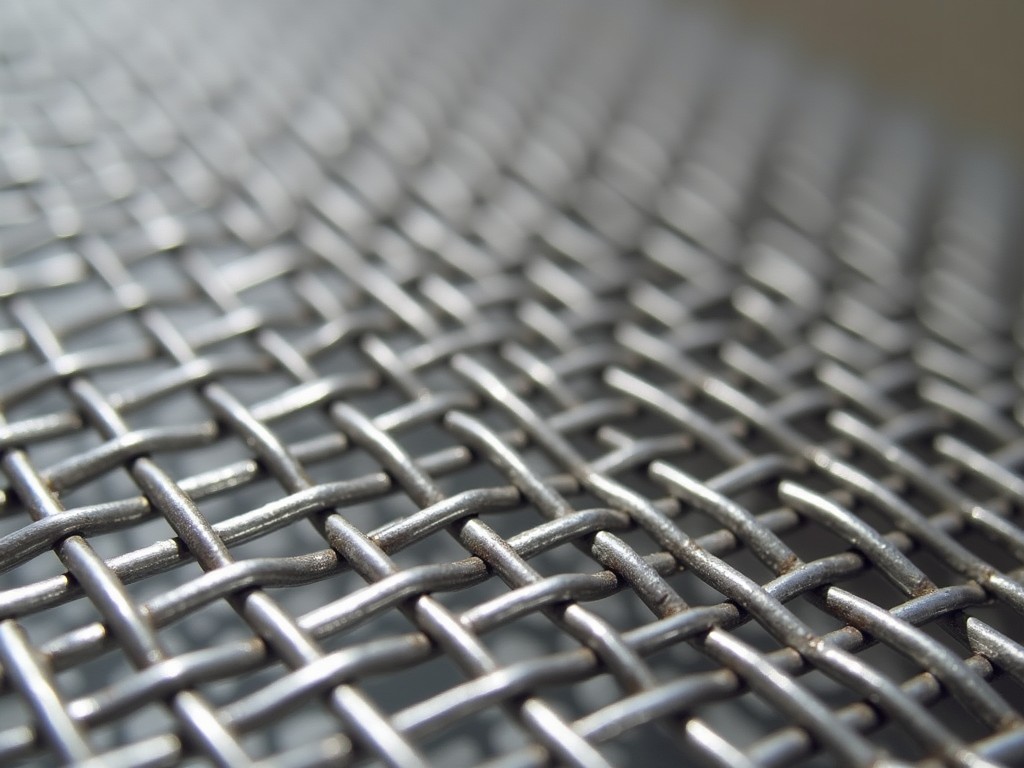
High Temperature Stainless Steel Wire Mesh
High Temperature Stainless Steel Wire Mesh
High temperature stainless steel wire mesh is engineered for continuous operation in environments exceeding 500°C where oxidation resistance, mechanical stability, and precise aperture control are critical. This product page explains material behavior, structural specifications, and selection criteria to support informed procurement decisions for furnace linings, catalyst supports, and thermal processing equipment.
Material Performance at Elevated Temperatures
Stainless steel grades used in high temperature wire mesh are selected based on chromium and nickel content, which directly influence oxidation resistance and creep strength above 600°C. Grade 310S (25% Cr, 20% Ni) forms a stable chromium oxide layer that minimizes scaling up to 1050°C in dry air, while Grade 316L (16-18% Cr, 10-14% Ni, 2-3% Mo) offers improved resistance to sulfidation and chloride-induced pitting in mixed atmospheres at temperatures up to 850°C. For applications above 900°C, Grade 330 (17% Cr, 35% Ni) provides superior resistance to thermal cycling fatigue due to its austenitic structure and low carbon content.
Creep resistance becomes the limiting factor in long-term load-bearing applications. At 700°C, 310S mesh exhibits a creep rupture strength of approximately 15 MPa after 10,000 hours, whereas 330 maintains over 25 MPa under the same conditions due to its higher nickel content stabilizing the austenitic phase. Stress relaxation testing shows that 310S loses 40% of initial tensile strength after 500 hours at 800°C under 50 MPa load, while 330 retains over 65% under identical conditions, making it preferable for vibratory or cyclically loaded screens.
Mesh Construction and Structural Specifications
Wire diameter and opening size are defined by ISO 9044 standards, with tolerances held to ±0.02 mm for wire and ±0.05 mm for aperture in precision grades. Common constructions include plain weave, twill weave, and Dutch weave, each affecting flow dynamics and mechanical loading. Plain weave offers symmetrical flow resistance and is standard for catalyst beds where even distribution is required. Twill weave provides higher tensile strength in the warp direction due to increased wire interlocking, suitable for conveyor belts under tension. Dutch weave, with finer weft wires, achieves sub-micron filtration ratings while maintaining high burst strength, often used in hot gas filtration.
Open area percentage directly impacts pressure drop and heat transfer efficiency. A 2 mm x 2 mm opening with 0.5 mm wire yields 36% open area, resulting in a pressure drop of approximately 120 Pa at 2 m/s air velocity at 20°C, scaling with temperature-dependent gas viscosity. At 800°C, the same mesh exhibits a pressure drop of ~280 Pa due to reduced gas density. Engineers must recalculate Reynolds number and Darcy friction factor using temperature-adjusted properties to avoid underestimating blower load in recuperators or oxidizers.
Typical Applications and Thermal Matching
In petrochemical reformers, 310S mesh with 1.2 mm wire and 3 mm openings supports nickel-based catalysts at 850°C, where its resistance to carburization prevents embrittlement from methane cracking byproducts. The mesh maintains dimensional stability over 20,000 hours, with measured elongation under 0.5% at 800°C under 10 kPa differential pressure. For glass lehrs, 330 mesh with 0.8 mm wire and 1.5 mm openings transports annealed glass rollers at 650°C, where its low thermal expansion (14.5 µm/m·K) minimizes misalignment-driven wear compared to carbon steel alternatives.
In metal sintering furnaces, Dutch weave 316L mesh with 0.3 mm warp and 0.15 mm weft wires filters particulates from hydrogen atmospheres at 700°C, achieving 98% efficiency for 2-micron particles while withstanding 15 kPa differential pressure without deformation. The molybdenum content in 316L inhibits reactions with sulfur compounds present in recycled metal powders, extending service life beyond 18 months in continuous operation. Aerospace thermal barriers use 330 mesh as a radiant shield in turbine blade testing rigs, where its emissivity of 0.85 stabilizes radiative heat transfer measurements at 1100°C.
Selection Criteria and Engineering Considerations
Choosing the correct grade requires evaluating the furnace atmosphere composition, not just temperature. Oxidizing conditions favor high-chromium grades (310S, 330), while reducing or sulfidizing environments necessitate nickel-rich alloys (330) or molybdenum-enhanced types (316L) to prevent internal oxidation or sulfide scale spalling. Carburizing atmospheres, common in heat treatment, degrade austenitic stainless steels by absorbing carbon at grain boundaries; in such cases, Grade 309 or heat-resistant alloys like Inconel 600 may be required despite higher cost.
Mechanical loading conditions dictate weave type and wire diameter. For static supports under uniform load, plain weave with larger wire diameters minimizes deflection. For dynamic loads involving vibration or cyclic bending, twill weave distributes stress more evenly, reducing fatigue crack initiation. Aperture clogging risk in particulate-laden flows favors Dutch weave or reverse Dutch weave, where the finer side faces the dirty stream to capture particles without blinding the open side.
Thermal expansion mismatch between mesh and supporting frame can induce buckling or weld failure. Austenitic stainless steels expand approximately 16-18 µm/m·K between 20°C and 800°C; carbon steel frames expand ~12 µm/m·K, creating differential strain. To mitigate this, use sliding clips or serpentine mounting arrangements that allow lateral movement, or match the frame material to 304L stainless steel for compatible expansion coefficients.
Quality Control and Testing Protocols
Dimensional verification includes laser scanning of aperture dimensions across multiple mesh widths to detect weaving inconsistencies, with acceptance criteria of ±5% for opening size and ±0.03 mm for wire diameter. Tensile testing follows ASTM E8/E8M at room temperature and elevated temperature fixtures up to 800°C to validate yield strength and elongation. Surface oxidation resistance is assessed via thermogravimetric analysis (TGA) in air at 900°C for 24 hours, with acceptable weight gain under 2 mg/cm² for 310S and 330 grades.
Non-destructive evaluation employs eddy current scanning to detect broken wires or microcracks in high-stress zones, particularly after forming or welding. Mesh intended for pressure vessels undergoes hydrostatic testing at 1.5 times design pressure, with leak detection using helium mass spectrometry for applications requiring high purity. Certification includes EN 10204 3.1 inspection reports for chemical composition and mechanical properties, with traceability to mill heat numbers.
Customization Options and Manufacturing Notes
Widths are available from 50 mm to 3000 mm, constrained by loom width and edge stability requirements; widths over 2000 mm may require center support wires to prevent sagging during weaving. Lengths are supplied in rolls or cut-to-size panels, with edge finishing options including selvage welding, fold-over hems, or PTFE-coated edges to prevent fraying in handling. Custom apertures can be produced using modified heddle patterns, enabling tapered or graded mesh designs for flow distribution applications.
Post-weaving treatments include stress relieving at 650°C for 2 hours to reduce residual tension from weaving, improving dimensional stability during thermal cycling. Electropolishing is available for applications requiring ultra-clean surfaces, such as semiconductor wafer boats, reducing surface roughness to Ra < 0.2 μm and removing embedded contaminants. Passivation in nitric acid baths enhances chromium oxide layer formation, particularly important for 316L in chloride-exposed environments.
Packaging and Handling Guidelines
Mesh under 1000 mm width is rolled on 76 mm diameter cores with polyethylene film wrapping to prevent surface abrasion during transit. Wider panels are shipped flat in wooden crates with corner bracing and foam edge protection to avoid bending stresses that could induce permanent set. Rolls include humidity indicator cards to monitor moisture exposure, as prolonged dampness can lead to surface staining or pitting initiation in chloride-containing atmospheres, even in stainless steel.
Handling recommendations include using wide-band slings or tubular sleeves to avoid point loading that could deform openings. Storage should be in dry, covered areas with temperature stability to prevent condensation-induced corrosion. For outdoor temporary storage, elevate rolls on pallets and cover with breathable, UV-stabilized tarps to allow ventilation while blocking precipitation and direct sunlight, which can degrade polyethylene wraps over time.
| Property | Grade 310S | Grade 316L | Grade 330 |
|---|---|---|---|
| Maximum Continuous Use Temp (°C) | 1050 | 850 | 1150 |
| Creep Rupture Strength at 700°C (MPa, 10k h) | 15 | 18 | 25 |
| Oxidation Resistance in Air | Excellent up to 1050°C | Good up to 850°C | Outstanding up to 1150°C |
| Sulfidation Resistance | Moderate | Good (Mo-enhanced) | Excellent (High Ni) |
| Typical Applications | Furnace linings, catalyst supports | Chemical processing, heat exchangers | High-temp conveyor belts, thermal shields |
For technical consultation on grade selection, weave configuration, or dimensional tolerances for your high temperature process, provide your operating temperature, atmosphere composition, mechanical load requirements, and panel dimensions. Our engineering team will review your specifications and return a detailed feasibility assessment including material recommendations, pressure drop estimates, and lead time.
Request Technical Review