


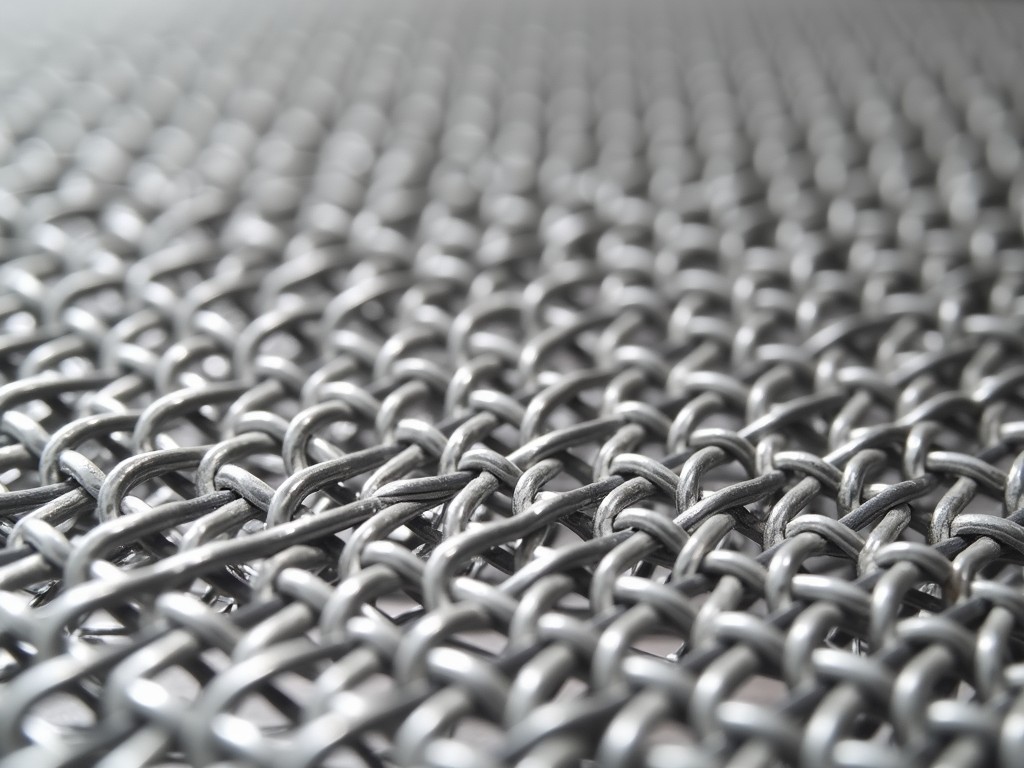
Industrial 304 Stainless Steel Dutch Weave Mesh
Industrial 304 Stainless Steel Dutch Weave Mesh
Dutch weave mesh is a specialized filtration medium engineered for precision separation in demanding industrial processes. Unlike standard square weave meshes, Dutch weave employs a distinct wire arrangement where finer warp wires are densely packed and interlaced with coarser shute wires, creating a tortuous path that enhances particle retention without significantly increasing pressure drop. This structural characteristic makes it particularly suitable for applications requiring high dirt-holding capacity and consistent filtrate clarity under variable flow conditions.
The use of AISI 304 stainless steel provides a balance of corrosion resistance, mechanical strength, and formability appropriate for a wide range of chemical, food, and pharmaceutical environments. Containing approximately 18% chromium and 8% nickel, this alloy resists oxidation and mild chemical attack while maintaining ductility for weaving and subsequent forming operations. Its performance is well-documented in environments involving water, steam, dilute acids, and alkaline solutions up to moderate temperatures and concentrations.
Material Characteristics and Weave Structure
In Dutch weave construction, the warp wires (running lengthwise) are typically finer in diameter and placed at a high density, while the shute wires (running widthwise) are coarser and spaced farther apart. This asymmetry results in a mesh where the filtration rating is primarily determined by the warp wire diameter and count, rather than the nominal opening size. The shute wires provide structural support and help maintain warp wire alignment during operation, reducing the risk of deformation under differential pressure.
The tight crimp interference between warp and shute wires creates a rigid, self-supporting structure that resists shifting or elongation. This mechanical stability is critical in applications involving pulsating flow, backwashing, or mechanical cleaning cycles. The resulting filter medium maintains consistent pore geometry over time, which is essential for reproducible separation performance in regulated industries.
Typical Specifications and Customization Options
Industrial 304 stainless steel Dutch weave mesh is available in a range of standard configurations tailored to common filtration requirements. Warp wire diameters typically range from 0.05 mm to 0.25 mm, while shute wires range from 0.15 mm to 0.60 mm, depending on the desired flow resistance and particle retention level. Mesh counts (warp wires per inch) can exceed 800 in fine grades, enabling sub-micron filtration capabilities when combined with appropriate wire diameters.
| Parameter | Typical Range | Notes |
|---|---|---|
| Warp Wire Diameter | 0.05 – 0.25 mm | Finer diameters increase retention; affect flow resistance |
| Shute Wire Diameter | 0.15 – 0.60 mm | Provides structural support; influences open area |
| Warp Count | 200 – 800+ wires/inch | Higher counts enable finer filtration thresholds |
| Shute Count | 10 – 50 wires/inch | Lower density than warp; maintains stability |
| Open Area | 5% – 35% | Dependent on wire diameters and weave tightness |
| Standard Width | 500 – 1500 mm | Custom slit widths available upon request |
| Length | Per roll or cut-to-length | Typical rolls: 20–50 m; longer lengths spliced |
Customization options include alternative stainless steel grades (such as 316L for enhanced chloride resistance), edge treatments (hemmed, welded, or fringed), and forming into specific shapes like discs, cylinders, or pleated elements. Width slitting to non-standard dimensions and length cutting to exact specifications are routinely performed to minimize waste and simplify integration into existing filtration housings. Surface finishes can be adjusted to reduce friction in dynamic sealing applications or to facilitate cleaning-in-place (CIP) procedures.
Industrial Applications and Functional Advantages
Dutch weave mesh is extensively used in liquid filtration where the removal of fine particulates, gels, or deformable contaminants is required. In chemical processing, it serves as a pre-filter for catalyst recovery systems or as a polishing stage in solvent reclamation, where its high dirt-holding capacity extends service life between changeouts. The tortuous flow path effectively captures agglomerated particles and microgels that might pass through conventional meshes of similar nominal rating.
In food and beverage production, 304 stainless steel Dutch weave is employed for clarification of juices, wine, and dairy extracts, meeting hygiene standards due to its smooth, non-porous surface and ease of sterilization. Its resistance to common food-grade cleaning agents and tolerance to intermittent steam exposure make it suitable for repeated CIP cycles. The absence of organic binders or coatings eliminates contamination risks associated with polymeric filter media.
Pharmaceutical manufacturers utilize this mesh in intermediate purification steps, such as buffer preparation or harvest clarification, where consistent particle retention and minimal extractables are critical. The predictable flow characteristics and lack of fiber shedding support compliance with particulate control requirements in aseptic processing. Additionally, its thermal stability allows use in autoclave sterilization without degradation of filtration performance.
Quality Control and Manufacturing Considerations
Production of Dutch weave mesh requires precise tension control during weaving to maintain uniform wire alignment and crimp geometry. Variations in warp tension can lead to irregular pore distribution, affecting both retention efficiency and pressure drop consistency. Manufacturers employ closed-loop monitoring systems to track wire feed rates and loom behavior, ensuring that each roll meets specified dimensional and structural tolerances.
Post-weaving inspection includes visual examination under magnification to detect wire crossing errors, broken filaments, or foreign inclusions. Dimensional verification is conducted using optical comparators or laser scanning to measure wire diameters, pitch, and open area at multiple points across the width. For critical applications, bubble point testing or bead challenge tests may be performed to validate the actual filtration rating against design specifications.
Material traceability is maintained through heat lot tracking, linking the final mesh back to the raw wire certification. This enables users to verify chemical composition and mechanical properties in accordance with ASTM A240 or equivalent standards. Packaging is designed to prevent deformation during transit — rolls are wound on rigid cores, wrapped in protective film, and housed in crush-resistant containers to preserve edge integrity and winding uniformity.
Ordering Information and Technical Support
To obtain a quotation or technical consultation, provide the required mesh specifications including warp and shute wire diameters, desired width and length, edge finish, and any forming requirements. Indicate the intended fluid, operating temperature, pressure differential, and particle size distribution to enable appropriate material and construction recommendations. Samples are available for evaluation upon request, typically shipped within 3–5 business days for standard configurations.