


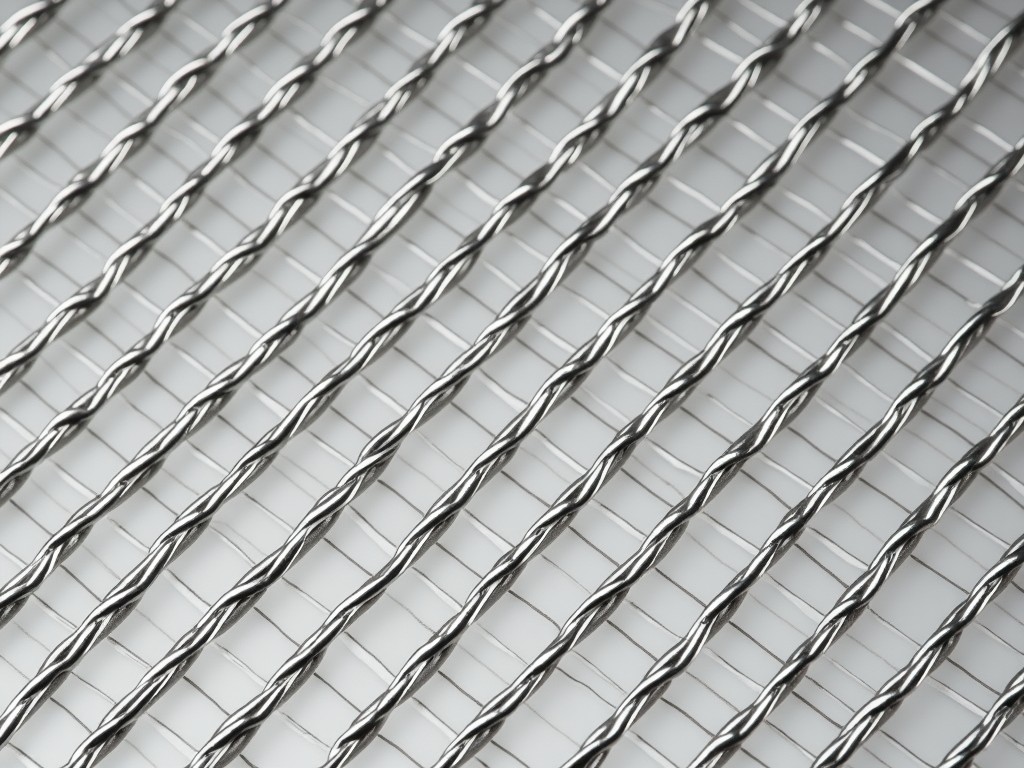
Stainless Steel Crimped Wire Mesh
Stainless Steel Crimped Wire Mesh
Stainless steel crimped wire mesh is a woven metal screen produced by interlacing pre-crimped stainless steel wires at right angles. The crimping process introduces controlled bends in each wire prior to weaving, which locks the intersection points and enhances dimensional stability under load. This construction method reduces wire shift and maintains consistent opening sizes compared to plain weave alternatives, making it suitable for applications requiring precise filtration, screening, or structural integrity.
Material Composition and Corrosion Resistance
The mesh is fabricated from austenitic stainless steel grades, primarily AISI 304 and 316, selected for their chromium and nickel content which forms a passive oxide into a protective chromium-rich layer. Grade 304 offers adequate resistance to atmospheric corrosion and mild chemicals, while 316 includes molybdenum to improve resistance to chlorides and acidic environments, such as marine exposure or chemical processing streams. Wire diameter and opening size are specified independently, allowing engineers to balance flow rate, mechanical strength, and particle retention based on process requirements.
Crimping Styles and Structural Implications
Two primary crimping profiles are used: plain crimp and lock crimp. Plain crimp features symmetric bends in both warp and weft wires, creating a flexible yet stable mesh suitable for general screening. Lock crimp incorporates interlocking notches that resist lateral displacement, increasing rigidity and making it preferable for high-vibration environments or applications where mesh tension must be maintained over long spans. The choice between styles affects open area percentage, pressure drop, and fatigue resistance — critical factors in industrial dryer screens or conveyor belts.
Typical Specifications and Customization Parameters
| Parameter | Typical Range / Options |
|---|---|
| Wire Diameter | 0.2 mm to 6.0 mm (customizable) |
| Opening Size (Mesh Count) | 2 mesh to 400 mesh (e.g., 2x2 to 400x400 wires per inch) |
| Material Grade | AISI 304, 304L, 316, 316L (others upon request) |
| Crimp Style | Plain crimp, lock crimp, intercrimp |
| Width | Up to 3000 mm (seamless); wider via joining |
| Length | Cut-to-length or continuous rolls (standard 30m) |
Industrial Applications and Functional Rationale
In aggregate processing, crimped mesh serves as a screening medium in vibratory separators where its resistance to blinding and ability to handle abrasive materials extends screen life. The lock crimp variant minimizes wire movement under constant impact, reducing maintenance frequency. In food and pharmaceutical industries, 316L mesh is used in sanitary filtration systems due to its smooth surface finish and ease of cleaning, meeting requirements for non-product-contact surfaces under FDA 21 CFR §177.2600. Chemical plants deploy it in catalyst retention baskets where corrosion resistance and structural integrity at elevated temperatures are essential.
Architectural applications leverage the mesh’s aesthetic uniformity and durability; it is used as infill panels in railings or facades where wind load resistance and corrosion resistance reduce lifecycle costs. Unlike perforated sheet, crimped mesh offers higher open area for equivalent strength, improving visibility and airflow. In mining, it functions as rock fall protection on slopes, where flexibility allows conformity to uneven surfaces while maintaining tensile strength to absorb energy from impacting debris.
Manufacturing Considerations and Quality Control
Post-weaving, the mesh may undergo stress-relief annealing to reduce residual stresses from crimping and weaving, which helps prevent distortion during subsequent forming or cutting. Dimensional inspection verifies opening size and wire diameter using optical comparators or calibrated gauges, with tolerances typically held to ±10% for opening size and ±0.02 mm for wire diameter, depending on mesh count. Surface finish is evaluated for burrs or sharp edges, particularly in food-grade applications, where edge rolling or welding may be applied to ensure safety.
Packaging and Handling
Mesh is typically rolled onto cardboard or plastic cores with protective interleaving paper to prevent surface abrasion during transit. Rolls are wrapped in polyethylene film and secured with strapping to guard against moisture and mechanical damage. For precision-cut panels, flat packaging with corner protectors and rigid inserts prevents bending. Labeling includes material grade, dimensions, crimp style, and heat number for traceability. Export shipments comply with ISPM 15 standards for wooden packaging when applicable.
Inquiry and Technical Support
To ensure accurate specification, provide the intended operating environment, required flow characteristics, mechanical loads, and any regulatory standards (e.g., FDA, ASME, ISO). Our technical team can assist with material selection, open area calculations, and custom fabrication including edge treatment, framing, or cutting to shape. Submit your requirements via the contact form to receive a detailed quotation and lead time estimate.
Request Technical Quote