


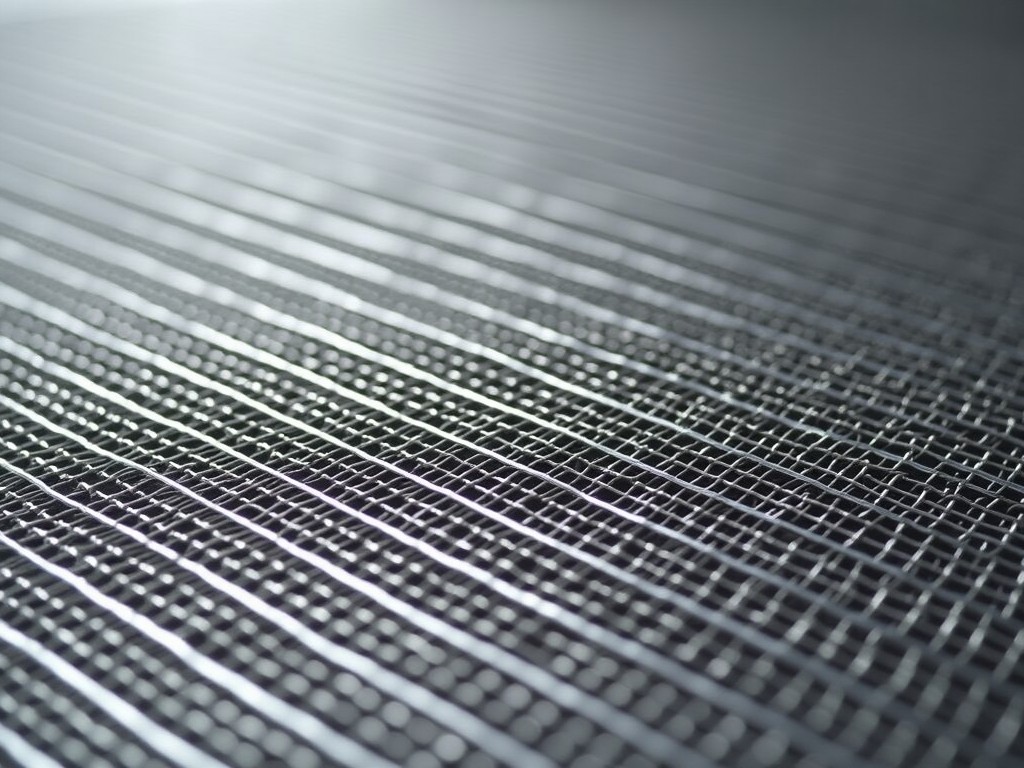
Stainless Steel Finish Aluminum Screen Mesh Factory
Stainless Steel Finish Aluminum Screen Mesh Factory
This page details the manufacturing process, material properties, and application suitability of aluminum screen mesh treated with a stainless steel finish. The finish combines the lightweight strength of aluminum with the corrosion-resistant appearance and surface hardness of stainless steel, addressing specific industrial requirements where weight savings and aesthetic durability are both critical.
The treatment is not a coating but a surface modification process that alters the outer layer of the aluminum alloy to mimic the visual and protective characteristics of 304 or 316 stainless steel while retaining the base material’s density of approximately 2.7 g/cm³—about one-third that of steel. This allows engineers to reduce structural load in elevated installations, mobile equipment, or seismic zones without sacrificing the expected appearance of stainless steel in architectural or food-grade environments.
The process involves electrochemical anodizing followed by nickel-sealing or chromate-free passivation, depending on end-use regulations. The resulting surface achieves a typical Vickers hardness of 150–200 HV, significantly higher than untreated aluminum (20–40 HV), and demonstrates improved resistance to UV fading, salt spray (tested per ASTM B117 for 500+ hours without white rust), and mild chemical exposure common in pharmaceutical or beverage processing lines.
Material Composition and Finish Characteristics
The base aluminum alloy is typically 5052-H32 or 6061-T6, selected for their balance of tensile strength (210–310 MPa), formability, and inherent corrosion resistance. These alloys contain magnesium and silicon, which enhance the uniformity of the anodic layer during finishing. The stainless steel finish is achieved through a two-stage process: first, sulfuric acid anodizing creates a porous oxide layer (10–25 µm thick), then nickel acetate sealing fills the pores to produce a non-reflective, stainless-steel-like appearance.
Unlike painted or plated finishes, this method does not add significant mass—surface buildup averages 5–8 µm—preserving the mesh’s open area and airflow dynamics. The finish is integral to the substrate, meaning it cannot chip, peel, or delaminate under mechanical stress or thermal cycling. Surface roughness (Ra) typically measures 0.2–0.4 µm after sealing, comparable to brushed 304 stainless steel, ensuring compatibility with sanitary wipe-down protocols.
Color stability is maintained under prolonged UV exposure due to the inorganic nature of the oxide layer. Accelerated weathering tests (QUV-A, 1000 hours) show ΔE < 2.0, indicating no perceptible color shift to the human eye. This makes the finish suitable for exterior architectural screens, solar panel framing, or outdoor conveyor guards where long-term appearance consistency is required.
Mesh Specifications and Weaving Options
The aluminum screen mesh is produced in plain weave, twill weave, or Dutch weave configurations, each affecting flow dynamics, filtration precision, and mechanical rigidity. Wire diameters range from 0.15 mm to 2.0 mm, with opening sizes from 0.2 mm (200 mesh) to 25 mm (1 mesh), enabling use in applications from fine particulate screening to large-particle separation in aggregate processing.
Open area percentage—critical for pressure drop calculations in HVAC or pneumatic conveying systems—varies with weave and specification. For example, a 1 mm wire, 4 mm opening plain weave mesh delivers approximately 64% open area, while a Dutch weave with 0.3 mm warp and 0.8 mm shute wires at 0.5 mm openings achieves 36% open area but provides superior particle retention down to 40 µm. These values are calculated per ISO 9044 standards and verified via optical microscopy.
Tensile strength of the finished mesh is tested per ASTM E8 using 25 mm wide strips cut parallel and perpendicular to the weave. Typical values range from 80 to 180 N/mm² depending on wire diameter and temper, with elongation at break between 8% and 15%. These mechanical properties remain stable after finishing, as the anodic layer is non-structural and does not embrittle the substrate.
Application-Specific Advantages
In food and beverage processing, the finish meets FDA 21 CFR §175.300 and EU 10/2011 requirements for indirect food contact when sealed with nickel acetate. The non-porous, smooth surface inhibits biofilm adhesion and allows for effective CIP (clean-in-place) cycles using alkaline detergents at 80°C. Unlike stainless steel, the aluminum base reduces tool wear during cutting or fabrication, lowering maintenance costs in modular sanitary enclosures.
For architectural applications such as solar shading facades or balcony guards, the finish provides a uniform appearance that matches adjacent stainless steel components without the thermal bridging or weight penalties. The material’s emissivity (0.85–0.90) aids in passive cooling, while its reflectivity in the visible spectrum (40–50%) reduces glare compared to bare aluminum. Wind load calculations benefit from the lower density—reducing dead load on structures by up to 65% versus equivalent steel mesh.
In chemical processing environments, the finish resists staining from dilute acids (e.g., 5% citric acid) and alkaline cleaners (pH up to 10.5) due to the sealed oxide barrier. However, prolonged exposure to chlorides above 200 ppm or pH < 4 may degrade the seal over time; in such cases, a chromate-free sealing alternative is available upon request, offering improved resistance to pitting in marine or industrial atmospheres.
Quality Control and Testing Protocols
Every batch undergoes incoming material verification via spectrometer to confirm alloy composition (e.g., Mg 2.2–2.8% for 5052, Si 0.4–0.8% for 6061). Post-finishing, thickness of the anodic layer is measured using eddy current probes per ASTM B244, with acceptance criteria of 12–22 µm for architectural grades and 18–25 µm for industrial sealing grades. Sealing quality is validated by dye spot testing—no dye penetration after 30 seconds indicates effective pore closure.
Surface hardness is checked via micro-Vickers indentation (10 gf load) at five random points per panel; average must exceed 130 HV. Adhesion is assessed via tape test (ASTM D3359) – no removal of finish qualifies as 5B. For corrosion resistance, representative samples undergo 500-hour salt spray fog testing (ASTM B117) followed by visual inspection per ISO 4628-3; acceptance is no more than trace white rust at edges.
Dimensional stability is verified after thermal cycling (-20°C to +80°C, 10 cycles); mesh opening variation must remain within ±3%. Final inspection includes 10x magnification visual scan for wire breaks, weave defects, or finish inconsistencies. All test records are retained for 36 months and available for audit upon request.
Customization and Ordering Parameters
Customization is available for wire diameter, opening size, weave pattern, panel dimensions, and edge treatment. Standard roll widths are 1000 mm and 1250 mm, but slit widths from 50 mm to 2000 mm can be produced to minimize scrap in downstream fabrication. Lengths are typically supplied in 20 m or 30 m rolls, but custom lengths up to 50 m are feasible for large-scale architectural projects.
Edge options include plain cut, folded hem (5–10 mm), or welded selvedge for fray resistance in high-vibration environments. Panels can be laser-cut to custom shapes with tolerances of ±0.5 mm for mounting frames or machine guards. Surface finish appearance can be adjusted from matte (Ra 0.3–0.4 µm) to semi-bright (Ra 0.1–0.2 µm) by modifying sealing time and temperature, upon customer specification.
Documentation includes material test reports (MTR), finish compliance certificates, and REACH/RoHS declarations. Packaging uses polyethylene-wrapped rolls inside corrugated cartons with edge protectors; export shipments include moisture desiccants and are secured with poly strapping. Lead time is typically 10–15 working days for standard specifications, with express options available for critical projects.
| Parameter | Typical Range | Test Standard |
|---|---|---|
| Anodic Layer Thickness | 12–25 µm | ASTM B244 |
| Surface Hardness (Vickers) | 150–200 HV | ASTM E384 |
| Tensile Strength (Wire) | 80–180 N/mm² | ASTM E8 |
| Open Area (1mm wire, 4mm opening) | ~64% | ISO 9044 |
| Salt Spray Resistance | >500 hrs (no white rust) | ASTM B117 |
| Surface Roughness (Ra) | 0.2–0.4 µm | ISO 4287 |