


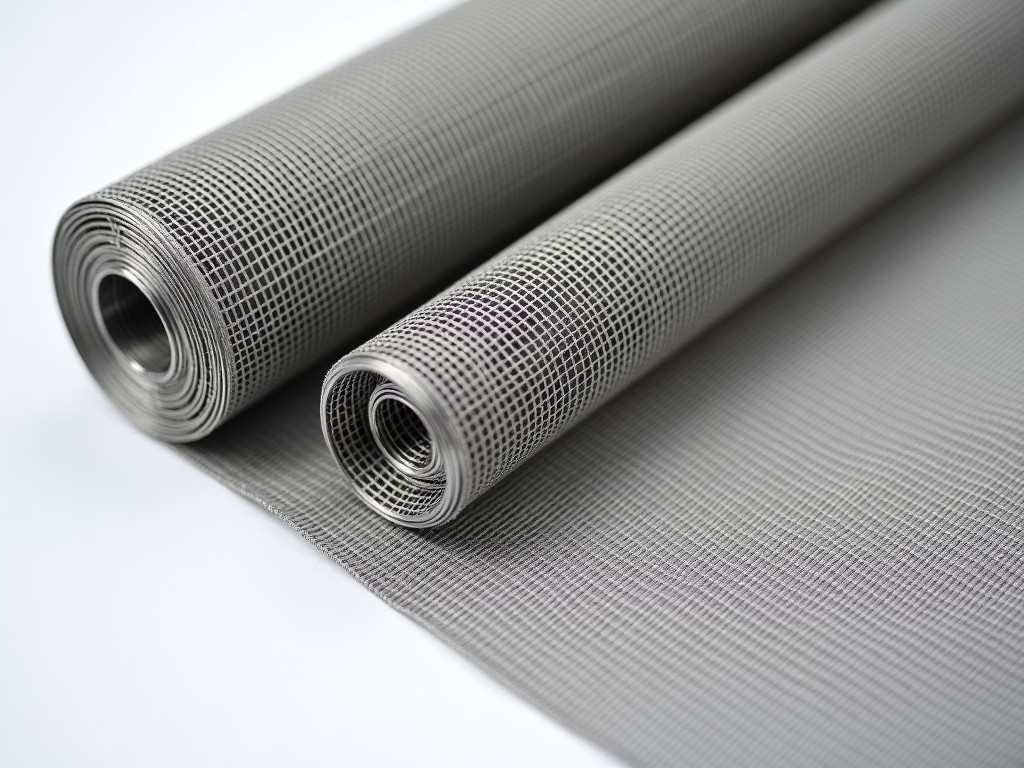
Stainless Steel Gauze Wire Mesh Cloth
Stainless Steel Gauze Wire Mesh Cloth
Stainless steel gauze wire mesh cloth is a precision-engineered filtration and screening material formed by weaving fine-diameter stainless steel wires in plain, twill, or Dutch weave patterns. It serves critical functions in industrial processes requiring particle separation, fluid filtration, or structural support under demanding conditions. The material’s performance depends on wire diameter, mesh count, weave type, and alloy composition, all of which influence flow dynamics, mechanical strength, and chemical resistance.
Material Composition and Alloy Selection
The base material for gauze mesh is selected from austenitic stainless steel grades, primarily 304 (18-8) and 316L, based on environmental exposure and required corrosion resistance. Grade 304 offers adequate resistance to atmospheric corrosion, mild chemicals, and intermittent moisture, making it suitable for general industrial screening and food processing where chloride exposure is limited. Grade 316L, with added molybdenum (2-3%), provides superior resistance to pitting and crevice corrosion in chloride-rich environments, such as marine applications, chemical processing, or pharmaceutical washdown cycles. Both grades maintain structural integrity up to 870°C (1600°F) in intermittent service, with 316L preferred for sustained high-temperature exposure due to lower carbon content minimizing carbide precipitation.
Weave Patterns and Their Functional Implications
The weave pattern determines the mesh’s open area, flow characteristics, particle retention efficiency, and mechanical stability. Plain weave, where each warp wire alternates over and under each weft wire, produces symmetrical openings and is standard for general filtration and sieving applications requiring balanced flow in both directions. Twill weave, with wires passing over two then under two, allows finer wire diameters to be used at higher mesh counts, increasing strength and reducing blinding in viscous fluids. Dutch weave, featuring a coarse warp and fine weft, creates a tortuous path ideal for microfiltration where high dirt-holding capacity and low pressure drop are required, commonly used in catalyst recovery and sterile filtration.
Mesh Specifications and Dimensional Parameters
Mesh count is defined as the number of openings per linear inch (25.4 mm), directly influencing aperture size and open area percentage. For example, a 100 mesh cloth with 0.10 mm wire diameter yields approximately 153 µm openings and 36% open area, while a 200 mesh with 0.05 mm wire delivers 76 µm openings and 30% open area. Wire diameter typically ranges from 0.025 mm (25 µm) for ultrafine filtration to 0.50 mm for heavy-duty screening. Aperture size is calculated as (25.4 / mesh count) – wire diameter, and open area percentage derives from the ratio of open space to total surface area, critical for predicting pressure drop in fluid systems.
Typical Industrial Applications
In chemical processing, stainless steel gauze mesh is used in catalyst baskets, reactor internals, and solvent recovery systems where corrosion resistance and thermal stability prevent degradation during prolonged exposure to organic solvents, acids, and alkaline solutions. In pharmaceutical manufacturing, it supports aseptic filtration of parenteral solutions and buffer preparations, meeting USP<61>and<71>standards for particulate control when validated for integrity testing. Food and beverage applications include juice clarification, yeast harvesting, and edible oil filtration, where 316L mesh avoids metallic contamination and withstands CIP/SIP cycles at 121°C. Environmental engineering employs mesh in air scrubbers, particulate monitors, and sediment traps, relying on its durability in wet/dry cycling and UV exposure.
Quality Assurance and Inspection Protocols
Each roll undergoes dimensional verification using optical comparators or laser scanning to confirm mesh count, wire diameter, and roll width within ±5% tolerance. Visual inspection under 10x magnification identifies defects such as broken wires, missing picks, or irregular weave patterns that could compromise filtration integrity. Chemical composition is validated via mill certificates or spot-check XRF analysis to ensure alloy conformity. Burst strength and tensile elongation are tested per ASTM E8/E8M for specific grades, with typical values for 304 gauze ranging from 500–700 MPa tensile strength and 40–60% elongation at break, indicating sufficient ductility for handling and installation without cracking.
Customization and Supply Options
Standard roll widths range from 914 mm (36 in) to 1524 mm (60 in), with lengths up to 30 m (100 ft) depending on wire diameter and mesh count to prevent excessive weight or handling difficulty. Custom slitting to narrow widths (as low as 50 mm) or precision cutting to specified dimensions is available for OEM integration into filter housings, cartridges, or laboratory apparatus. Edge finishing options include heat-sealed borders to prevent fraying, ultrasonic welding for seamless joints, or stainless steel binding strips for reinforced mounting. All products are supplied with traceable lot numbers and compliance documentation upon request.
| Parameter | Typical Range | Notes |
|---|---|---|
| Wire Diameter | 0.025 mm – 0.50 mm | Finer diameters enable higher mesh counts; limited by tensile strength |
| Mesh Count | 20 – 635 mesh/inch | Higher counts increase flow resistance; Dutch weave extends practical limits |
| Open Area | 10% – 60% | Influences pressure drop; calculated from mesh and wire dimensions |
| Alloy Options | 304, 316L, 310, 904L | 316L preferred for chlorides; 904L for severe reducing acids |
| Maximum Service Temp | 870°C (intermittent), 750°C (continuous) | Oxidation resistance limits; reduces in sulfidizing atmospheres |
Ordering Information and Technical Support
To receive a quotation or technical consultation, provide the required mesh count, wire diameter, weave type, alloy grade, roll dimensions, and intended application. Environmental factors such as temperature, chemical exposure, pressure differentials, and cleaning cycles should be specified to ensure optimal material selection. Our engineering team can recommend weave patterns and open area targets based on fluid viscosity, particle size distribution, and flow rate requirements. Samples are available for validation testing upon request, typically shipped within 3–5 business days for standard configurations.