


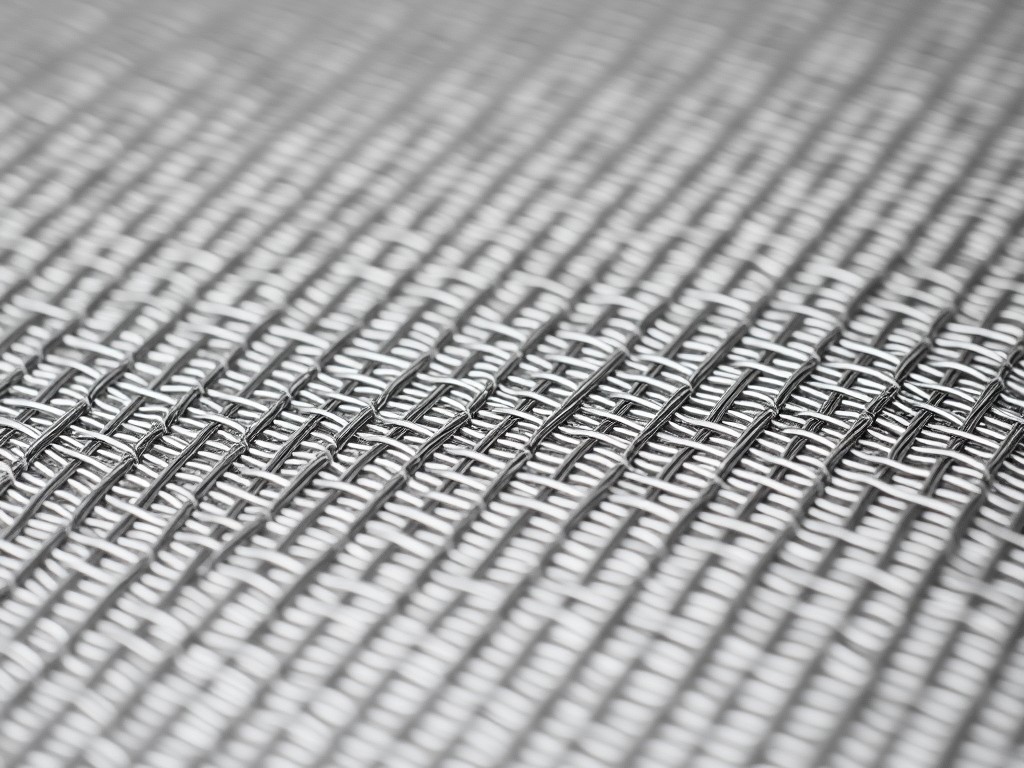
Stainless Steel Plain Woven Wire Mesh Screen
Stainless Steel Plain Woven Wire Mesh Screen
Plain woven stainless steel wire mesh is produced by alternately passing each warp wire over and under each weft wire at right angles, creating a balanced, symmetrical grid with uniform square openings. This basic weave structure provides consistent open area and precise dimensional stability, making it suitable for applications requiring accurate filtration, separation, or screening where predictable flow characteristics and mechanical integrity are essential.
Material Composition and Corrosion Resistance
The base material is typically austenitic stainless steel, most commonly grades 304 or 316L, selected for their chromium-nickel composition which forms a passive oxide layer resistant to oxidation and chemical attack. Grade 304 contains approximately 18% chromium and 8% nickel, offering good resistance to atmospheric corrosion, mild acids, and alkalis. Grade 316L adds 2-3% molybdenum, significantly enhancing resistance to chlorides and pitting corrosion in marine or chemical processing environments. Both grades maintain mechanical properties at elevated temperatures, with 304 suitable up to 870°C intermittent service and 316L up to 925°C.
Mesh Specifications and Dimensional Parameters
Key specifications include mesh count (number of openings per linear inch), wire diameter, and opening size, which are interrelated: opening size = (1 / mesh count) - wire diameter. For example, a 10 mesh screen with 0.020" wire diameter has approximately 0.080" openings. Standard mesh counts range from 2 to 635, with corresponding wire diameters from 0.105" down to 0.0015". Open area percentage varies with weave tightness, typically between 30% and 70% for plain weave, directly affecting flow rate and pressure drop in filtration applications.
| Mesh Count (per inch) | Typical Wire Diameter (in) | Nominal Opening Size (in) | Approximate Open Area (%) |
|---|---|---|---|
| 4 | 0.035 | 0.215 | 74 |
| 10 | 0.020 | 0.080 | 64 |
| 20 | 0.010 | 0.040 | 64 |
| 50 | 0.005 | 0.015 | 56 |
| 100 | 0.0023 | 0.0077 | 59 |
| 200 | 0.0015 | 0.0035 | 51 |
Values in the table represent typical commercial tolerances; actual dimensions may vary slightly based on wire drawing precision and weaving tension. Open area is calculated as (opening size² × mesh count²) × 100. For critical applications, exact specifications should be confirmed with dimensional inspection reports traceable to national standards.
Mechanical Properties and Performance Characteristics
Tensile strength of the drawn wire typically ranges from 125,000 to 300,000 psi depending on grade and temper, with 304 stainless steel wire in spring temper averaging 250,000 psi. The plain weave provides equal strength in both warp and weft directions, resulting in isotropic load distribution under uniform pressure. Burst strength, defined as the pressure required to rupture the mesh, increases with finer mesh counts and thicker wire diameters but decreases with higher open area. Elongation at break for austenitic stainless wire is typically 40-60%, allowing the mesh to deform elastically under transient loads without permanent set.
In dynamic applications such as vibratory screening, the mesh exhibits natural frequency dependent on tension, support span, and mass per unit area. Proper tensioning — typically 50-70% of the wire’s yield strength — minimizes deflection and fatigue failure. Creep resistance is negligible below 400°C for 304 and 500°C for 316L, making both suitable for continuous industrial use within these limits.
Industrial Applications and Functional Suitability
In chemical processing, 316L plain weave mesh is used as a catalyst support or filter medium in corrosive liquid streams where chloride-induced pitting must be avoided. The uniform opening size ensures consistent particle retention, critical in catalyst recovery systems where fines loss impacts reactor efficiency. In food and beverage production, 304 mesh is employed in syrup filtration and pulp washing, meeting FDA 21 CFR 177.2600 for food contact surfaces due to its non-reactive finish and cleanability via CIP systems.
In mining and aggregate processing, coarser meshes (4-20 mesh) serve as screen media in vibrating deck separators for ore sizing, where resistance to abrasion from silica-based materials is essential. The symmetrical weave resists blinding better than some Dutch weaves under low-fines conditions. In architectural applications, finer meshes (80-200 mesh) are used in protective barriers or decorative panels, where corrosion resistance and aesthetic uniformity are prioritized over flow rate.
For high-temperature exhaust filtration, such as in thermal oxidizers or furnace off-gas treatment, 316L mesh retains structural integrity above 800°C, capturing particulates while resisting oxidation-induced embrittlement. In each case, selection depends on matching mesh geometry to particle size distribution, chemical exposure, temperature cycling, and mechanical stress profiles specific to the process.
Customization and Fabrication Options
Mesh can be supplied in flat rolls or cut-to-size panels with standard widths up to 60 inches and lengths constrained only by handling logistics. Edge treatments include selvaged (looped) wires to prevent fraying, welded borders for frame integration, or hemmed edges with stainless steel binding tape for sealing in gasketed applications. Custom fabrication includes die-cutting to specific shapes, perforated reinforcement rings for high-pressure differentials, or lamination with perforated metal backings for added rigidity in pleated filter elements.
Width tolerances are typically ±1/8" for rolled goods and ±1/16" for cut panels. Length tolerances depend on cutting method: shear cutting holds ±1/4", while laser or waterjet cutting achieves ±1/32". For applications requiring precise tensioning, pre-stretched and heat-set mesh is available to minimize retensioning during installation. All customizations are subject to minimum order quantities and lead times dependent on material availability and tooling requirements.
Quality Control and Inspection Protocols
Raw wire undergoes diameter verification via laser micrometry with traceability to NIST standards, with lot-specific certification of chemical composition (ASTM A240/A240M) and mechanical properties (ASTM A370). During weaving, tension is monitored to maintain uniform crimp and prevent localized thinning. Finished mesh is inspected for conformance to opening size using optical comparators or digital imaging systems calibrated to ISO 9044:2019 for wire cloth specifications.
Visual inspection checks for broken wires, skips, double picks, or contamination under 10x magnification. Acceptance criteria follow ANSI/ASME B94.19 for allowable defects per square foot. For critical filtration applications, bubble point testing or glass bead challenge tests may be performed to validate retention efficiency. All inspection records are retained for a minimum of three years and available upon request.
Packaging, Handling, and Storage
Mesh is wound onto corrosion-resistant cores (plastic or coated steel) with inner diameter sized to prevent deformation — typically 3" for narrow widths, 6" for wider rolls. Rolls are wrapped in polyethylene film to protect against moisture and particulates, then placed in corrugated cartons or crush-resistant crates for shipment. Cut panels are stacked flat with interleaving sheets of kraft paper or polyethylene to prevent abrasion, secured with banding and corner protectors.
Storage recommendations include indoor, dry environments below 80% relative humidity to prevent surface staining, though passivation ensures resistance to light oxidation. Avoid direct contact with carbon steel surfaces to prevent galvanic transfer or rust staining. For long-term storage, desiccant packs may be included in sealed packaging. Handling requires clean gloves to avoid oil or salt transfer that could initiate localized corrosion in chloride environments.