


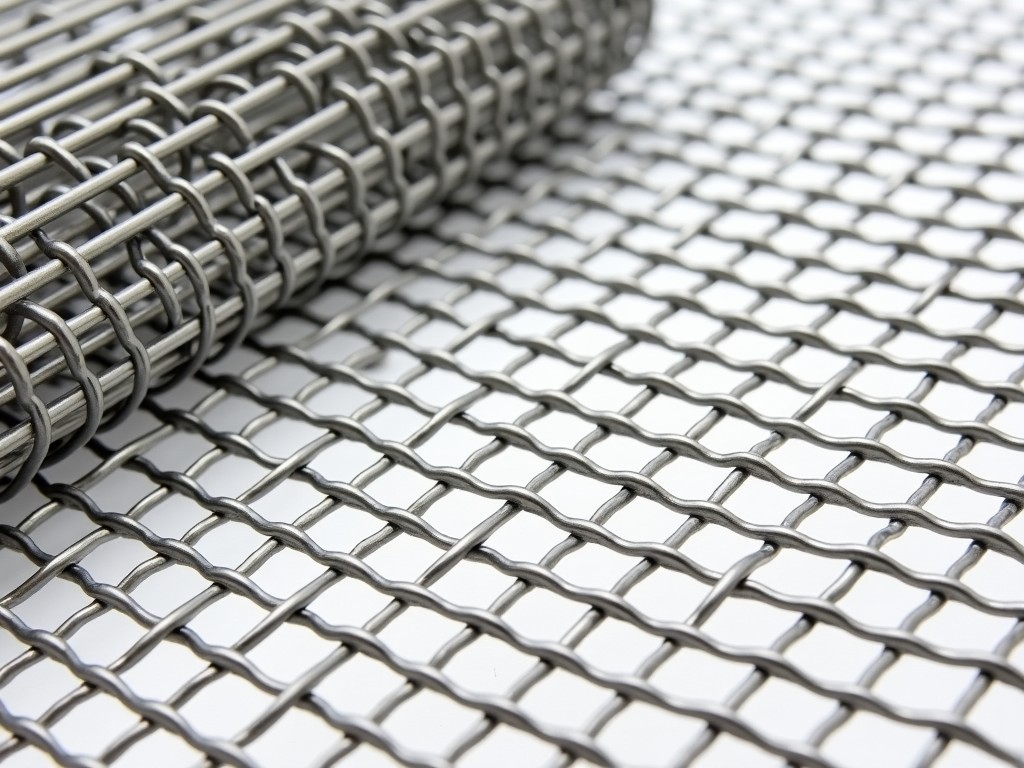
Stainless Steel Wire Mesh Price Cost For Sale
Stainless Steel Wire Mesh Price, Cost Factors & Buying Guide for Industrial Applications
Procurement teams evaluating stainless steel wire mesh price quickly learn that published list prices rarely reflect final project costs. Mesh geometry, alloy grade, surface condition, and order volume interact in ways that shift unit cost by 30–50 %. This page breaks down the technical drivers behind pricing, explains how to structure an RFQ for accurate quotations, and outlines the quality checkpoints that protect long-term value.
Primary Cost Drivers in Stainless Steel Wire Mesh
Wire diameter and opening size define the baseline material consumption. A 304 plain weave mesh at 100 × 100 µm with 0.065 mm wire uses significantly less raw alloy per square meter than a 60 × 60 µm mesh at 0.09 mm wire, even though the finer mesh appears “lighter.” Thicker wires increase tensile strength and abrasion resistance but raise both material weight and calendering passes required to achieve target thickness.
Alloy selection is the second major lever. Grade 304/304L remains the default for general corrosion resistance. Moving to 316/316L adds 2–3 % molybdenum, increasing raw material cost roughly 15–20 % while delivering superior pitting resistance in chloride environments. Duplex grades such as 2205 (UNS S31803) or super-austenitic 904L enter the conversation only when mechanical loads combine with aggressive chemistry, pushing alloy surcharges 40–60 % above 304 baseline.
Weave pattern alters both production speed and scrap rate. Plain weave runs fastest on high-speed looms. Twill weave, preferred for higher wire diameters relative to aperture, requires slower loom speeds and more frequent heddle changes. Dutch weaves — plain Dutch, twill Dutch, reverse Dutch — add a second set of warp/weft differentials, increasing setup time and inspection frequency. Five-heddle twill Dutch, common in hydraulic filtration, can double loom hours per square meter versus plain weave.
Surface Condition & Post-Weave Processing Impact
Mill-finish mesh exits the loom with drawing lubricants and oxide residues. For pharmaceutical, food, or semiconductor pathways, electropolishing removes a controlled 10–20 µm surface layer, eliminating micro-crevices and reducing surface roughness (Ra) from ~1.5 µm to ≤0.4 µm. The process adds 18–25 % to unit cost but prevents product contamination and eases CIP/SIP validation.
Calendering (rolling) reduces mesh thickness and tightens aperture tolerance. A single-pass calender may hold ±5 % aperture; precision double-pass calendering with in-line optical gauging holds ±2 %. Each additional pass increases yield loss 1–2 % and machine time, reflected in price. Heat treatment (solution annealing at 1050–1100 °C followed by rapid cooling) relieves work hardening from heavy calendering, restoring ductility for subsequent forming — essential when mesh is deep-drawn into filter cartridges.
Dimensional Tolerances & Custom Fabrication Costs
Standard roll widths (1 m, 1.2 m, 1.5 m) minimize edge trim waste. Custom slit widths below 200 mm incur slitting setup charges and higher per-kg conversion cost due to increased handling. Cut-to-size pieces (discs, rectangles, custom profiles) add laser/Waterjet programming, nesting optimization, and edge deburring. A 500 mm disc punched from 1 m roll yields ~60 % material utilization; laser-cut complex geometry may drop to 35 %, directly inflating effective cost per usable part.
Edge treatment matters in sealing applications. Raw slit edges leave wire ends exposed, creating leak paths in gasketed joints. Hemmed, welded, or overlocked edges add secondary operations but eliminate assembly rework. For spiral-wound gasket inner/outer rings, precision sheared edges with ±0.05 mm width tolerance are non-negotiable.
Volume Tiers, MOQ Logic & Lead Time Trade-offs
Most mills structure pricing in three bands: sample/trial (≤50 m²), standard production (50–500 m²), and blanket-order (>500 m² or annual agreement). Setup amortization dominates small orders — loom changeover, tension calibration, and first-article inspection consume 4–6 hours regardless of run length. Consequently, a 20 m² order of custom twill Dutch mesh may carry 3× the per-m² cost of a 300 m² run.
Lead time correlates with alloy availability. 304/316 wire in common diameters (0.05–0.5 mm) typically sits in mill stock; 2205 or 904L in non-standard diameters often requires a dedicated wire draw, adding 3–4 weeks. Electropolishing and precision calendering slots are scheduled separately; peak season (Q4) can extend finishing queues by 10–15 working days. Blanket orders with rolling releases lock finishing capacity and stabilize pricing against nickel surcharge volatility.
| Parameter | Typical Range / Options | Cost Impact Note |
|---|---|---|
| Wire Diameter | 0.025 mm – 3.0 mm | Thicker wire = higher kg/m², slower loom speed |
| Aperture Size | 10 µm – 25 mm (clear opening) | Finer apertures increase wire count & inspection |
| Alloy Grade | 304/304L, 316/316L, 2205, 904L, 310S | Alloy surcharge varies monthly (LME nickel) |
| Weave Type | Plain, Twill, Plain Dutch, Twill Dutch, Reverse Dutch, 5-Heddle | Complex weaves reduce loom throughput 30–60 % |
| Surface Finish | Mill, Annealed, Calendered, Electropolished, Passivated | Electropolish adds 18–25 %; calendering passes additive |
| Width / Format | Roll (std 1000/1200/1500 mm), Slit coil, Cut pieces, Discs | Custom slit<200 mm="" adds="" setup=""> |
| Edge Treatment | Raw slit, Hemmed, Welded, Overlocked, Sealed | Sealed edges critical for gasket/sealing apps |
| Order Volume | Trial ≤50 m² | Standard 50–500 m² | Blanket >500 m²/yr | Setup amortization drives tier breaks |
Application-Driven Specification & Why It Affects Price
Liquid filtration in pharma CIP loops demands 316L electropolished twill Dutch mesh (typically 12 µm × 64 µm) to withstand back-pulse cleaning at 6 bar without aperture distortion. The tight weave and electropolish raise cost 2.2× versus mill-finish 304 plain weave, but eliminate filter cartridge failure risk that costs $15k–$50k per batch loss.
Catalyst support grids in reformers use 2205 duplex calendered plain weave (1.6 mm wire, 4 mm aperture) for high-temperature creep resistance and chloride stress-corrosion cracking immunity. Here, alloy premium is justified by 3–5× service life extension over 316L in cyclic 550 °C / H₂S environments.
Architectural facades and safety barriers prioritize visual flatness and dimensional stability. 304 calendered plain weave (0.8 mm wire, 12 mm aperture) with electrolytic polishing delivers uniform reflectance; the calendering pass ensures panel flatness ≤2 mm/m, reducing installation shim labor. Cost sits mid-range — higher than mill finish, far below electropolished filtration grades.
Quality Verification Checkpoints That Protect Your Investment
Incoming wire certification: MTC 3.1 per EN 10204 confirming chemistry, tensile strength, and diameter tolerance (±1 % or ±0.005 mm, whichever greater).
First-article loom audit: Optical aperture measurement at 5 points across width, wire count per 25.4 mm (mesh count), and thickness verification pre/post calendering.
In-process statistical sampling: Every 500 m² for aperture distribution (ASTM E161), width consistency, and surface defect mapping (scratches, broken wires, oil spots).
Final release package: Certificate of Conformance, MTC for finished mesh (if heat-treated), electropolish validation (Ra measurement, free-iron test per ASTM A380), and packaging integrity photos.
Requesting this documentation upfront adds zero cost to the quotation but prevents receiving mesh that fails incoming inspection — a scenario that stalls production lines and triggers emergency re-sourcing at spot-market premiums.
RFQ Checklist: Information Needed for Accurate Quotation
Providing complete specifications in the first inquiry eliminates clarification cycles and ensures comparable quotes. Include the following:
Alloy grade (UNS number preferred) and any specific heat-treatment condition.
Weave pattern with wire diameter and clear opening/aperture (or mesh count + wire diameter).
Target thickness if calendered; otherwise state “loom state.”
Surface finish requirement: mill, annealed, calendered, electropolished (target Ra), passivated.
Roll width or cut-piece dimensions with tolerances; quantity in m² or piece count.
Edge treatment specification (raw, hemmed, welded, sealed).
Packaging: wooden case (fumigated), plywood case, plastic spool, vacuum-sealed roll, custom crate.
Certification needs: MTC 3.1, EN 10204 3.2, PMI testing, RoHS/REACH declaration, FDA/USP Class VI compliance letter.
Target delivery window and incoterm (EXW, FOB Shanghai/Ningbo, CIF destination port).
Packaging & Export Logistics Considerations
Standard export packaging uses fumigated wooden cases (IPPC ISPM-15 marked) with internal VCI film wrapping and desiccant packs. Rolls are suspended on steel mandrels or laid flat with cardboard core protection to prevent ovality. For electropolished mesh, each roll receives individual polyethylene sleeve + VCI paper + outer woven bag before case loading — preventing transit abrasion that would negate the finish investment.
Container loading plans optimize weight distribution: 20 ft GP typically accommodates 18–22 metric tons of rolled mesh (≈450–550 m² of 1.2 m wide 316L 0.5 mm wire). Cut pieces on pallets require plywood slip-sheets between layers to avoid wire imprinting. Hazardous goods classification does not apply, but customs HS code 7314.14 (woven cloth of stainless steel) determines duty rates; confirm with your broker for destination-specific tariffs.
Frequently Asked Questions
Can dimensions and mesh specifications be fully customized?
Yes. Wire diameter, aperture, weave pattern, width, and length are all configurable within loom mechanical limits (minimum wire 0.025 mm, maximum practical width 2.5 m). Non-standard combinations may require custom reed/heddle sets, adding 1–2 weeks to first-article lead time. Our engineering team reviews CAD drawings or specification sheets to confirm feasibility before quoting.
What information is required before a firm quotation can be issued?
At minimum: alloy grade, weave type, wire diameter, aperture (or mesh count), width, quantity, and surface finish. For cut pieces, provide DXF/DWG profiles. Target delivery date and destination port allow accurate freight and scheduling. Missing any of these defaults to standard tolerances and mill-finish assumptions, which may not match your application.
Which stainless steel grades are regularly stocked versus mill-run?
304/304L and 316/316L in wire diameters 0.05–1.0 mm are typically held in wire rod stock, enabling 2–3 week loom scheduling. 2205, 904L, 310S, and diameters outside 0.05–1.0 mm usually require a dedicated wire draw (3–4 weeks additional). Confirm current stock status at time of inquiry.
How is quality inspected and documented?
Per the checkpoints above: incoming wire MTC 3.1, first-article full dimensional report, in-process SPC records, final CoC with applicable certifications. Third-party inspection (SGS, BV, TÜV) can be arranged at buyer’s expense. PMI testing on finished mesh is available for critical alloy verification.
What packaging methods are available for export shipment?
Standard: fumigated wooden case with VCI liner. Options: plywood case (lighter, ISPM-15 exempt), plastic spools for fine mesh (<0.15 mm="" wire="">
What is the typical production lead time?
Stock alloy + standard weave: 15–20 working days from PO confirmation. Custom wire draw or non-stock alloy: add 15–20 working days. Electropolishing/calendering: add 5–10 working days depending on finishing queue. Blanket orders with scheduled releases lock capacity and reduce effective lead time to ex-stock for subsequent call-offs.
How are samples arranged?
A4/A5 swatches from existing production runs are free (courier collect). Custom specification samples require a paid trial run (minimum 10–20 m²) covering loom setup and wire allocation. Trial material carries full MTC and inspection report; cost is creditable against first production order ≥100 m².
Ready to define specifications and receive a detailed quotation?
Share your alloy, weave, dimensions, finish, and volume targets. Our technical sales engineers will return a structured quote with lead time, packaging options, and certification package within one business day.
Submit RFQ for Stainless Steel Wire Mesh