


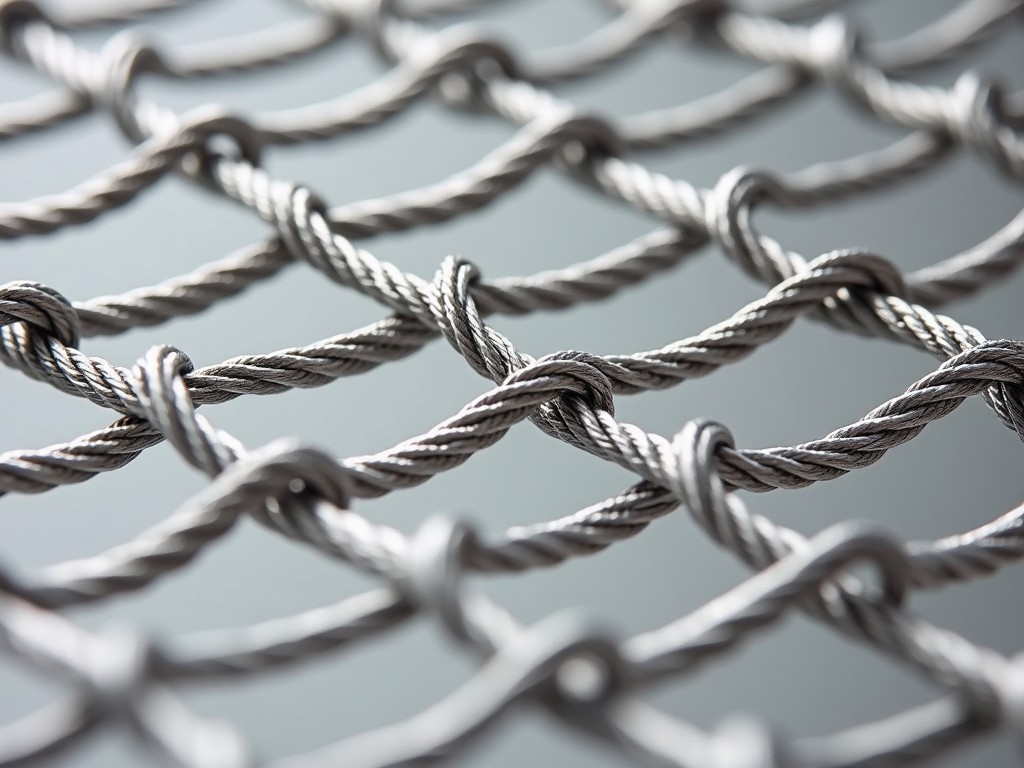
Stainless Steel Wire Rope Mesh
Stainless Steel Wire Rope Mesh
Stainless steel wire rope mesh is a flexible architectural and industrial fabric formed by interlacing stainless steel wire ropes in a grid pattern, typically using a ferrule or welded junction at each crossover point. Unlike welded mesh or woven wire cloth, this construction relies on the tensile strength of continuous wire ropes rather than individual wires, resulting in a material that combines high load-bearing capacity with significant flexibility and impact energy absorption. The open area ratio—determined by rope diameter, spacing, and weave pattern—can be engineered to meet specific requirements for visibility, airflow, light transmission, or containment while maintaining structural integrity under dynamic loads.
Commonly used in applications where both safety and aesthetics are critical, such as fall protection systems, animal enclosures, architectural facades, and debris barriers, this product leverages the corrosion resistance of stainless steel grades like 304, 316, or 316L to perform reliably in harsh environments including coastal, industrial, or high-humidity settings. The inherent ductility of the wire rope construction allows it to deform elastically under impact—such as from falling objects or animal contact—without permanent failure, making it suitable for environments where rigid barriers might crack or transmit excessive force.
Material Selection and Corrosion Resistance
The performance of stainless steel wire rope mesh in corrosive environments depends primarily on the alloy composition of the wire rope, with 316 stainless steel offering superior resistance to chloride-induced pitting compared to 304 due to its 2-3% molybdenum content. In marine environments or areas exposed to de-icing salts, 316L—with its lower carbon content—is often specified to minimize sensitization during welding or ferrule attachment, preserving the passive chromium oxide layer that prevents rust formation. For less aggressive atmospheres such as inland urban or rural settings, 304 stainless steel provides adequate resistance at lower cost, though it may show surface staining over time in high-chloride zones.
Wire rope diameter typically ranges from 1.5mm to 6.0mm, with larger diameters increasing tensile strength but reducing flexibility and open area. The choice between 1x7, 1x19, or 7x7 wire rope constructions affects flexibility and fatigue resistance: 1x7 offers greater stiffness for tensioned applications like balustrades, while 7x7 provides enhanced flexibility for curved or frequently deformed installations such as animal containment barriers. Surface finish—whether mill finish, electropolished, or passivated—further influences long-term appearance and corrosion resistance, with electropolishing reducing surface roughness to minimize contaminant adhesion.
Structural Properties and Load Characteristics
Tensile strength of the mesh system is not simply the sum of individual rope strengths due to load distribution at junctions and potential slippage under asymmetric loading. Engineered designs account for the efficiency factor of the junction—whether swaged ferrule, welded node, or mechanical connector—which typically ranges from 85% to 95% of the rope’s nominal breaking strength when properly installed. Under uniform load, the mesh behaves as a tensile membrane, with stress distributing across adjacent ropes; however, point loads—such as from a falling tool or animal impact—create localized stress concentrations that depend on mesh aperture size and rope diameter.
Elongation at break for stainless steel wire rope mesh generally falls between 2% and 5%, significantly higher than rigid welded mesh (<1%) but="" lower="" than="" synthetic="" nets="">15%), providing a balance between energy absorption and dimensional stability. This characteristic allows the mesh to deflect under impact without transmitting excessive peak force to the supporting structure, reducing the risk of anchor failure or secondary damage. In fall arrest applications, this energy-absorbing quality helps limit the force exerted on a worker’s harness to within safe limits as defined by standards such as EN 353-2 or ANSI Z359.1.
Open area percentage—calculated as the ratio of void space to total area—directly influences visibility, airflow, and light penetration, with typical values ranging from 40% to 80% depending on rope diameter and center-to-center spacing. For example, a 3.0mm rope on 50mm centers yields approximately 65% open area, while the same rope on 30mm centers reduces open area to about 40%. This parameter is critical in architectural applications where sightlines must be preserved, or in animal enclosures where ventilation and visual contact with handlers are required for welfare compliance.
Manufacturing Process and Quality Control
Production begins with precision-cut stainless steel wire ropes to specified lengths, which are then laid out in orthogonal or diagonal patterns according to the desired mesh geometry. Junctions are formed using either hydraulic swaging of copper or stainless steel ferrules, resistance welding at crossover points, or mechanical locking systems, each method affecting junction strength, fatigue life, and visual appearance. Swaged ferrules provide a low-profile joint with consistent axial strength but require precise tooling and operator training to avoid over- or under-compression, which can either damage the rope or leave the joint underdeveloped.
Quality control focuses on junction integrity, rope alignment, and dimensional accuracy, with tension testing of sample junctions verifying that the connection maintains at least 90% of the rope’s minimum breaking load before slip or failure. Visual inspection checks for uniform tension across the mesh—uneven tension can lead to premature fatigue in over-tensioned ropes or sagging in loose areas—while dimensional checks ensure aperture sizes remain within tolerance, typically ±10% of design, to maintain predictable performance in safety-critical applications. Non-destructive methods such as dye penetrant testing may be applied to welds or ferrules in high-reliability contexts.
Post-production treatments include passivation to remove free iron particles and enhance the passive oxide layer, particularly important after welding or ferrule attachment which can disturb the surface chemistry. For architectural applications, additional cleaning and polishing may be specified to achieve a uniform aesthetic finish, while industrial or safety-focused versions may retain a utilitarian mill finish. Packaging involves rolling or folding the mesh onto protective cores with interleaving layers to prevent abrasion during transit, with clear labeling indicating material grade, rope diameter, aperture size, and load ratings to avoid misapplication on-site.
Applications Across Industries
In architectural facade systems, stainless steel wire rope mesh serves as a lightweight infill panel that meets building code requirements for fall protection while allowing unobstructed views and natural ventilation—unlike solid panels or perforated metal, which can create wind tunnels or trap heat. Its use in balustrades and parapets leverages the material’s ability to span large distances between support points with minimal visual intrusion, reducing the need for frequent vertical mullions that can detract from design continuity. The flexibility of the mesh also accommodates slight building movements without cracking, a common issue with rigid glass or metal panels in tall structures subject to wind sway.
For zoological and agricultural enclosures, the mesh provides a physical barrier that prevents animal escape or intrusion while allowing tactile and visual interaction—critical for species requiring social stimulation or handler access for feeding and veterinary care. Unlike chain-link fencing, which can cause abrasions, or solid barriers that induce stress through isolation, the rounded contours of wire ropes minimize injury risk during contact, and the open design reduces wind loading, decreasing the likelihood of structural failure during storms. Aperture sizes are selected based on the target species’ size and behavior, with smaller openings for rodents or birds and larger ones for primates or ungulates.
In industrial safety applications, such as debris netting beneath elevated work platforms or rockfall mitigation on slopes, the mesh absorbs kinetic energy from impacting objects through controlled deformation, reducing peak forces transmitted to anchor points or catch systems. Compared to nylon or polyester nets, stainless steel offers superior UV resistance, non-flammability, and long-term dimensional stability under constant load, making it suitable for permanent installations where synthetic alternatives would degrade over time. The material’s non-conductive surface—when properly insulated from supporting steel—also allows safe use near electrical equipment where static discharge or arcing must be avoided.
Customization Options and Design Considerations
Aperture size—defined as the clear opening between ropes—is a primary customization variable, directly affecting function: smaller apertures (e.g., 20mm x 20mm) increase containment capability for small objects or animals but reduce open area and increase wind load, while larger apertures (e.g., 100mm x 100mm) maximize visibility and airflow but may allow passage of smaller debris or limbs. Designers must balance these trade-offs based on the specific hazard: for fall protection, apertures are typically limited to ensure a 4-inch sphere cannot pass through (per OSHA 1926.502), whereas for bird deterrence, openings may be larger to avoid entanglement while still blocking larger pests.
Rope diameter and construction are selected based on anticipated loads: a 2.0mm 1x7 rope may suffice for light-duty architectural screening, while a 5.0mm 7x7 construction is chosen for high-impact zones such as highway overpasses where debris from vehicles could strike the mesh. Junction type also influences performance—swaged ferrules offer a clean look and reliable strength for static loads, whereas welded junctions provide higher fatigue resistance for dynamic applications like vibrating machinery guards, though they may require post-weld treatment to prevent corrosion at the heat-affected zone. Edge finishing—such as folding ropes over a core wire or using end caps—prevents fraying and ensures consistent tension distribution at the perimeter.
Mounting and attachment methods vary by substrate and load direction: tensioned systems use turnbuckles or threaded anchors to achieve initial pretension, which reduces sag and increases resistance to dynamic loads, while framed systems bolt the mesh edge to structural angles or channels for simpler installation where tensioning is impractical. For curved surfaces, the mesh can be fabricated in pre-shaped panels or installed flat and tensioned to conform to the substrate, relying on the material’s flexibility to drape without wrinkling. Designers must account for thermal expansion—stainless steel expands approximately 9 µm/m/°C—to avoid over-tensioning in hot climates or slackening in cold conditions, particularly in long-span installations.
Typical Specifications
| Parameter | Typical Range / Options | Notes |
|---|---|---|
| Wire Rope Diameter | 1.5 mm – 6.0 mm | Larger diameters increase strength but reduce flexibility |
| Wire Rope Construction | 1x7, 1x19, 7x7, 7x19 | Affects flexibility and fatigue resistance |
| Stainless Steel Grade | 304, 316, 316L | 316L preferred for marine or high-chloride environments |
| Aperture Size (Clear Opening) | 15 mm – 150 mm | Determined by rope diameter and spacing |
| Open Area Percentage | 40% – 80% | Affects visibility, airflow, and light transmission |
| Junction Type | Swaged ferrule, welded, mechanical lock | Influences strength, appearance, and fatigue life |
| Tensile Strength (per rope) | Depends on diameter and grade | Typical 3.0mm 316: ~14 kN breaking load |
| Elongation at Break | 2% – 5% | Higher than rigid mesh, lower than synthetic nets |
| Standard Roll Width | Up to 3.0 m | Custom widths available upon request |
| Surface Finish | Mill finish, electropolished, passivated | Affects appearance and corrosion resistance |
For project-specific requirements including custom aperture sizes, material grades, junction types, or load ratings, our engineering team can provide detailed technical support and quotation. To initiate a consultation, please share your application details, environmental conditions, and performance criteria via the contact form.
Request Technical Consultation